On this page · 10 sections
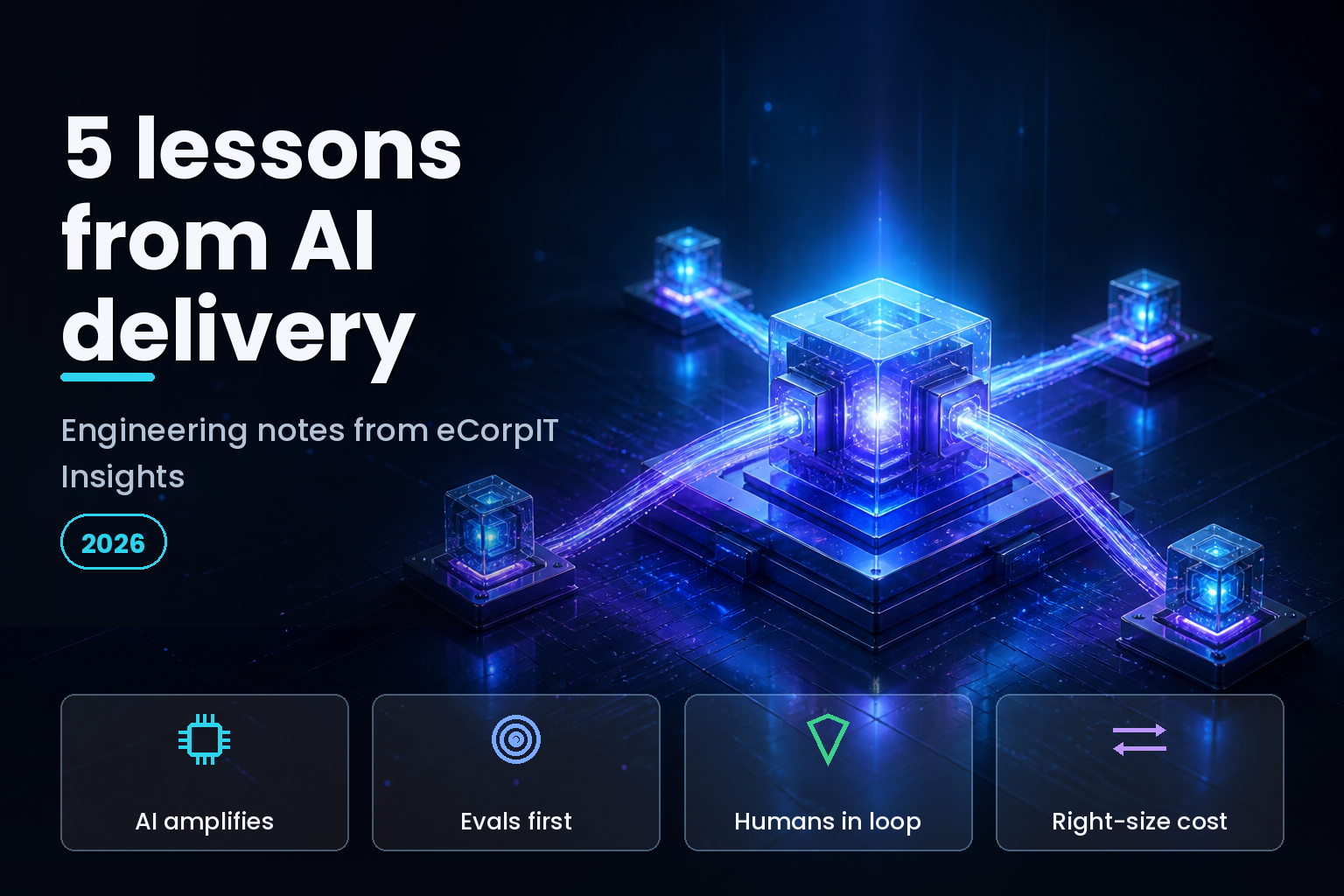
- Lesson 1: AI amplifies your engineering system, it does not replace it
- Lesson 2: Treat evals as infrastructure, not a final check
- Lesson 3: Keep humans in the loop, because trust is the real bottleneck
- Lesson 4: Design for token economics from the first sprint
- Lesson 5: Protect delivery stability, because throughput without control is just faster incidents
- Putting the five lessons into one delivery workflow
- India-specific considerations
- FAQ
- How eCorpIT can help
- References
Summary. This is the launch post of eCorpIT Insights, and it collects five engineering lessons from delivering AI work in 2026. The evidence is blunt. The 2025 DORA report, built on nearly 5,000 professionals, found AI adoption at 90%, up 14 points in a year, with over 80% reporting a productivity gain, yet AI adoption still shows a negative relationship with delivery stability. The 2025 Stack Overflow survey found 84% of developers use or plan to use AI, up from 76% in 2024, while trust in AI accuracy fell to about 29%. Cost is just as concrete: as of June 2026, Google's Gemini 3.1 Pro runs about $2 input and $12 output per million tokens, OpenAI's GPT-5.4 is $2.50 and $15, and Anthropic's Claude Opus 4.6 is $5 and $25. The five lessons below are the practices that decide whether those numbers help you or hurt you, and each is tied to a source rather than a slogan.
eCorpIT is a CMMI Level 5 technology company founded in 2021 in Gurugram, and our senior engineering teams have spent the past year putting large language models into real client software. eCorpIT Insights, our engineering blog, starts here because the gap between a working demo and a dependable feature is where most AI projects fail. For the wider strategy view, we cover that in our guide to generative AI enterprise strategy; this post stays at the engineering level.
| Lesson | The short version | Evidence |
|---|---|---|
| 1. AI amplifies your system | Strong teams gain, weak teams break | 2025 DORA report |
| 2. Evals are infrastructure | Test every change, not just at the end | OpenAI, EDDOps research |
| 3. Keep humans in the loop | Trust in AI accuracy is falling | Stack Overflow 2025 survey |
| 4. Design for token economics | Route work to the right-priced model | 2026 LLM pricing |
| 5. Protect delivery stability | Throughput rises, stability can fall | 2025 DORA report |
Lesson 1: AI amplifies your engineering system, it does not replace it
The single most useful finding of the year is that AI is a multiplier on what already exists. The 2025 DORA report, published by Google Cloud's DORA team, states it plainly: AI does not fix a team, it amplifies what is already there. Strong teams get faster; struggling teams get their bottlenecks magnified. Nathen Harvey, the report's lead author at Google Cloud, put it in one line: "AI is an amplifier. It's an amplifier of the things that you already have in your organization."
The practical read for an engineering leader is that AI spending pays back only on top of sound delivery practice. The DORA research identified seven organisational capabilities, from clear workflows to strong platform engineering, that decide whether AI turns into faster value or faster chaos. Before adding a coding assistant or an agent, the honest question is whether your version control, testing, and deployment are already in good shape. If they are not, AI will make the mess arrive sooner.
Lesson 2: Treat evals as infrastructure, not a final check
Traditional software is deterministic: the same input gives the same output, so a passing test stays passing. Large language models break that assumption. A prompt tweak that improves one case can silently degrade ten others. That is why evaluation-driven development treats evaluation as infrastructure rather than a quality gate at the end.
The pattern, described in OpenAI's evaluation best practices and in the academic work on evaluation-driven development and operations, is to run automated evals on every change, combine LLM-as-a-judge scoring with human review, and grow the eval set from real production data as new failure modes appear. In practice our teams build a small labelled eval set before scaling a feature, wire it into continuous integration so every prompt or model change is scored, and treat a drop in eval pass rate the same way we treat a failing unit test. Without that, "it looked fine in the demo" becomes the entire quality process, which is not a process.
Lesson 3: Keep humans in the loop, because trust is the real bottleneck
Capability is racing ahead of trust, and that gap is an engineering constraint, not a mood. The 2025 Stack Overflow Developer Survey found that 84% of developers use or plan to use AI tools, up from 76% in 2024, yet trust in the accuracy of AI output fell to roughly 29%, with 46% of developers actively distrusting accuracy against 33% who trust it. Only about 3% said they highly trust the output, and the most experienced developers were the most sceptical.
| Signal | Source | Figure |
|---|---|---|
| Developers using or planning to use AI | Stack Overflow 2025 | 84%, up from 76% |
| Developers who trust AI accuracy | Stack Overflow 2025 | about 29% |
| Professionals using AI | 2025 DORA | 90%, up 14 points |
| Report a productivity gain from AI | 2025 DORA | over 80% |
| Positive on AI's effect on code quality | 2025 DORA | 59% |
The design conclusion is to put a human at the point of accountability. For anything that touches customer data, money, or a legal record, the AI drafts and a person approves. That is not a lack of ambition; it matches how experienced engineers already treat AI output, and it is the difference between a helpful feature and an incident.
Lesson 4: Design for token economics from the first sprint
AI features have a running cost that traditional code does not, and it shows up on a monthly invoice. Pricing spans two orders of magnitude. As of June 2026, the cheapest capable APIs sit near $0.14 to $0.40 per million tokens, while premium reasoning models cost twenty to fifty times more.
| Model | Input ($/1M tokens) | Output ($/1M tokens) |
|---|---|---|
| Gemini 3.1 Flash-Lite | $0.10 | $0.40 |
| DeepSeek V3.2 | $0.14 | $0.28 |
| Gemini 3.1 Pro | $2.00 | $12.00 |
| GPT-5.4 | $2.50 | $15.00 |
| Claude Sonnet | $3.00 | $15.00 |
| Claude Opus 4.6 | $5.00 | $25.00 |
Two facts shape the design. First, output tokens cost roughly five to six times more than input tokens, so trimming verbose responses and caching repeated context saves more than most micro-optimisations. Second, prices have fallen 30% to 50% a year since 2023, so a design locked to one expensive model wastes money within months. The workable pattern is a router: send simple, high-volume calls to a cheap model, reserve a premium model for genuinely hard reasoning, and measure cost per request as a first-class metric from the first sprint, not after the bill arrives.
Lesson 5: Protect delivery stability, because throughput without control is just faster incidents
The 2025 DORA report carried one warning that engineering leaders should not skip. AI adoption is now linked to higher software delivery throughput, a reversal of the previous year, but it still has a negative relationship with delivery stability. More code ships, and more of it breaks, unless the surrounding system absorbs the extra volume.
The countermeasures are the same DevOps disciplines that predate AI, now more valuable, not less: small batch sizes, automated tests, continuous delivery, feature flags, and fast rollback. When AI helps a team open more pull requests, the constraint moves to review and release. Teams that had already invested in platform engineering and continuous delivery convert the extra throughput into value; teams that had not convert it into a longer incident list. AI raised the stakes on engineering fundamentals; it did not retire them.
Putting the five lessons into one delivery workflow
The lessons are not five separate ideas; they form one order of operations for shipping an AI feature. It starts before any model is chosen. Confirm the delivery fundamentals from Lesson 1 are in place, because the 2025 DORA report shows AI returns land only where version control, testing, and deployment are already sound. Then scope the smallest useful use case, since a narrow problem is one you can actually measure.
Next comes the eval set from Lesson 2. Write a labelled set of real examples before scaling, wire it into continuous integration, and let a drop in the pass rate block a release the way a failing unit test would. Around that, place the human review from Lesson 3 at the point of accountability: anything touching money, customer data, or a legal record gets a person's approval, which matches how the most experienced developers in the Stack Overflow survey already work.
Only then does model choice matter. Apply the token economics from Lesson 4 by routing high-volume, low-difficulty calls to a cheap model, reserving a premium model for hard reasoning, and tracking cost per request as a named metric. Finally, wrap the whole thing in the stability guardrails from Lesson 5, small batches, feature flags, and fast rollback, so the extra throughput AI creates does not become a longer incident list. Run in that order and the numbers at the top of this post, the 90% adoption, the falling trust, the wide price spread, stop being risks and start being inputs you control.
India-specific considerations
For teams building AI features in and for India, two points matter beyond the global picture. The first is data governance. India's Digital Personal Data Protection Act 2023 sets expectations around data minimisation, purpose limitation, and consent, and any pipeline that sends user data to a third-party model has to account for that. The practical step is to design the data path first: decide what leaves your systems, what is redacted, and where inference runs, so the application is built to meet DPDP requirements rather than retrofitted.
The second is cost sensitivity. Indian product teams often run at price points where per-request AI cost decides whether a feature is viable, which makes the token-economics discipline from Lesson 4 more central, not less. Routing high-volume calls to cheaper models and caching aggressively can be the difference between a feature that ships and one that is cut. The same eval and human-review practices apply unchanged; the cost ceiling is simply lower, so the engineering has to be tighter.
FAQ
How eCorpIT can help
eCorpIT is a CMMI Level 5, MSME-certified technology company founded in 2021 in Gurugram, with partnerships across AWS, Microsoft, and Google. Our senior engineering teams help product and platform teams put these practices to work: building eval harnesses, right-sizing models for cost, and adding the human review and guardrails needed to meet India's DPDP Act requirements. To discuss an AI delivery review for your team, contact us.
References
- Google Cloud Blog, "Announcing the 2025 DORA Report": cloud.google.com
- DORA, "State of AI-assisted Software Development 2025": dora.dev
- Jellyfish, "AI as Amplifier: the 2025 DORA Report with lead author Nathen Harvey": jellyfish.co
- InfoQ, "AI Is Amplifying Software Engineering Performance, Says the 2025 DORA Report": infoq.com
- blog.google, "How are developers using AI? Inside Google's 2025 DORA report": blog.google
- Stack Overflow, "2025 Developer Survey: AI": survey.stackoverflow.co
- Stack Overflow Blog, "Developers remain willing but reluctant to use AI: the 2025 Developer Survey results": stackoverflow.blog
- Stack Overflow, press release, "2025 Developer Survey reveals trust in AI at an all-time low": stackoverflow.co
- CloudZero, "LLM API Pricing Comparison 2026": cloudzero.com
- OpenAI, "Evaluation best practices": developers.openai.com
- arXiv, "Evaluation-Driven Development and Operations of LLM Agents" (2411.13768): arxiv.org
- Deepchecks, "How to Build an LLM Evaluation Framework in 2025": deepchecks.com
_Last updated: July 1, 2026._