On this page · 8 sections
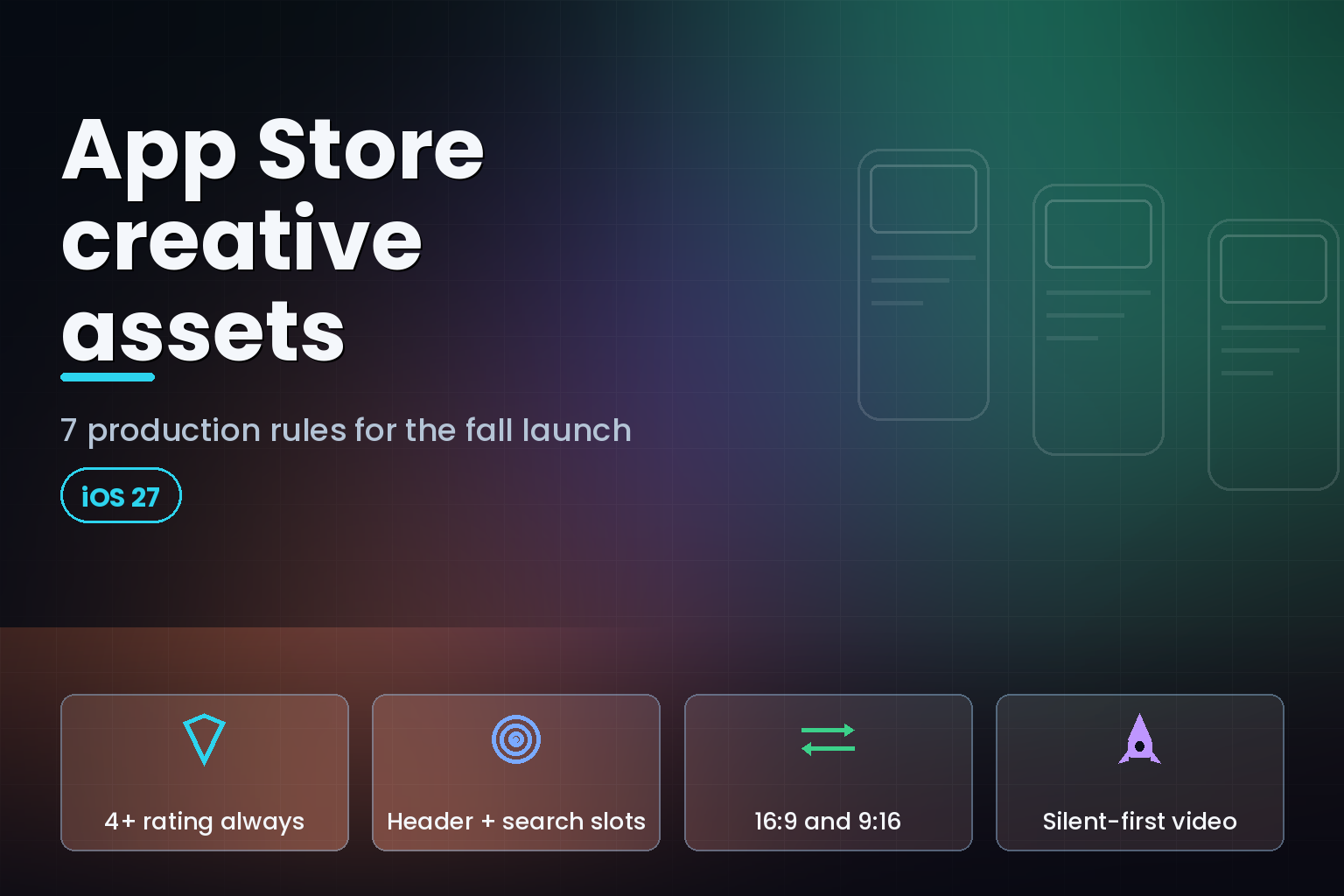
Summary. On 5 August 2026 Apple published its App Store asset best-practices guidance together with Figma, Photoshop and Pixelmator templates, telling developers to plan images and videos "ahead of the fall launch". The change was announced on 8 June 2026. Creative assets appear across the App Store in iOS 27 and iPadOS 27 and later, including the product page header, search results, In-App Events and featuring placements. The constraint that catches most teams first: every asset displayed on the App Store must meet a 4+ age rating even when the app itself is rated higher. The existing limits stay as they are, at up to 10 screenshots and 3 app previews per product page, with up to 3 of each able to appear in search results, and In-App Events still needing both a 16:9 event card and a 9:16 details page. Apple's own published product page optimization results are a warning against guessing: Peak Brain Training tested 3 icon treatments over 44 days and the brain icon won at +8% conversion with over 98% confidence while the robots icon it expected to win lost 3.5%, and Simply Piano's 12-day test found its control page beat the app-preview-video treatment by 3% at 100% confidence. Against a $99 per year Apple Developer Program membership, or $299 for the Enterprise Program, artwork is now the largest recurring production cost in an App Store presence.
eCorpIT, founded in 2021 and based in Gurugram, produces this artwork for iOS and Flutter apps we build and for apps we did not build. This article is the working brief we use.
What actually changed
Creative assets are a new asset class, separate from app previews and screenshots. App previews and screenshots show the app in use or gameplay. Creative assets highlight brand, seasonal offerings and new content, and Apple places them in slots screenshots never occupied.
| Asset | Where it appears | Production reality |
|---|---|---|
| Product page header | Top of your product page, first thing a visitor sees | Video or image; needs one clear idea, not a feature list |
| Search results asset | Search tab, before anyone reaches the product page | If you supply none, In-App Events, previews and screenshots appear instead |
| Universal creative asset | Header and search results together | One asset covering both slots, for brand consistency |
| In-App Events media | Event card and event details page | Two aspect ratios required: 16:9 landscape and 9:16 portrait |
| Screenshots | Product page and search results | Up to 10 per page; up to 3 can appear in search depending on orientation |
| App previews | Product page and search results | Up to 3 per page; up to 3 can appear in search |
| App icon | App Store, Spotlight, Home Screen | Layered Liquid Glass icons via Icon Composer from a single design |
Two structural changes matter more than the slots themselves.
The Asset Library decouples artwork from binaries. You submit assets for approval in App Store Connect either alongside a new app version or independently in your Asset Library, and you can drive it through the App Store Connect API. Approved images, videos, app previews and screenshots all land in one place, showing where each asset can be used across the App Store. A seasonal campaign no longer needs an app release. The exception is alternate app icons, which still have to ship inside the binary of your published app.
The product page preview tool lets you see the header, app name, description, screenshots and search results asset as they will appear before publishing. Use it. Apple explicitly warns that assets appear differently across the App Store and that focal-point artwork belongs in the centre of the composition to avoid unwanted clipping.
The 7 rules that decide whether your artwork ships
1. Every asset must clear a 4+ age rating
Assets displayed on the App Store must meet a 4+ age rating even if the app's rating is higher and it is intended for an older audience. This is the rule that sends the most artwork back. A shooter rated 17+ cannot use its own key art if that art shows gore, graphic imagery, or a weapon pointed directly at a person or the audience. Games with violence may use action imagery, within those limits.
Apple's list of content to refrain from is specific: explicit or harmful imagery, profanity, illegal drugs, self-harm, hate speech, stereotypes, sexually suggestive content, inflammatory religious commentary, and inaccurate or misleading quotations of religious texts.
2. No pricing, no discounts, no URLs, no copyright symbols
Apple's stated reason is that this keeps content relevant to a global audience and more evergreen. In practice it removes the single most common template a performance-marketing team reaches for. "50% off this week" is a paid-social asset, not an App Store asset.
3. No unverifiable claims, and no Apple recognitions
Avoid claims that cannot be verified, such as awards or recognition the app has not actually received. Separately, do not include Apple's own editorial and design recognitions in artwork, because many of them already appear alongside the app in search results and on the product page. Adding them yourself is duplication at best.
4. No other-platform logos or references
Logos or references to other platforms or marketplaces are out. Cross-platform apps that habitually show a row of store badges need a different lockup for the App Store than for their website.
5. Video has to work silently, and loop
Audio is muted by default in most cases, so the creative must work without sound first. When audio is used, Apple's guidance is to treat it as brand texture rather than information delivery: favour a short music loop over heavy sound effects, avoid sudden loud moments, and make sure it loops cleanly. Videos autoplay and repeat, so the loop point is a design decision, not an export setting. Choose a poster frame that represents the app and stands up on its own, because it is the first thing people see before the video plays. Avoid quick cuts and fast-moving visuals, which are hard to follow and may not be accessible for everyone.
6. Text is a supplement, not a caption
Apple's guidance is to use a short phrase that enhances the visual rather than describes it, and to localise it for every language the app supports. Overlays are legitimate for demonstrating an input mechanism or highlighting specific functionality. A screenshot with a full sentence pasted across it is neither.
7. Screenshots stay about the product, not the pitch
Screenshots should depict the app in use and stay focused on the core experience. Apple calls out using the entire asset to highlight general accolades or call-to-action statements as the thing to avoid. Sequence them so they tell a coherent story in the order someone would actually use the app.
Test, do not guess: Apple's own published results
Apple publishes two developer stories on its product page optimization page, and both of them contradict the developer's hypothesis. That is the argument for testing in one table.
| Test | Setup | Result |
|---|---|---|
| Peak Brain Training | 44 days, 3 app icon treatments, hypothesis that a robot icon would convert best | Brain icon won at +8% conversion, over 98% confidence; orange −2.9%, robots −3.5% |
| Simply Piano | 12 days, 1 treatment, hypothesis that adding an app preview video as the first asset would raise conversion | The original page without the video won by 3%, at 100% confidence |
The mechanics constrain how you plan a season of creative. A test can include up to three treatments. You can run one test at a time, and it runs for up to 90 days or until you stop it. You cannot change a test once it has started. Any new metadata in a treatment must be approved by App Review before you can publish the test. Apple recommends waiting until at least one treatment is performing better or worse than the baseline with at least 90% confidence before applying a treatment or stopping a test. Tests are shown to randomly selected people on iOS and iPadOS 15 or later, and a person sees the same treatment for the whole test.
Traffic allocation is arithmetic worth doing before you start: allocate 40% of traffic across two treatments and each treatment gets 20% while the original keeps 60%. More treatments and more localisations both push the time-to-significance out, and 90 days is a hard ceiling.
One asymmetry in the rules changes sequencing. A product page optimization test that includes no alternate app icons can be submitted for review independently of a new app version. A test that includes alternate icons requires every icon variant to be in the binary of the published app. Icon tests therefore ride a release train; everything else does not.
What eCorpIT produces, and how the work is sequenced
We treat this as a production pipeline with an approval gate, not a design sprint.
Audit and slot map first. We inventory what exists, which slots are empty, which localisations are live, and which assets will fail the 4+ rule, the pricing rule or the platform-logo rule as they stand. On most apps this surfaces artwork that has been quietly non-compliant since before creative assets existed.
Then a modular creative system rather than one-off files. The practical lesson from Apple's own guidance is that the same idea has to survive a product page header, a search result, a 16:9 event card and a 9:16 event details page. Building a layout system with a defined safe area, a centred focal point and swappable content layers costs more on the first asset and far less on the fortieth. Colour palette, iconography, fonts, message and tone stay consistent across the set so the assets look like one story.
Then production against Apple's templates. Apple ships Figma, Photoshop and Pixelmator templates for both the product page header and the search results asset, so there is no reason to reverse-engineer dimensions. For video we build to the silent-first, clean-loop constraint from the storyboard rather than fixing it in the edit.
Then localisation. Metadata including images and videos can be localised per region or country. For Indian apps this is usually where the biggest conversion gains sit, and it is a language-and-imagery problem, not a translation problem. We handle it as part of Indic language app localisation.
Then submission and library hygiene. Assets go through App Store Connect or the App Store Connect API, get approved ahead of the campaign, and live in the Asset Library so a seasonal swap is a scheduling decision rather than an engineering one.
Then measurement. One test at a time, one variable per treatment where possible, and no applying a treatment below 90% confidence. Apple's own two case studies are the reason we write the hypothesis down before the test and keep it even when it loses.
Our engagements run either as a fixed-scope production block for a launch or seasonal campaign, or as a retained creative pipeline for teams shipping In-App Events and seasonal content on a regular cadence. Senior-led teams do the design and the ASO reasoning together, because an asset that converts and an asset that passes review are two different constraints and both have to hold. eCorpIT is CMMI Level 5, MSME Certified and ISO 27001:2022 certified, and we are Apple-platform practitioners as well as marketers, which matters when the artwork question turns into an Icon Composer or App Store Connect API question.
Teams that want the strategic layer around this should read our App Store optimization service and the App Store creative assets and Asset Library guide. If the artwork sits on top of an app we are also building, it slots into the wider enterprise mobile app development guide and our product design and design system work.
India-specific considerations
Indian publishers get three things out of this that global teams often do not.
Localised creative is unusually high-use in a market where the same app is discovered in several languages. Apple allows metadata including images and videos to be localised per region, and a header that reads naturally in Hindi, Tamil or Marathi is a different asset from an English one with translated text pasted over it. That is production work, not a translation ticket.
The 4+ rule interacts with categories that are large in India. Real-money gaming, fintech and health apps all tend to carry higher age ratings and marketing artwork built for a higher rating. Auditing that artwork against the 4+ constraint before the fall launch is cheaper than discovering it during a campaign window.
The September age-rating deadline lands in the same quarter. Responses to Apple's updated age rating questions become required when submitting new apps or updates from September 2026, which is covered in our note on the App Store age rating social media questions. Creative production and metadata compliance are the same calendar problem for most teams, and running them as one workstream avoids two separate scrambles.
Where personal data appears in artwork, even as staged screenshots, treat it as personal data. Screenshots showing real names, real transaction amounts or real health entries have shipped to the App Store more often than anyone would like, and under the Digital Personal Data Protection Act 2023 that is a disclosure, not a design choice. Use synthetic data in every screenshot, generated to look real.
The expensive part is rarely the design. It is discovering, three weeks before launch, that every asset needs to be remade at a 4+ rating.
FAQ
How eCorpIT can help
eCorpIT produces App Store creative assets end to end: a slot-by-slot audit against Apple's 4+ and content rules, a modular design system that survives the header, search result and both In-App Event aspect ratios, silent-first looping video, localised variants, and submission through App Store Connect or its API into your Asset Library. We run the product page optimization tests afterwards and hold the line on Apple's 90% confidence guidance rather than calling a winner early. Our senior-led, multi-disciplinary teams cover the design and the platform engineering, and we design deployments aligned with DPDP requirements. To get artwork ready before the fall launch, talk to us.
References
Last updated: 6 August 2026.