On this page · 10 sections
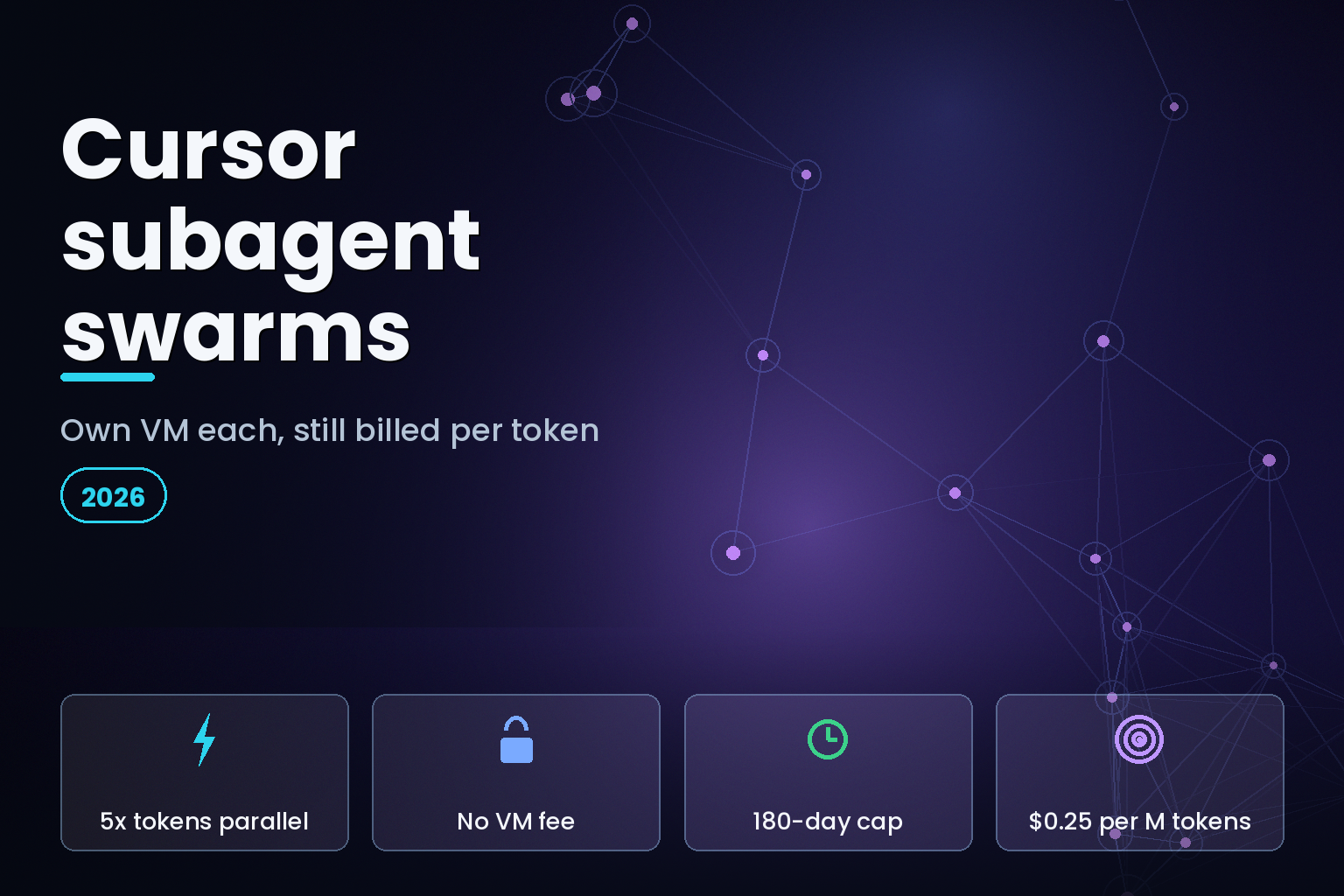
Summary. Cursor's 19 August 2026 release lets each subagent run on its own virtual machine, and its changelog suggests running "a swarm of subagents to test my app for bugs, each in its own environment". Cursor's own documentation says the machines are free and the tokens are not: "Running five subagents in parallel uses roughly five times the tokens of a single agent." The fee schedule at cursor.com/terms/pricing, last updated 21 May 2026, lists exactly three billable elements - Model API Fees, Cursor Token Fees and Bugbot Usage Fees - and none of them is measured in machine time. Pro is $20/month with $20 of third-party model usage included, Pro Plus $60 with $70 included, Ultra $200 with $400 included. Teams seats are $40 and $120 per user per month. There is no published cap on how many cloud agents you can run at once, and the docs say so plainly: "You can run as many agents as you want in parallel."
That last sentence is the whole risk. A per-VM price would have been a natural brake on a swarm. Cursor has removed the brake and priced the swarm per token instead.
What actually shipped on 19 August
The Cursor changelog entry dated 19 August 2026 carries five items. Three of them change how much a team can spend without noticing.
Subagents on their own machines. The subagents documentation explains the mechanism: subagents share the parent agent's checkout by default, and "when several subagents edit files at once, they can overwrite each other's changes". Ask for isolation and each one runs in "an isolated Git worktree with a separate working directory on the same machine, or its own cloud environment with a dedicated VM and clone of the repository". The trigger is /in-cloud, which "spins up its own VM and branch to work on the task".
Subscriptions. A cloud agent can now wait on an event source and wake when something happens. The cloud agent capabilities page lists four event sources: GitHub, Slack, Linear, and Timers, where a timer can be "a one-off reminder after a delay, or a recurring cron schedule". Two hard limits appear here and nowhere else: "A subscription lasts at most 180 days", and a cloud agent skips automatic CI follow-ups once "the PR has already had 10 CI-failure follow-ups". That ceiling covers automatic follow-ups only; a manually tagged request to fix the CI is described separately and is not capped.
`/goal`. The agent overview documents /goal as "a long-lived objective to work towards until it's fully complete", with the example /goal fix all flaky tests and make CI green. The same page states: "There is no limit on the number of tool calls Agent can make during a task."
An open-ended objective, no tool-call ceiling, unlimited parallelism and a per-token meter is a combination worth costing before you enable it across a team.
Where the money goes
Cursor's cloud agent documentation gives the billing rule in one line: "Cloud Agents are charged at API pricing for the selected model. You can select the context window size, and a larger context window can increase token usage and costs." The same page adds that "Cursor manages VM provisioning, isolation, snapshots, startup, artifacts, and capacity for every Cloud Agent" - managed, and priced nowhere.
The 13 August 2026 changelog entry confirms the direction: "Builds are included with Cloud Agents at no additional cost", alongside environments that "boot 10x faster, with 3x faster time to first token".
So the exposure is token-side, and it compounds in three documented ways.
| Multiplier | What the docs say | Where it applies |
|---|---|---|
| Parallel subagents | "Running five subagents in parallel uses roughly five times the tokens of a single agent" | Any /in-cloud swarm |
| Forced maximum context | "Automations use each model's maximum supported context window because they run as cloud agents. There is no context-window toggle." | Every automation and subscription-driven run |
| Cursor Token Rate | "$0.25 per million tokens... This applies to BYOK as well." | Teams and Enterprise, on third-party model requests |
The third row is the one teams miss. The Teams pricing documentation says the $0.25 per million token rate "is charged on third-party model requests" and covers "Custom model execution (Tab, Apply, etc.); Infrastructure and processing costs" - and it still applies when you bring your own API key. Bringing your own key does not take you off Cursor's meter.
Two further uplifts are published on the models and pricing page: opting in to regional data residency "incurs a 10% uplift on Model pricing for eligible Models", and Max Mode is "billed at the model's API rate plus 20%", though Max Mode is "available only on legacy request-based plans".
What a swarm plausibly costs
Cursor publishes its own usage bands rather than leaving buyers to guess. The models and pricing page gives "Daily Agent users: Typically $60-$100/mo total usage" and, for the exact population this release targets, "Power users (multiple agents/automation): Often $200+/mo total usage".
Set those against the included pools:
| Plan | Monthly price | Third-party model usage included | Cloud agents |
|---|---|---|---|
| Start (India only) | ₹649, tax inclusive | $0 | Included |
| Pro | $20 | $20 | Included |
| Pro Plus | $60 | $70 | Included |
| Ultra | $200 | $400 | Included |
| Teams Standard | $40 per user | Team pool | Included, with shared team context |
| Teams Premium | $120 per user | 5x Standard limits on Agent | Included |
A Pro subscriber at $20 with a $20 included pool who runs one five-way swarm on maximum context is, by Cursor's own arithmetic, spending five times a normal agent run against a pool sized for one. Everything past the pool is on-demand: "All On-Demand Usage Fees are billed monthly in arrears, based on actual consumption", per the Cursor pricing policy.
The Start plan deserves a separate warning for Indian teams. At ₹649 per month it is the cheapest paid entry point and it includes cloud agents, but the documentation says "Start does not include the Other Models pool, on-demand usage, Bugbot, Auto, Automations, or the Cursor SDK". A team that buys Start expecting the automations half of this release does not get it.
The contradiction: who actually gets CI autofix
The changelog states the behaviour without qualification: "Cloud agents automatically subscribe to PRs they create and drive them to completion, fixing CI and addressing bot comments."
The documentation qualifies it: "Automatically fixing CI failures is currently only available on Teams; support for non-Teams accounts is coming soon."
Both pages are live on cursor.com today. A Pro or Pro Plus subscriber who read the 19 August announcement has been promised the headline behaviour of the release and, per the docs, does not have it. If you are evaluating this release on the strength of unattended CI repair, the seat type decides whether you get it, and $40 per user per month for Teams Standard is the floor - a real difference from $20 Pro for a small team. We have written before on how the Cursor Teams premium and standard seat mix changes the per-developer number.
Controls that exist, and one that does not
Cursor's only documented brake on a runaway swarm is financial. The cloud agent page says "You'll be asked to set a spend limit when you first start using them." Teams "can configure monthly team-wide spending limits", but the Teams pricing page adds the constraint that matters at scale: "Per-member spend limits are available on Enterprise plans."
So on Teams you can cap the organisation and not the individual. One engineer running an open-ended /goal against a maximum-context model can consume a team-wide pool that everyone else is depending on, and the only signal is the shared limit being hit.
Attribution is at least documented. For automations, "Team Owned: Usage is billed to the team's usage pool... Private: Usage is billed to the user who created the automation. Team Visible: Usage is billed to the user who created the automation, the same as Private."
There is one structural limit on recursion. The subagents documentation says that since Cursor 2.5, "subagents can launch child subagents to create a tree of coordinated work. The main agent and its direct subagents can launch subagents, but a subagent launched by another subagent can't launch further ones." That caps depth at two levels. It caps nothing about width.
India-specific considerations
Indian teams have a plan that global buyers do not: Start at ₹649 per month, tax inclusive. It is the only Cursor tier that excludes the third-party model pool entirely, which makes it a poor fit for the workflow this release is built around. Teams running agents against repositories holding personal data should also note the residency trade: regional data residency is available at "a 10% uplift on Model pricing for eligible Models", and under the Digital Personal Data Protection Act 2023 the choice of processing region is a decision worth recording rather than defaulting. Isolation is a separate question from residency - our note on sandboxing AI coding agents with VM isolation covers the boundary a dedicated VM does and does not give you.
What is still unknown
Cursor publishes no per-VM rate, no machine-hour rate, and no concurrency cap for cloud agents or subagents. That is not an oversight to be filled with an estimate - the fee schedule is explicit that fees are a function of "the aggregate number of tokens processed across all input, output, and cache (read and write) tasks", and compute is simply not a billable element. Enterprise pricing is listed only as "Custom". Origin, the code hosting product that rolled out on 17 August 2026 "in early beta on all paid plans", carries no published storage quota or repository limit either.
Before you enable swarms across a team: set the spend limit first, keep open-ended /goal runs on Enterprise seats where per-member caps exist, and measure a single five-way swarm against a single agent run on the same task before you trust the throughput story. The real cost is the context window, not the machine.
FAQ
How eCorpIT can help
eCorpIT runs AI coding agents in production for client teams and sizes the token bill before the rollout, not after the first invoice. Our senior engineering teams set spend limits, seat mixes and context-window policy against the workload you actually have, and we publish the method in our AI coding agent rollout governance service and our work on AI agent unit economics and cost per task. If you are weighing a swarm rollout against a per-seat budget, contact us and we will model it with your repositories.
Related reading: Cursor Automations and event-triggered coding agents and the pillar guide to enterprise AI agents in production.
References
Last updated: 21 August 2026.