On this page · 8 sections
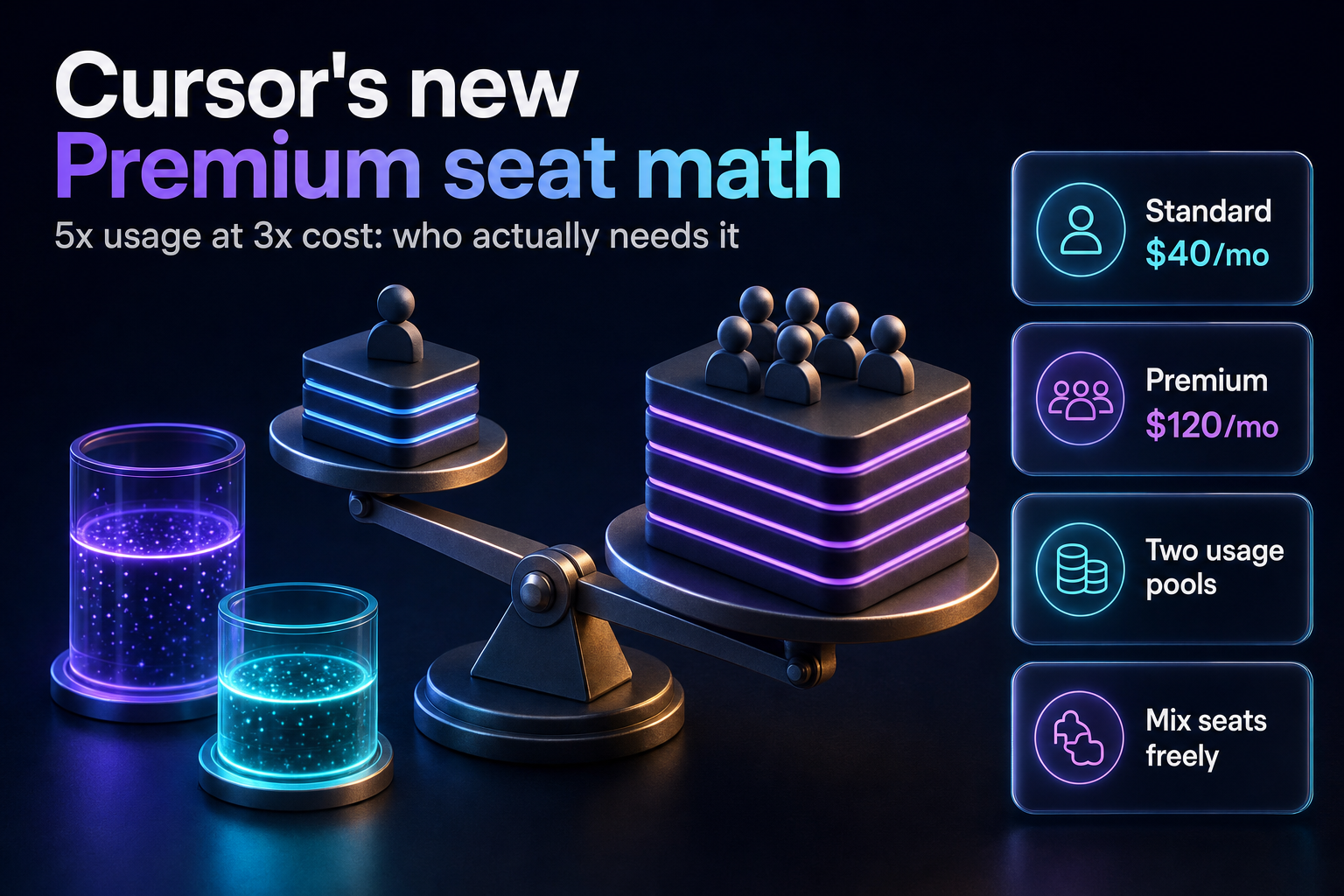
Summary. Cursor changed Teams pricing on 1 June 2026, and the change reached renewing customers on billing cycles starting 1 July 2026. Every Teams seat now carries two separate pools of included usage rather than one: a Composer and Auto pool for Cursor's first-party models, and a Third-Party API pool for everything else. Standard stays at $40 per seat per month, or $32 on annual, with more total usage than before. The new Premium seat is $120 monthly or $96 annual, and gives 5x the included usage of Standard at 3x the cost. That ratio is the whole story: Premium's included usage costs $24 per unit against Standard's $40, so it is 40% cheaper per unit of capacity. The break-even is exact. Premium wins the moment a developer's on-demand overage on a Standard seat would pass $80 a month. GitHub Copilot Business, by comparison, is $19 per granted seat per month and Copilot Enterprise is $39, both with an AI Credits allowance.
What actually changed on 1 July
Cursor published the change on 1 June 2026. It took effect for new customers immediately and for renewing customers on billing cycles starting 1 July 2026, so most existing teams saw it this month rather than last.
Three things moved.
The first is the split into two usage pools. Previously a Teams seat had one bucket of included usage that any model could drain. Now there is a pool reserved for Composer and Auto, Cursor's first-party models, and a separate pool for third-party API models. Cursor's stated reason is that Composer 2.5 delivers frontier performance at a fraction of the cost, so it can afford to be generous with first-party capacity in a way it cannot with models it buys wholesale.
The practical effect is that a developer who runs everything on Composer now gets meaningfully more work out of the same $40 than they did in May. A developer who insists on third-party models for everything gets a smaller dedicated bucket and hits on-demand pricing sooner. That is a pricing lever pointed squarely at model choice, and it is worth being honest that it is one.
The second is the Premium seat: 5x the included usage of Standard at 3x the cost. Teams can mix seat types freely. Cursor expects the Composer pool on a Premium seat to cover a full month of heavy agent usage for 99% of users.
The third is spend control. The dashboard now shows each user how close they are to their limits, split by pool, and admins can configure dollar-threshold alerts delivered to Slack or email. Cursor also makes seat-type recommendations based on observed usage.
| Seat | Monthly | Annual | Included usage | Cost per unit of included usage |
|---|---|---|---|---|
| Standard | $40 per seat | $32 per seat | 1x (baseline) | $40 monthly, $32 annual |
| Premium | $120 per seat | $96 per seat | 5x Standard | $24 monthly, $19.20 annual |
That last column is the one nobody prints. Premium is not simply "more expensive"; per unit of included capacity it is 40% cheaper than Standard. Cursor is selling volume at a discount, which is what "5x usage at only 3x the cost" means when you divide it out.
The break-even, exactly
Here is the arithmetic that decides your seat mix, and it needs no assumptions.
A Standard seat costs $40. A Premium seat costs $120. The difference is $80. A developer on a Standard seat who exhausts the included pool pays on-demand rates for the rest of the month. So:
Premium is cheaper than Standard the moment that developer's monthly on-demand overage exceeds $80.
Below $80 of overage, a Standard seat plus overage is cheaper and you should leave them on Standard. Above it, you are paying a premium for the privilege of being metered. The Premium seat's 5x pool then absorbs the usage that was being billed at on-demand rates.
The ceiling matters too. Premium buys 5x Standard's pool. A developer who would blow through more than 5x is going to hit on-demand pricing anyway, just later. Cursor's claim that the Composer pool on Premium covers a full month of heavy usage for 99% of users is the company's own estimate, so treat it as a claim rather than a measurement, but it sets the expectation that the 5x ceiling is rarely the binding constraint.
Running it on a real team
Take a 20-developer team where 3 people are genuine power users. That distribution is not a guess; Cursor's own position is that a small number of power users on any team drive the majority of spend and the unpredictable on-demand costs.
| Seat mix | Monthly cost | Annual billing | Yearly at annual rates |
|---|---|---|---|
| 20 Standard | $800 plus overage | $640 | $7,680 plus overage |
| 17 Standard + 3 Premium | $1,040 | $832 | $9,984 |
| 20 Premium | $2,400 | $1,920 | $23,040 |
The middle row costs $240 a month more than all-Standard at monthly rates. It is the right call if, and only if, those 3 developers were generating more than $240 a month of overage between them, which is $80 each. Same break-even, applied three times.
The bottom row is what happens when procurement decides uniformity is simpler than measurement. It costs $23,040 a year against $9,984 for the mix, and it buys 17 people a 5x pool they will never touch. Do not do this.
Two more observations from the table. Annual billing is a flat 20% off on both seat types, which is a larger and more certain saving than most seat-mix optimisation will produce, and it is available today. And the all-Standard row is the only one with an open-ended tail: "plus overage" is the line item that arrives as a surprise. Part of what you buy with Premium is a known number.
How this compares with GitHub Copilot
Cursor and Copilot are not priced on the same axis, which makes head-to-head comparison harder than vendors would like.
| Cursor Standard | Cursor Premium | Copilot Business | Copilot Enterprise | |
|---|---|---|---|---|
| Price per seat per month | $40 ($32 annual) | $120 ($96 annual) | $19 | $39 |
| Included usage model | Two pools: Composer/Auto and third-party API | Same, 5x the capacity | Monthly pool of AI Credits | Larger monthly pool of AI Credits |
| Overage | On-demand rates | On-demand rates | Usage-based beyond the credit pool | Usage-based beyond the credit pool |
| Admin spend controls | Dollar-threshold alerts to Slack or email | Same | Centralised management and policy control | Adds enterprise-grade capabilities |
| Model access | Composer 2.5 plus third-party | Same | Broad model catalogue | Priority access to new models |
GitHub's own plans documentation puts Copilot Business at $19 per granted seat per month and Copilot Enterprise at $39, with each plan carrying an allowance of GitHub AI Credits. On individual plans, Copilot Pro is $10 a month, Pro+ is $39 and Max is $100.
The sticker gap is real: Copilot Business at $19 is less than half a Cursor Standard seat. Whether that gap survives contact with your actual usage depends entirely on how much work each tool's included allowance covers, and neither vendor publishes a unit you can convert between. Anyone who tells you Copilot is "less than half the price" of Cursor is comparing the price of the seat, not the price of the work.
One structural note worth having in a procurement conversation: since 22 April 2026, new self-serve sign-ups for Copilot Business for organizations on GitHub Free and GitHub Team plans are paused, per GitHub's documentation. If you were planning to swipe a card and roll it out, check that first.
The honest read: the two tools are close enough on capability in 2026 that price should not be the deciding factor, and the seat sticker is the least informative number either of them publishes. Pick on how your team actually works, then optimise the seat mix inside whichever you choose. We covered the underlying token economics of agentic coding in our look at what Claude Code tokens actually cost Microsoft and Uber.
What to do this month
Measure before you buy. Cursor's dashboard now splits usage by pool per user, which is the data you need and did not have in May. Pull a month.
Then apply the test. Any developer whose on-demand overage clears $80 in a month goes on Premium. Everyone else stays on Standard. Re-run it quarterly, because the population shifts as agent workflows spread through a team, and because Cursor now makes seat recommendations from the same data.
Set the dollar-threshold alerts on the way through. The failure mode this pricing change is designed around is the surprise invoice, and the alerts are free.
If you are on monthly billing and have any confidence you will still be using Cursor in a year, the 20% annual discount is worth more than the seat-mix exercise on most teams. Do that one first.
The real lever is not the seat. It is model choice: the pool split means a team that defaults to Composer gets materially more included work per dollar than one that routes everything to third-party models. That default is a one-line policy decision, and it moves the bill more than any of this.
FAQ
How eCorpIT can help
eCorpIT is a CMMI Level 5 certified, MSME-registered technology organisation in Gurugram, founded in 2021, and a Microsoft partner. Our senior engineering teams run AI tooling reviews for engineering organisations: measuring actual per-developer usage, modelling the seat mix against real overage data, and setting the model-default policies that move the bill more than seat selection does. If you are renewing a Cursor or Copilot contract this quarter and want the numbers run against your own usage rather than a vendor's example, talk to our team.
References
- Improvements to Teams Pricing - Cursor Team, 1 June 2026. Seat prices, the two-pool split and the Premium seat.
- Cursor Teams pricing documentation - Cursor Docs.
- Cursor pricing - Cursor.
- Composer 2.5 - Cursor Team, first-party model referenced in the pricing change.
- Plans for GitHub Copilot - GitHub Docs, seat prices retrieved 17 July 2026.
- GitHub Copilot is moving to usage-based billing - The GitHub Blog.
- Usage-based billing for organizations and enterprises - GitHub Docs.
- Monitor AI credits usage - GitHub Docs.
- Introducing organizations for Cursor Enterprise - Cursor Team, 3 June 2026.
- Cursor changelog - Cursor.
- GitHub Copilot plans and pricing - GitHub.
Last updated: 17 July 2026.