On this page · 12 sections
- What Cohere actually published
- The trial ceiling is 1,000 calls, not 5 requests a minute
- The pricing doc does not mention audio
- What $3.75 an hour per instance means against metered ASR
- Three gaps you have to engineer around
- The Arabic model is missing from the model index
- The benchmark table does not support the four-of-six claim
- How to tell if this affects you
- India-specific considerations
- FAQ
- How eCorpIT can help
- References
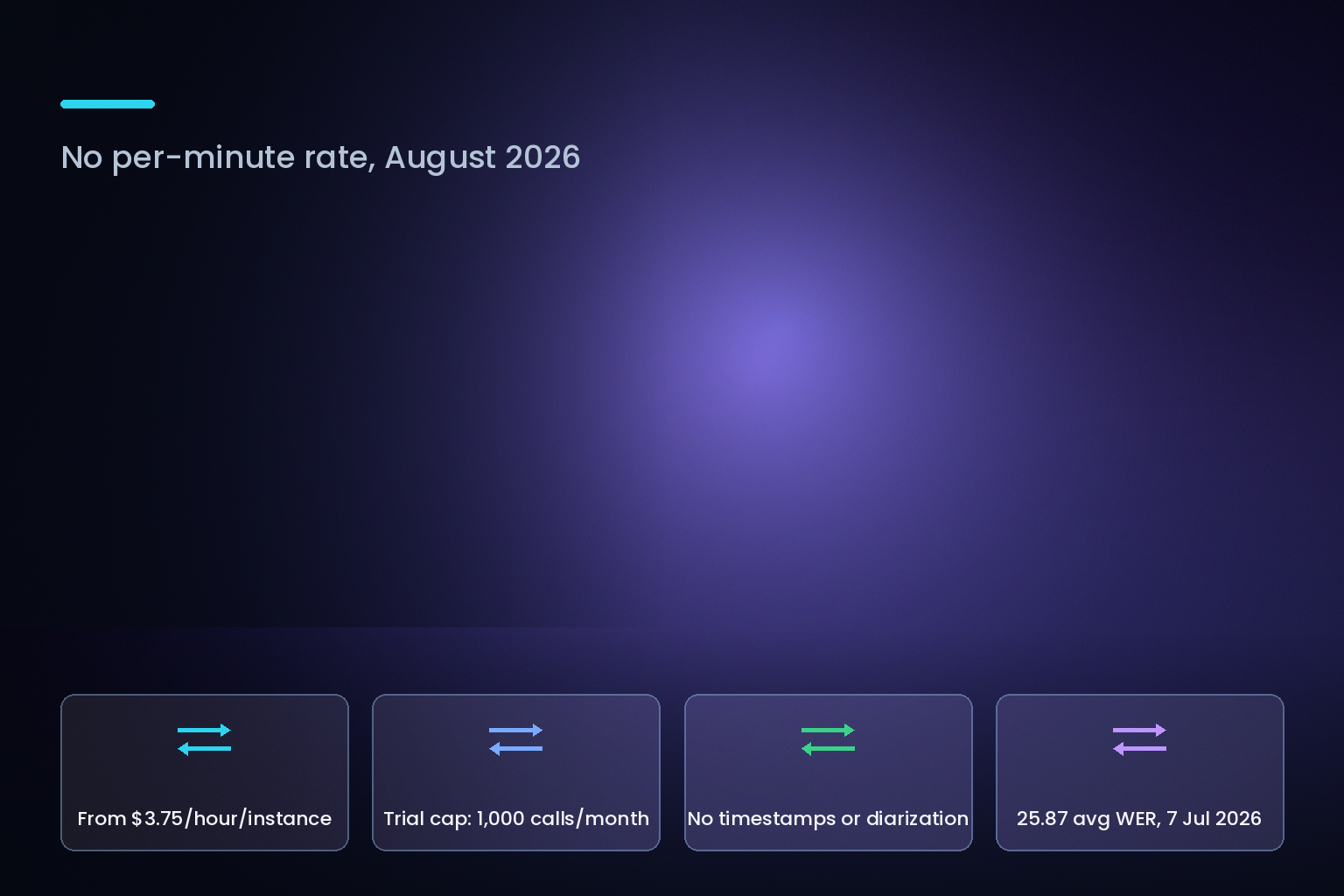
Summary. Cohere sells two automatic speech recognition models, cohere-transcribe-03-2026 and cohere-transcribe-arabic-07-2026, both released under Apache 2.0. Neither has a published per-minute or per-token price. The Cohere pricing page lists Transcribe under the unit "1M tokens" with no token rate at all, and instead prints one line: "From $$3.75 / hour / instance (via Model Vault)". The trial key that lets you evaluate it is capped at 1,000 API calls a month and 5 requests a minute on the Audio Transcriptions endpoint, and the production rate limit for that endpoint is the string "Contact sales@cohere.com". OpenAI, by contrast, publishes $0.0045 per minute for gpt-transcribe and $0.006 per minute for Whisper. At those rates a single always-on Cohere instance at $3.75/hour has to absorb roughly 10,100 hours of audio a month before it beats metered transcription.
That is the commercial shape. The engineering shape is worse in a way the marketing page does not admit: the models return a bare string, cannot detect the input language, and produce neither timestamps nor speaker labels.
What Cohere actually published
cohere-transcribe-03-2026 is a 2-billion-parameter audio-in, text-out Conformer, documented as covering 14 languages: English, German, French, Italian, Spanish, Portuguese, Greek, Dutch, Polish, Vietnamese, Chinese, Arabic, Japanese and Korean. Maximum file size is 25MB. The weights went up on Hugging Face on 24 March 2026 and have been pulled 526,930 times as of 25 August 2026.
cohere-transcribe-arabic-07-2026 is a fine-tune of that model, announced on 7 July 2026, covering Arabic and English only, with multidialectal and code-switching support declared. Its weights were created on 18 June 2026 and last modified on 13 July 2026, with 53,753 downloads.
Both are Apache 2.0. Both are callable free, subject to rate limits. Neither has a metered price.
The trial ceiling is 1,000 calls, not 5 requests a minute
Cohere's rate limits page gives the Audio Transcriptions endpoint a trial limit of 5 requests per minute and a production limit of "Contact sales@cohere.com". The same page opens with a sentence that governs everything below it: "Trial keys (and prod keys on newer Chat model variants) are limited to 1,000 API calls a month."
Those two numbers do not describe the same constraint. Five requests a minute sustained for a month is about 216,000 calls. The monthly cap is 1,000. The per-minute figure is a burst limit that you can exhaust, permanently, in three and a half minutes of steady traffic. Anyone sizing a pilot off the 5 req/min row will build a load test that dies on day one.
The endpoint has no self-serve production tier at all. Every other Cohere endpoint on that page publishes a production number: Embed 2,000 inputs/min, Rerank 1,000 req/min, Tokenize 2,000 req/min, EmbedJob 50 req/min. Audio is the only one routed to sales.
The pricing doc does not mention audio
Cohere's own pricing explainer enumerates how each family is billed: generative models per token with separate input and output rates, Rerank by quantity of searches, Embed by tokens embedded. Audio does not appear. There is no billing unit defined for speech anywhere in the documentation.
On the marketing pricing page the Transcribe card carries the field "per":"1M tokens" in the page payload with no input or output price attached, next to cards like Command R7B that do carry rates ($0.0375 input, $0.15 output per 1M tokens). An audio-in model priced in tokens per million, with the token rate missing, is not a pricing model. It is a placeholder.
What $3.75 an hour per instance means against metered ASR
Model Vault bills per hour per instance, not per minute of audio, so the comparison only resolves once you fix a utilisation figure.
| Basis | Published rate | Cost for 100 hours of audio/month | Monthly cost at 730 hours |
|---|---|---|---|
| Cohere Model Vault instance | $3.75/hour/instance | $2,737.50 (instance runs regardless) | $2,737.50 |
OpenAI gpt-4o-mini-transcribe |
$0.003/minute | $18.00 | $131.40 |
OpenAI gpt-transcribe |
$0.0045/minute | $27.00 | $197.10 |
| OpenAI Whisper | $0.006/minute | $36.00 | $262.80 |
OpenAI gpt-4o-transcribe-diarize |
$0.006/minute | $36.00 | $262.80 |
An always-on instance at $3.75/hour costs $2,737.50 over a 730-hour month. Against $0.0045 a minute that instance has to process about 10,139 hours of audio per month, roughly 338 hours a day, before it is the cheaper option. Against Whisper's $0.006 a minute the break-even falls to about 7,604 hours a month, still 253 hours of audio a day per instance. Below that, metered transcription wins on price and you have not yet paid for the capability gaps below.
The instance-hour model is the right one for steady, high-volume, privacy-constrained pipelines. It is the wrong one for bursty workloads, and Cohere publishes nothing that lets you model the middle.
Three gaps you have to engineer around
The Audio Transcriptions API reference makes the shape of the endpoint plain. POST https://api.cohere.com/v2/audio/transcriptions takes model, language, file and an optional temperature. The 200 response has exactly one field: text.
Language is a required parameter. Cohere's model page states, verbatim, that the model "does not feature explicit, automatic language detection" and "performs best when remaining in-distribution of a single, pre-specified language amongst the 14 in the range it supports". If you do not already know what language a file is in, you need a separate language-identification step in front of the call. The marketing bullet "Multilingual across 14 languages" means 14 languages one at a time, chosen by you.
No timestamps, no diarization. Both model pages list these as limitations in the same words. There are no segments, no word offsets, no speaker labels. Any product that shows a synchronised transcript, jumps playback to a phrase, or attributes a line to a speaker has to build forced alignment and diarization itself. OpenAI charges $0.006 a minute for gpt-4o-transcribe-diarize, which includes the feature Cohere's models do not have.
The accepted file extensions exclude what phones and browsers record. The API reference lists flac, mp3, mpeg, mpga, ogg and wav. There is no m4a, no mp4, no webm. iOS voice memos and MediaRecorder output both need a transcode step before they reach the endpoint.
The Arabic model is missing from the model index
Cohere's models overview has an Audio table with exactly one row, cohere-transcribe-03-2026. Two lines above that table, the same page says: "For Arabic-language transcription, use Cohere Transcribe Arabic for best-in-class performance." The model ID for the model it recommends is not in the table. It is only on the Transcribe Arabic page, where the identifier cohere-transcribe-arabic-07-2026 finally appears.
The same page adds that Transcribe is available on Microsoft Foundry as coherelabs-cohere-transcribe-03-2026 and that "Cohere Transcribe Arabic is not yet available on other platforms". So the recommended Arabic model is absent from the model index, absent from Foundry, and reachable only through Cohere's own API or a Model Vault instance.
If your model registry is generated by scraping the models table, as most are, you will never see it.
The benchmark table does not support the four-of-six claim
Cohere's Transcribe Arabic announcement reports an average word error rate of 25.87 on the Open Universal Arabic ASR leaderboard as of 7 July 2026, against 28.32 for Meta's OmniASR-LLM-7B and 36.86 for OpenAI's Whisper Large V3. Those two deltas check out: 2.45 points and 10.99 points.
The claim that does not check out is the next one. The post says the model "ranks first on four of the six composite task sets". Count the rows in Cohere's own table.
| Test set | Transcribe Arabic | OmniASR 7B-LLM | Whisper Large V3 | Cohere Transcribe | Lowest WER |
|---|---|---|---|---|---|
| SADA | 37.47 | 41.61 | 55.96 | 60.11 | Transcribe Arabic |
| Common Voice | 5.82 | 9.75 | 17.83 | 8.17 | Transcribe Arabic |
| MASC (clean) | 15.54 | 19.69 | 24.66 | 8.66 | Cohere Transcribe |
| MASC (noisy) | 27.07 | 29.29 | 34.63 | 19.01 | Cohere Transcribe |
| MGB-2 | 15.54 | 14.13 | 16.26 | 25.33 | OmniASR 7B-LLM |
| Casablanca | 49.71 | 56.46 | 71.81 | 62.71 | Transcribe Arabic |
Counting all four columns, Transcribe Arabic has the lowest WER on three of six sets, not four. Counting only the leaderboard peers and excluding the base Cohere model, it wins five of six. Neither reading produces four. The same post says it "delivers substantial gains over Cohere Transcribe" on Arabic audio, yet the base March model beats it by 6.88 points on MASC clean and 8.06 points on MASC noisy.
For a buyer this matters in one specific way. If your Arabic audio resembles MASC, which is read and broadcast Arabic rather than spontaneous dialect, the older and more broadly multilingual cohere-transcribe-03-2026 is the better model on Cohere's own numbers, and it is the one that is actually listed in the model index and on Microsoft Foundry.
How to tell if this affects you
Run three checks before you commit. Measure your monthly audio hours; below roughly 250 hours a day per instance, metered per-minute transcription is cheaper than a $3.75/hour instance. Check whether your product needs timestamps or speaker labels, because neither model produces them and building forced alignment is the larger part of that work. Check what your clients actually upload, because m4a and webm both need a transcode before the endpoint will accept them.
If data residency is the reason you are looking at open weights, note that Apache 2.0 gives you the option to self-host without any Cohere contract at all. For teams in India weighing this against DPDP Act 2023 obligations, self-hosting the weights inside your own VPC keeps voice recordings, which are personal data, out of a third-party processor entirely. That path costs GPU time rather than instance-hours, and it is the only one where the absence of a published per-minute rate stops mattering.
India-specific considerations
None of the 14 supported languages is an Indian language. Hindi, Bengali, Tamil, Telugu and Marathi are all outside the range, and the Arabic fine-tune covers only Arabic and English. Indian teams building voice products for a domestic user base get English-only coverage from these models, and English spoken with an Indian accent is not represented in any of the six benchmark sets Cohere published. Anyone evaluating this for an Indian contact-centre workload needs their own held-out test set before the pilot, not after.
FAQ
How eCorpIT can help
Choosing between metered transcription, an instance-hour contract and self-hosted open weights is a utilisation question before it is a model-quality question, and the break-even moves with your actual audio hours. Our senior engineering teams build the held-out test set, measure word error rate on your own recordings, and model the three cost bases side by side. eCorpIT is CMMI Level 5 and ISO 27001:2022 certified, which matters when the audio in question is customer voice data. Talk to our speech and AI platform team about your transcription workload.
Related reading: our comparison of transcription cost and accuracy across OpenAI's speech models, our guide to choosing an embedding model for retrieval, and the Command A migration notes for teams already on Cohere.
References
- Cohere Transcribe model documentation - model ID, 14 languages, 25MB file size, limitations, retrieved 25 August 2026.
- Cohere Transcribe Arabic model documentation - model ID
cohere-transcribe-arabic-07-2026, code-switching support, limitations, retrieved 25 August 2026.
- An overview of Cohere's models - Audio table with a single row, Microsoft Foundry availability, retrieved 25 August 2026.
- Cohere API keys and rate limits - 1,000 calls a month trial cap, 5 req/min audio trial limit, contact-sales production limit, retrieved 25 August 2026.
- How does Cohere's pricing work? - per-token, per-search and per-embedding billing units, retrieved 25 August 2026.
- Create a transcription - Cohere API reference - required
languageparameter, accepted file extensions, single-field response, retrieved 25 August 2026.
- Cohere pricing - Transcribe card, "From $$3.75 / hour / instance (via Model Vault)", Command R7B token rates, retrieved 25 August 2026.
- Meet Cohere Transcribe Arabic - Cohere blog, 7 July 2026 - 25.87 average WER, per-dataset table, four-of-six claim, human preference results.
- OpenAI API pricing -
gpt-transcribe$0.0045/minute, Whisper $0.006/minute,gpt-4o-transcribe-diarize$0.006/minute, retrieved 25 August 2026.
- Hugging Face models API listing for cohere-transcribe - creation dates, last-modified dates and download counts, retrieved 25 August 2026.
- CohereLabs/cohere-transcribe-03-2026 on Hugging Face - Apache 2.0 weights for the base model.
- Cohere documentation index - documentation index confirming the
.mdretrieval convention used for these pages.
Last updated: 25 August 2026.