On this page · 8 sections
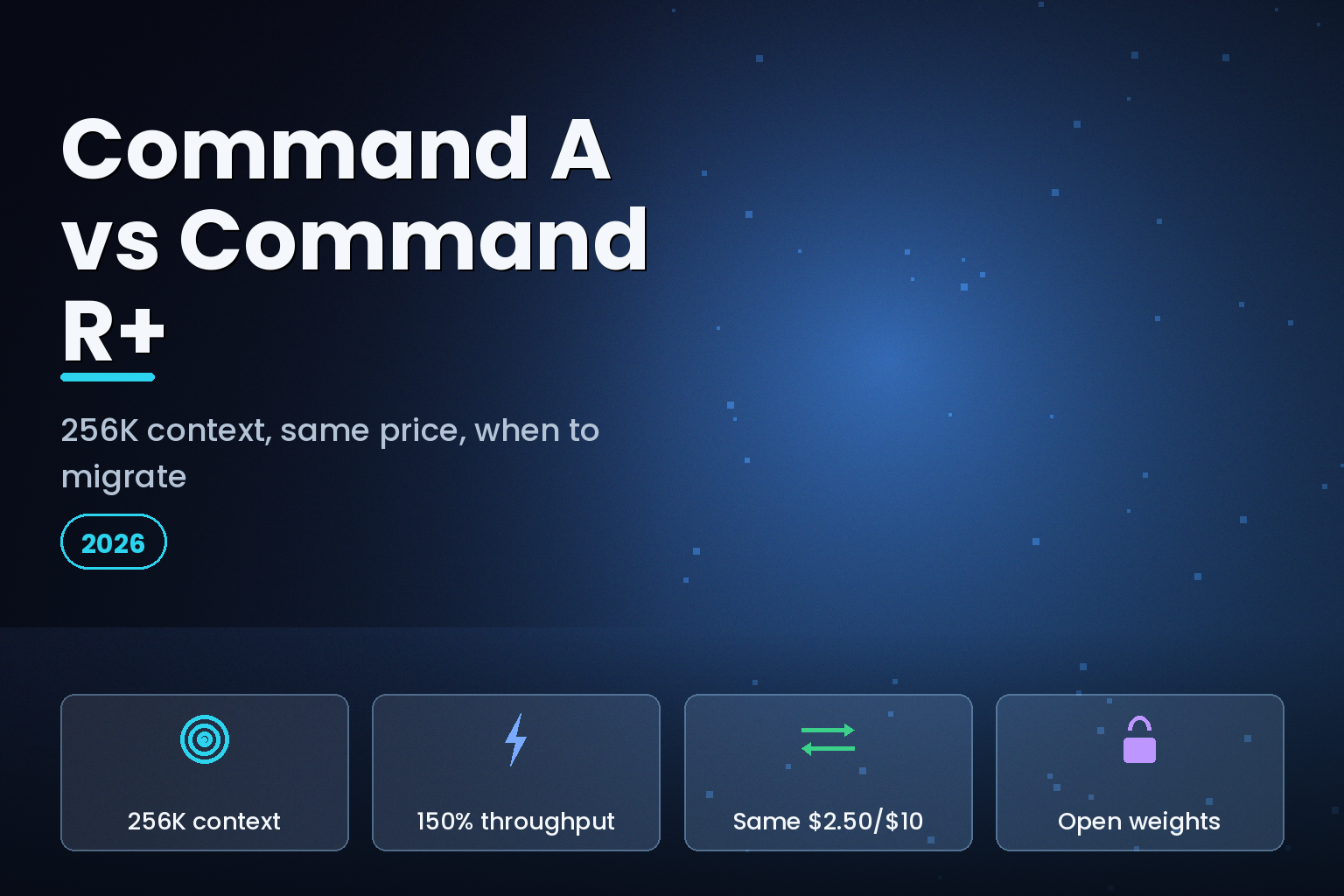
Summary. Cohere's Command A is a 111-billion-parameter open-weights model with a 256K-token context window, double the 128K of Command R+, and about 150% higher inference throughput than the Command R+ 08-2024 release, at the same rate card of $2.50 per million input tokens and $10.00 per million output tokens (as of June 2026). It runs on two GPUs. For most teams already on Command R+, that combination makes the migration to Command A close to a default: more context, more speed, the same price. Two things complicate it. Command R+ was purpose-built for retrieval-augmented generation with strict citation grounding, so validate that behaviour before you switch. And Cohere has since shipped Command A+, a 218-billion-parameter mixture-of-experts model aimed at private, sovereign, agentic deployments. This guide covers the migration math and where Cohere fits against GPT-5.6 and Claude.
What Command a changed
Command A is Cohere's current flagship for enterprise work: tool use, retrieval-augmented generation, agents and multilingual tasks. At 111 billion parameters it holds a 256K-token context and runs on as few as two A100 or H100 GPUs, which VentureBeat noted when Cohere positioned it for "global enterprises" needing long context without a large GPU fleet. Independent measurement from Artificial Analysis puts its output at roughly 32.8 tokens per second with a time-to-first-token near 706 milliseconds, and self-hosted setups on H200 hardware have reported far higher throughput.
The pricing is the part that makes this easy. Command A carries the same $2.50 and $10.00 per-million-token rate card as Command R+, which itself came down from $3.00 and $15.00 at its 04-2024 launch to $2.50 and $10.00 in the 08-2024 refresh. Cohere describes Command A as a "modern R+ on the same rate card" and recommends it as the default for most use cases. You get double the context and materially more throughput for no change in unit price.
The migration math: Command a vs Command R+
| Attribute | Command A | Command R+ (08-2024) |
|---|---|---|
| Parameters | 111B, open weights | Not open-weight at launch |
| Context window | 256K tokens | 128K tokens |
| Throughput | ~150% higher (baseline for the pair) | Baseline |
| Input / output price | $2.50 / $10.00 per 1M | $2.50 / $10.00 per 1M |
| Minimum GPUs to self-host | 2 (A100 / H100) | Higher |
| Built for | Agents, tool use, RAG, multilingual | RAG with strict citation grounding |
On raw specification the case is one-sided: same price, twice the context, more speed, open weights you can host yourself. For summarising long contracts, codebase-scale analysis or multi-document synthesis, the 256K window removes chunking that a 128K model forces on you.
The one caution is citation behaviour. Command R+ was trained specifically to retrieve documents and return cited, grounded answers, and in retrieval benchmarks it has held an edge on citation accuracy and source attribution. Command A carries RAG and tool use forward and Cohere recommends it, but grounding is exactly the behaviour a regulated buyer cares about. Before you cut over, run both models against your own RAG evaluation set and compare citation precision and hallucination rate on your documents, not on a generic benchmark. If the numbers match, migrate. If Command R+ still grounds better on your corpus, keep it for the citation-critical path and use Command A everywhere else.
Command A+ and the sovereignty tier
The lineup did not stop at Command A. Cohere released Command A+ for what it calls agentic AI sovereignty: a fully open-weight model with a mixture-of-experts architecture spanning 218 billion parameters while activating only about 24 billion per prompt, so it runs on as few as two H100s or a single B200 GPU. The point of Command A+ is not a benchmark score. It is deployment. It is built to run wherever sensitive data sits, in a virtual private cloud, on-premises, or fully air-gapped, with the weights and the data staying inside your own infrastructure.
That reflects Cohere's whole enterprise thesis. Aidan Gomez, the company's chief executive and a co-author of the original transformer paper, calls privacy "the most important, underrated and under-appreciated bottleneck" to AI adoption. Cohere offers single-tenant VPC deployment on AWS, Azure and Google Cloud plus on-premises installation, so data and model weights never traverse a shared environment. For a bank or a hospital that cannot send prompts to a public API, that data-residency story is the product.
Where Cohere fits against GPT-5.6 and Claude
Be honest about the frontier. Cohere's published comparisons put Command A on par with or ahead of models like GPT-4o and DeepSeek-V3 on agentic enterprise tasks, but GPT-4o was retired from OpenAI's lineup in 2026, so those numbers reference an older generation. For frontier reasoning in mid-2026 the reference points are GPT-5.6 and Claude Opus, and Cohere does not claim to out-reason them.
That is the wrong axis for most enterprise RAG, though. The question is rarely "which model reasons hardest" but "which model gives grounded, cited answers on my private data, at a serving cost and a deployment model I can live with." On that axis Cohere is strong: competitive quality on grounded RAG and tool use, a flat and predictable $2.50 / $10.00 rate card, open weights, and single-tenant or air-gapped hosting that a consumption-only API cannot match. Choose GPT-5.6 or Claude when you need the deepest reasoning or the widest ecosystem. Choose Cohere when data control, citation grounding and cost predictability outrank raw frontier scores. For the model-by-model view, see our enterprise model selection comparison and our note on RAG embedding model selection.
India-specific considerations
For regulated Indian enterprises in banking, insurance and healthcare, the deployment story often matters more than the leaderboard. The Digital Personal Data Protection Act 2023 pushes sensitive workloads toward architectures where personal data does not leave controlled infrastructure, which is exactly what Cohere's VPC and on-premises options, and the open weights of Command A and Command A+, are built for. A single-tenant deployment carries a higher commitment and a managed-service component than a metered API, so the trade is data sovereignty and predictable cost against operational overhead. Teams weighing self-hosting should read our guide to running local LLMs in production and, for the managed-versus-self-managed retrieval decision, Bedrock knowledge bases versus self-managed RAG.
FAQ
How eCorpIT can help
eCorpIT is a Gurugram-based, CMMI Level 5 and ISO 27001:2022 certified engineering organisation that builds grounded, private retrieval systems for regulated teams. Our engineers evaluate models like Command A on your own corpus, wire up citation-checked RAG, and deploy in a VPC or on-premises where the Digital Personal Data Protection Act 2023 demands it. If you are choosing a model for enterprise RAG, talk to our AI engineering team about a grounded evaluation.
References
- Command A model documentation, Cohere, 2026.
- Command R+ model documentation, Cohere, 2026.
- Cohere targets global enterprises with Command A, requiring only 2 GPUs, VentureBeat, 2026.
- Command A intelligence, performance and price analysis, Artificial Analysis, 2026.
- Cohere releases Command A+ for agentic AI sovereignty, Cohere, 2026.
- Private deployments for enterprise AI security, Cohere, 2026.
- Private deployment overview, Cohere documentation, 2026.
- Cohere API pricing 2026: Command R+, Rerank and Embed costs, MetaCTO, 2026.
- Cohere Command A (New) on Oracle Cloud Infrastructure, Oracle documentation, 2026.
- Cohere Command R and R+ on Amazon SageMaker JumpStart, AWS Machine Learning blog, 2026.
- Cohere CEO Aidan Gomez on enterprise AI and privacy, Upstarts Media, 2026.
_Last updated: 30 July 2026._