On this page · 12 sections
- What changed on July 31, 2026
- AI-200: the direct successor for Azure developers
- AB-410: the low-code and Power Platform path
- Was it worth rushing AZ-204 before the deadline?
- What AI-200 actually tests
- A study plan that fits a working week
- India-specific considerations
- Where this fits in the wider Azure shift
- What this means if you manage a team
- FAQ
- How eCorpIT can help
- References
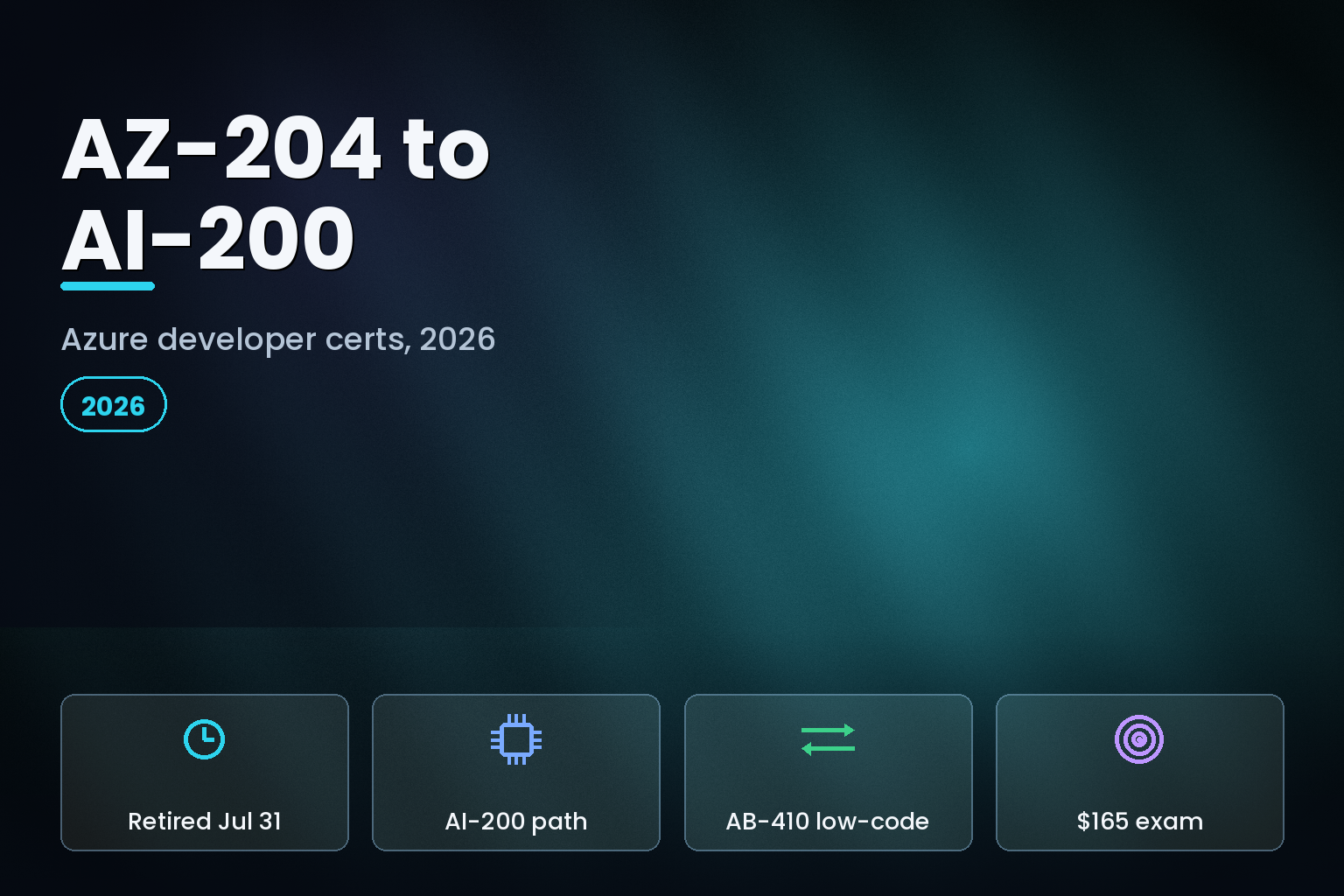
Summary. Microsoft retired exam AZ-204, Developing Solutions for Microsoft Azure, on July 31, 2026 at 11:59 PM Central. It was the exam behind the Azure Developer Associate credential, and it has two successors, not one. For cloud developers, the direct path is now AI-200, Developing AI Cloud Solutions on Azure, which earns the new Microsoft Certified: Azure AI Cloud Developer Associate. For low-code builders on Power Platform, AB-410 replaces PL-200, which itself retires on August 31, 2026. Both new exams reached general availability in July 2026 after a beta that opened in May 2026. A Microsoft associate exam costs $165 in the United States, roughly ₹4,800 in India before local taxes. This guide covers which credential matches your role, what AI-200 actually tests, and whether it was worth rushing AZ-204 before the deadline. The short answer: if you were exam-ready, sitting AZ-204 in July kept a valid credential on your transcript. If you were not, pivot to AI-200 rather than chase a retired exam.
What changed on July 31, 2026
AZ-204 stopped being available to schedule after July 31, 2026. If you passed it before that date, the Azure Developer Associate certification stays on your transcript and remains valid until its normal expiry, and you can still renew it through the usual free online assessment while the renewal window is open. What you cannot do after retirement is take the exam for the first time. Microsoft confirmed on its Q&A forum that the credential continues to count as a prerequisite for exams such as AZ-400 during its validity, so nobody who already holds it is stranded.
The reason for the change is a role shift, not a rebrand. Microsoft is moving its developer credentials from generic cloud application development toward AI-first cloud development. As the company's Skills Hub blog put it in the AI-200 announcement, written by Microsoft's Liberty Munson, "AI is rewriting how cloud applications are designed and delivered, opening new opportunities for developers who design scalable, secure cloud solutions on Azure." The new exams test the services that sit under production AI systems rather than the classic web-app patterns AZ-204 emphasised.
AI-200: the direct successor for Azure developers
If your work is building back-end services on Azure, AI-200 is your path. The exam, Developing AI Cloud Solutions on Azure, leads to the Microsoft Certified: Azure AI Cloud Developer Associate credential. Microsoft describes the target skills as building, integrating, and monitoring AI solutions on Azure using containerized compute, vector-enabled databases, event-driven AI pipelines, serverless functions, secret management, and distributed observability.
That is a meaningful move away from AZ-204. Where the old exam leaned on App Service, storage, and the classic developer toolkit, AI-200 assesses serverless inference endpoints, asynchronous AI processing workflows, semantic retrieval with vector databases, and health-and-performance monitoring for AI systems. Microsoft lists the assumed proficiencies plainly: Azure SDKs, Azure data management services, monitoring and troubleshooting, messaging and eventing, vector databases, Python, and containerized applications on Azure.
One point of confusion worth clearing up: AI-200 is not AI-102. AI-102 remains the Azure AI Engineer Associate exam, focused on building AI solutions with Azure AI services and the model catalog. AI-200 is a separate, developer-facing credential centred on the cloud engineering around AI workloads. You do not need AI-102 or any other exam as a hard prerequisite before sitting AI-200.
AB-410: the low-code and Power Platform path
AB-410, Building Intelligent Applications, is the other successor, but it is aimed at a different person. It earns the Microsoft Certified: Intelligent Applications Builder Associate credential and replaces PL-200, the Power Platform Functional Consultant exam that retires on August 31, 2026. If you build with Microsoft Copilot, Dataverse, Power Apps, Power Automate, and Power Pages rather than writing back-end services in Python, AB-410 is your track. Its published domains cover designing AI solutions, developing intelligent features, optimising AI models, and responsible AI and governance.
So the old single Azure developer exam has split along the line that now divides real teams: professional developers writing code go to AI-200, and low-code or fusion-team builders go to AB-410. Choosing between them is mostly a question of what you build with day to day.
| Exam (2026) | Credential | Who it fits | Status | Replaces |
|---|---|---|---|---|
| AZ-204 | Azure Developer Associate | Legacy Azure developers | Retired July 31, 2026 | - |
| AI-200 | Azure AI Cloud Developer Associate | Code-first developers building AI back ends | GA July 2026 (beta from May 2026) | AZ-204 |
| AB-410 | Intelligent Applications Builder Associate | Power Platform and low-code builders | GA July 2026 (beta earlier) | PL-200 (retires Aug 31, 2026) |
| AI-102 | Azure AI Engineer Associate | AI solution engineers using Azure AI services | Active | - |
Was it worth rushing AZ-204 before the deadline?
This was the live question through July 2026, and the answer depended on one thing: how ready you were. If you had already prepared and could pass, sitting AZ-204 before July 31 put the Azure Developer Associate on your transcript, where it stays valid and renewable. That has value if a current job or contract lists it by name. But cramming an unfamiliar exam in the final weeks to grab a retiring credential is usually the wrong trade, because the market is already moving to the AI-first exams and a rushed pass buys a credential with a shrinking shelf life.
For most people who were not already exam-ready, the better move was to skip AZ-204 and prepare for AI-200 instead. You end with a current credential that reflects the skills employers are actually screening for in 2026, rather than a freshly earned badge for a retired exam.
| Your situation | Sensible move | Why |
|---|---|---|
| Already prepared for AZ-204 by mid-July 2026 | Sit AZ-204 before July 31, then plan AI-200 | Keeps a valid credential; renewable while active |
| Not close to ready | Skip AZ-204, prepare AI-200 | Current, AI-first, matches 2026 hiring |
| Low-code or Power Platform role | Prepare AB-410 | Direct PL-200 successor for builders |
| Already hold Azure Developer Associate | Keep it, add AI-200 when ready | Existing credential stays valid and counts toward AZ-400 |
What AI-200 actually tests
The value of AI-200 for a working engineer is that it maps to production reality, which is also why it resists a one-line answer from a search engine. Microsoft groups the skills into developing containerized solutions on Azure, developing AI solutions with Azure data management services, connecting to and consuming Azure services, and securing, monitoring, and troubleshooting Azure solutions.
In practice that means you should be comfortable packaging an inference workload into a container and scaling it, standing up a serverless endpoint that runs a model, wiring asynchronous processing through a queue or event stream so long-running AI jobs do not block a request, and implementing semantic retrieval against a vector database. It also means the operational half that teams often skip: secret management for keys and connection strings, and distributed observability so you can trace a slow or failing AI request across services. If your day job already includes these, the exam is a validation exercise. If it does not, the study path is real work, not a weekend of flashcards.
A study plan that fits a working week
Treat AI-200 as an eight-week effort if you are already a mid-level Azure developer, longer if vector databases or containers are new to you. Start with the official Exam AI-200 study guide to see the exact skills measured, then build one small end-to-end project that touches every domain: a containerized service that exposes a serverless inference endpoint, pulls context from a vector database, processes a queue of requests asynchronously, reads its secrets from a managed store, and emits traces you can inspect. Building the thing beats reading about it, because the exam rewards people who have wired these services together and hit the real failure modes.
Use Microsoft Learn modules for the theory, the study guide for scope control, and a practice project for retention. Book the exam only when your project runs end to end without you looking up every step.
India-specific considerations
For Indian developers and the global capability centers hiring them, two details matter. First, price: a Microsoft associate exam is $165 in the United States and around ₹4,800 in India before local taxes, so budgeting for a retake is sensible rather than pessimistic. Second, the beta discount did not reach India. Microsoft's 80% beta offer for the first 300 candidates who sat AI-200 on or before May 27, 2026 explicitly excluded India, Turkey, Pakistan, and China, so Indian candidates paid standard pricing from the start.
The demand signal is strong for Indian teams. GCCs are absorbing AI engineering mandates, and a current, code-first AI cloud credential is a cleaner hiring filter than a retired general-developer exam. If your organisation is planning an upskilling budget, our note on the India GCC AI skills gap and reskilling covers where that spend earns the most, and our look at Visual Studio 2026 agent skills and governance covers the tooling side of an AI-first developer workflow.
Where this fits in the wider Azure shift
The certification change tracks a broader move: AI workloads now drive Azure architecture decisions, from container scaling to cost. The same forces that reshaped the exams are reshaping bills, which is why the operational skills AI-200 tests, observability and cost-aware scaling, matter beyond a badge. Our analysis of agentic FinOps on Azure with Copilot and Graviton-class cost pressure sits alongside this for teams weighing cloud cost as carefully as certification.
What this means if you manage a team
If you lead engineers, treat the retirement as a prompt to align your team's credentials with the work you actually ship. Map each engineer to a track: code-first developers to AI-200, low-code and fusion builders to AB-410, and anyone already holding the Azure Developer Associate keeps it while adding AI-200 when a project makes the skills concrete. Avoid funding a scramble to collect retiring badges. Fund the skills the new exams measure, because those are the ones your production AI systems depend on.
Two failure modes are common. The first is certifying ahead of practice: paying for exams before anyone has built a containerized inference service or wired a vector database, so the badge outruns the capability. The second is the reverse, where strong practical skills go unrecognised because nobody scheduled the exam. The fix for both is a project-first approach: build one real AI workload as a team, then certify the people who built it. Budget for at least one retake per person at $165, and remember that Indian teams paid standard pricing because the beta discount excluded India.
FAQ
How eCorpIT can help
eCorpIT is a Gurugram-based, ISO 27001:2022 certified engineering organisation that builds and operates the kind of Azure AI cloud systems AI-200 now certifies: containerized inference, vector retrieval, event-driven pipelines, and the observability around them. If you are a team lead weighing which credential path your engineers should take, or you need AI cloud development delivered rather than just certified, our senior engineering teams can help you plan both. Start a conversation through our contact page.
References
- Microsoft Certified: Azure AI Cloud Developer Associate - Microsoft Learn credential page.
- New Microsoft Certified: Azure AI Cloud Developer Associate Certification - Microsoft Skills Hub blog, May 5, 2026.
- Study guide for Exam AZ-204 - Microsoft Learn.
- Will AZ-204 still count as a prerequisite for AZ-400 after it retires on July 31, 2026? - Microsoft Q&A.
- New Microsoft Certified: Intelligent Applications Builder Associate Certification - Microsoft Skills Hub blog.
- AB-410 replaces PL-200: Intelligent Applications Builder exam guide - PassQuestion, 2026.
- Microsoft AZ-204 is being replaced by AI-200 - Praveen Kumar Sreeram, June 2026.
- AZ-204 retires July 31, 2026 - Windows Forum, 2026.
- AI-200 certification guide: Azure AI Cloud Developer - Prepzee, 2026.
- Microsoft Azure certification cost 2026 - KnowledgeHut, 2026.
- How to pass the AI-200 exam in 2026: 8-week study plan - CertCrush, 2026.
_Last updated: August 1, 2026._