On this page · 13 sections
- What a Visual Studio agent skill actually is
- The six discovery paths
- The trust gap, stated precisely
- What to turn on, and what to turn off
- Custom agents are a separate feature, and teams conflate them
- Planning mode writes to your repo
- The billing angle nobody governs until the invoice
- A rollout sequence for a managed estate
- India-specific considerations
- On the reports of a July 2026 update
- FAQ
- How eCorpIT can help
- References
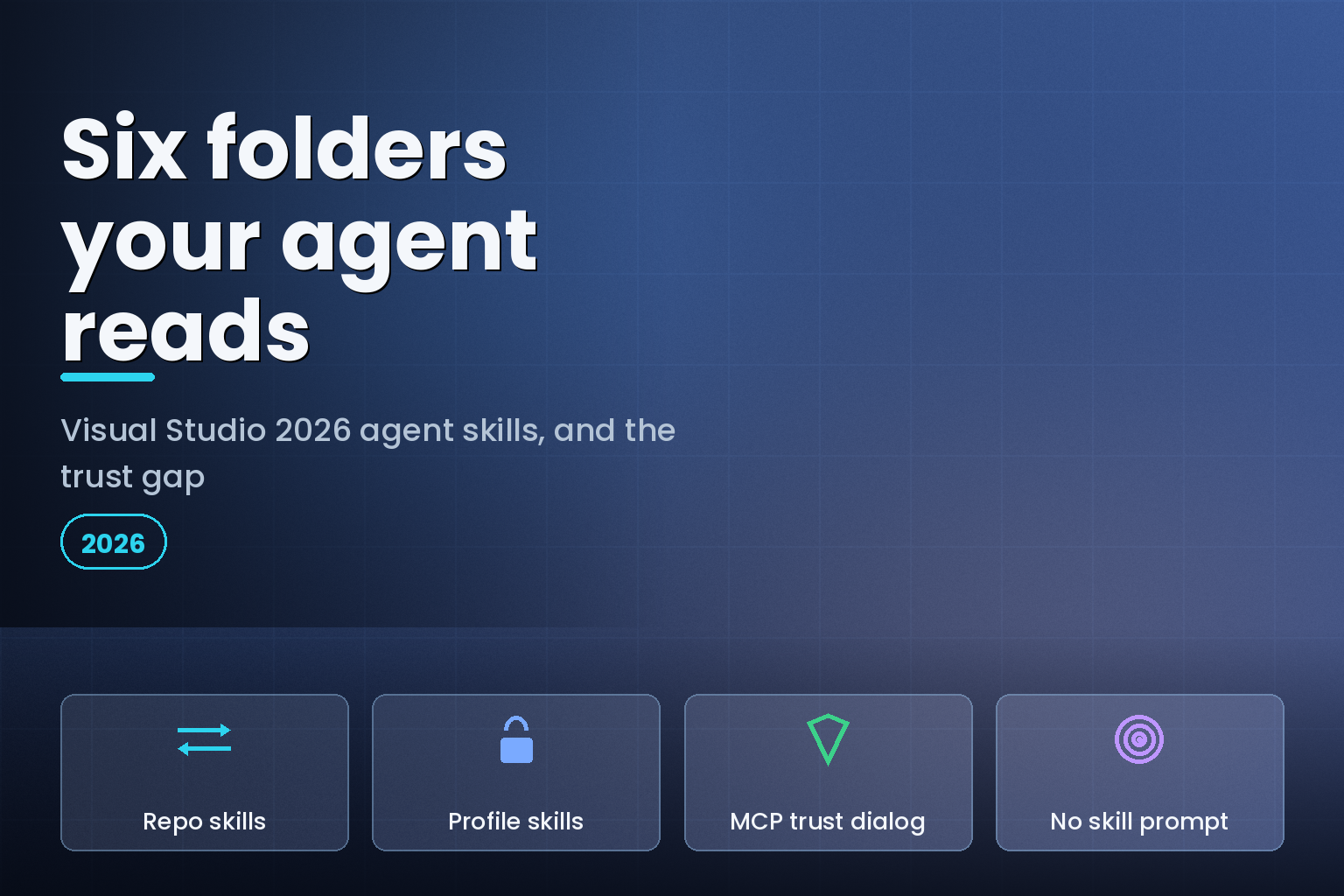
Summary. Visual Studio 2026 gained agent skills in the April update, version 18.5.0, released on 14 April 2026. Copilot agents automatically discover skills from 6 directories: 3 inside the repository and 3 in the user profile. A skill is a folder with a SKILL.md file, and Microsoft's own wording is that after you create one, "the agent decides when to use it." The May update, 18.6.0, released on 12 May 2026, added a panel to browse and edit them. Then the June update, 18.7.0, released on 9 June 2026, added trust validation for MCP servers, which prompts for re-approval when a server's configuration or assets change. Agent skills got no equivalent prompt. That matters because GitHub Copilot moved to usage-based billing on 1 June 2026, with GitHub Docs listing Copilot Business at $19 per user per month and Copilot Enterprise at $39, each carrying a matching monthly allotment of AI Credits. Skills that fire without you asking are now spending a budget as well as steering an agent.
What a Visual Studio agent skill actually is
Microsoft's release notes define it plainly: "Agent skills are reusable instruction sets that teach agents how to handle specific tasks, like running a build pipeline, generating boilerplate, or following your team's coding standards. Define a skill once to save time and keep behavior consistent across your workflow."
The mechanics are four steps in Microsoft's own instructions: create one of the skills directories, create a subdirectory per skill, create a SKILL.md file in it following the agentskills.io specification format, and optionally add scripts, examples or other resources to the skill directory.
Read that last clause carefully. A skill directory can carry scripts. A skill is not only prose.
The six discovery paths
| Scope | Path | Travels with |
|---|---|---|
| Workspace or project | .github/skills/ |
The repository |
| Workspace or project | .claude/skills/ |
The repository |
| Workspace or project | .agents/skills/ |
The repository |
| Personal | ~/.copilot/skills/ |
The developer's machine |
| Personal | ~/.claude/skills/ |
The developer's machine |
| Personal | ~/.agents/skills/ |
The developer's machine |
Three of those six are checked into source control. Clone a repository and you have imported its skills into your agent's behaviour. Microsoft points at github/awesome-copilot for community examples, which is exactly the sharing pattern that makes skills useful and also makes them worth reviewing.
Note also that two of the six paths are not GitHub's own conventions: .claude/skills/ and .agents/skills/ are cross-vendor directories. A repository set up for a different agent tool will be read by Visual Studio's Copilot agents without anyone having intended that.
The trust gap, stated precisely
In the June update Microsoft shipped trust validation for MCP servers, and the design is careful. Trust is validated at two points during server startup: configuration trust before the process starts, comparing the current configuration to a previously trusted baseline, and asset trust after startup, comparing a fingerprint of the server's tools, prompts, resources and instructions to the last trusted fingerprint. If either diverges, you get a dialog showing what changed, with three choices: accept the changes, always trust, or reject and abort startup.
Microsoft's stated rationale: "MCP servers extend Copilot's capabilities, but keeping them secure matters."
Agent skills also extend Copilot's capabilities. They arrive through the same repositories, they can carry scripts, and per the release notes the agent decides on its own when to invoke them. The documented feedback loop is visibility after the fact: "When a skill is active, it appears in chat so you know it's being applied." That is a log line, not a gate.
We are describing a documented difference in the product's own release notes, not a vulnerability. But the operating consequence for a platform team is concrete: your MCP configuration has a change-detection mechanism and your skills directory does not, so the review has to live in your process instead.
Teams that have already worked through MCP server hardening will recognise the shape of the problem, and the same review checklist mostly transfers.
What to turn on, and what to turn off
| Control | Where it lives | Our default for a managed estate |
|---|---|---|
| MCP trust dialog | Tools, Options, GitHub, Copilot, Copilot Chat, "Show trust dialog before running tools from an updated MCP server" | Leave on. It is on by default and it is your only automatic change detector |
| MCP registry policy set to RegistryOnly | Organisational policy, per Microsoft's note that trust validation is skipped when the registry policy is RegistryOnly | Use it only once you actually curate a registry, because it suppresses the dialog |
| Custom agents user directory | Tools, Options, Copilot Chat, "Custom agents user directory" | Point it at a managed path if you want personal agents reviewable |
| Extended range suggestions | Tools, Options, Text Editor, Inline Suggestions, "Enable extended range suggestions" | Off by default; opt in per team, it changes suggestion scope |
| Pull request features | Tools, Options, Preview Features, "Pull Request Comments" and "View pull requests for a Git repository" | On for teams doing review in the IDE |
| Copilot usage alerts | Copilot badge menu, Copilot Usage, plus a quota warning threshold percentage in settings | Set the threshold low enough to react, not just to be informed |
The RegistryOnly row is the one that catches people. It is a good control and it removes a prompt, so adopting it without curating the registry first trades a visible decision for an invisible one.
Custom agents are a separate feature, and teams conflate them
Skills and custom agents shipped in the same April update and do different jobs.
Custom agents are .agent.md files. Workspace agents live under .github/agents/, for example .github/agents/code-reviewer.agent.md. User-level agents default to %USERPROFILE%/.github/agents/. Microsoft's description: custom agents "can use workspace awareness, code understanding, tools, your selected model, and MCP connections to external knowledge sources such as internal documentation, design systems, APIs, and databases."
Two operational details from the release notes are worth putting in your internal guide, because both produce confusing failures.
If a custom agent does not specify a model, it uses whatever model is currently selected in the model picker. An agent that behaved one way for its author can behave differently for a colleague, and nothing in the file explains why.
Tool names vary across GitHub Copilot platforms. Microsoft says so directly and adds that community agent configurations from awesome-copilot should have their tool names verified before use in Visual Studio. An agent copied from a VS Code setup can reference tools that do not exist in Visual Studio.
Planning mode writes to your repo
The May update added Planning mode, which is useful and has a side effect teams should know about before it shows up in a diff.
Copilot saves every plan as a markdown file at .copilot/plans/plan-{title}.md, and Microsoft describes that file as "the single source of truth" which stays in sync when you edit it directly or refine it through chat. When you are ready, the "Implement plan" button hands the plan to Agent mode for execution.
So a mode designed to make no code changes does create files in the working tree. Decide now whether .copilot/plans/ is committed as design history or added to .gitignore, because the answer will otherwise be decided by whoever runs git add . first.
The billing angle nobody governs until the invoice
Microsoft's June update notes state the change plainly: "GitHub Copilot recently transitioned to usage-based billing, so your Copilot usage is now calculated based on token consumption rather than by request."
GitHub's own documentation on billing for organisations and enterprises lists Copilot Business at $19 per user per month and Copilot Enterprise at $39 per user per month as of July 2026, each including a monthly allotment of AI Credits matching that figure, with the usage-based model effective from 1 June 2026. Code completions do not draw from the credit pool; chat, agent mode, code review and CLI usage do.
Now connect that to skills. A skill the agent chooses to apply pulls its instructions into context on every invocation, and context is tokens. A verbose repository skill that fires on most prompts is a recurring line item across every developer who clones that repository. Nobody sizes skills for token cost, and the release notes give you no per-skill usage breakdown.
Visual Studio does give you the raw material to notice: the refreshed Copilot Usage window, reachable from the Copilot badge menu, plus proactive alerts when you are approaching a limit, at a limit, or running overages, with a configurable warning threshold. Our note on Copilot AI credit pools and cost control covers how to structure the pool itself.
The cheapest governance rule we have found is a length budget: a skill that cannot state its job in a page is usually two skills.
A rollout sequence for a managed estate
- Inventory the six paths across your repositories before you enable anything. A one-line search for
SKILL.mdand.agent.mdacross your organisation tells you whether this is already live without a decision having been made.
- Decide ownership of
.github/skills/in each repository the same way you decide ownership of CI configuration. It is build-affecting content.
- Require code review on skill and agent files explicitly. Add the paths to
CODEOWNERSso they cannot land in a routine pull request without the right reviewer.
- Treat
.claude/skills/and.agents/skills/as in scope even if your organisation does not use those tools, because Visual Studio reads them regardless.
- Keep the MCP trust dialog on until you have a curated registry, then move to RegistryOnly deliberately rather than to silence a prompt.
- Standardise custom agents on an explicit model rather than inheriting the picker, and verify tool names against Visual Studio before publishing an agent internally.
- Decide the
.copilot/plans/question in writing.
- Watch the usage window for the first two sprints after enabling skills broadly, because that is when a chatty skill shows up as spend.
Teams running the same exercise on the editor side will find our VS Code agent host rollout guide covers the equivalent controls, and the prompt injection guardrails piece covers what a hostile instruction set can actually do once an agent reads it.
India-specific considerations
Two things make this sharper for Indian engineering organisations and GCCs.
Offshore delivery teams clone more third-party and client repositories than product teams do, which raises the probability of importing skills nobody on the team wrote. A vendor repository handed over at the start of an engagement can carry .github/skills/ from a previous supplier, and the first person to open it in Visual Studio inherits those instructions.
The cost side lands differently too. At $19 and $39 per user per month before overages, a 200-seat delivery centre is committing a meaningful monthly figure in dollars against revenue often billed in rupees. Usage-based billing turns a fixed line item into a variable one, and the variable is partly controlled by files inside repositories your client owns. Put the usage threshold alerts in place before, not after, the first month where an agentic workflow gets popular.
On the reports of a July 2026 update
Several secondary sources in July 2026 describe a Visual Studio 2026 July update, version 18.8, released on 14 July 2026, adding built-in agent skills authored by the .NET and Azure teams and available when the corresponding workloads are installed.
We could not confirm that from a Microsoft primary source when writing this on 23 July 2026. The Microsoft Learn release notes page we read described the June update as the current release, listed 18.7.3 of 30 June 2026 as its newest version, and carried a last-updated stamp of 30 June 2026. The Visual Studio Blog's own monthly archive listing ended at June 2026.
That does not mean the July release does not exist. Documentation lags shipping, and a page can update after we read it. It means we are not going to describe features we could not read in Microsoft's own notes, and neither should your rollout plan. Check your installer's version number and the release notes page directly before you promise a team a built-in skill.
Everything else in this article comes from the release notes for versions 18.5.0, 18.6.0 and 18.7.0, which are documented.
FAQ
How eCorpIT can help
eCorp Information Technologies Private Limited is a Gurugram-based, CMMI Level 5 assessed technology consultancy founded in 2021, and a Microsoft partner, with senior-led platform teams that roll out developer tooling for organisations rather than for individuals. For agentic tooling that means an inventory of what your repositories already carry, review ownership on skill and agent files, a curated MCP registry before you switch on RegistryOnly, and usage alerting configured before the first surprise invoice. If you are standardising Visual Studio 2026 or VS Code agent tooling across more than a handful of teams, start at /contact-us/ and we will begin with the inventory.
References
- Microsoft Learn, Visual Studio 2026 release notes, read 23 July 2026.
- Microsoft Learn, Visual Studio 2026 release notes, "Use agent skills", April update 18.5.0, released 14 April 2026.
- Microsoft Learn, Visual Studio 2026 release notes, "View and manage Agent Skills", May update 18.6.0, released 12 May 2026.
- Microsoft Learn, Visual Studio 2026 release notes, "Trust validation for MCP servers", June update 18.7.0, released 9 June 2026.
- Microsoft Learn, Visual Studio 2026 release notes, "Build your own custom agents", April update 18.5.0.
- Microsoft Learn, Visual Studio 2026 release notes, "Plan before you build with Planning mode", May update 18.6.0.
- Microsoft Learn, Visual Studio 2026 release notes, "Copilot usage tracking and alerts", June update 18.7.0.
- Agent Skills, specification.
- GitHub, awesome-copilot repository.
- The GitHub Blog, GitHub Copilot is moving to usage-based billing.
- Microsoft Learn, Visual Studio release history.
- Visual Studio Blog, Visual Studio 2026 tag archive, checked 23 July 2026.
Last updated: 23 July 2026.