On this page · 10 sections
- The state of AI customer experience in 2026
- The five capabilities of AI-powered CX in 2026
- The implementation sequence that works in 2026
- The measurement framework the CFO will accept
- Governance and risk management
- Common implementation failures
- India-specific considerations
- FAQ
- How eCorpIT can help
- References
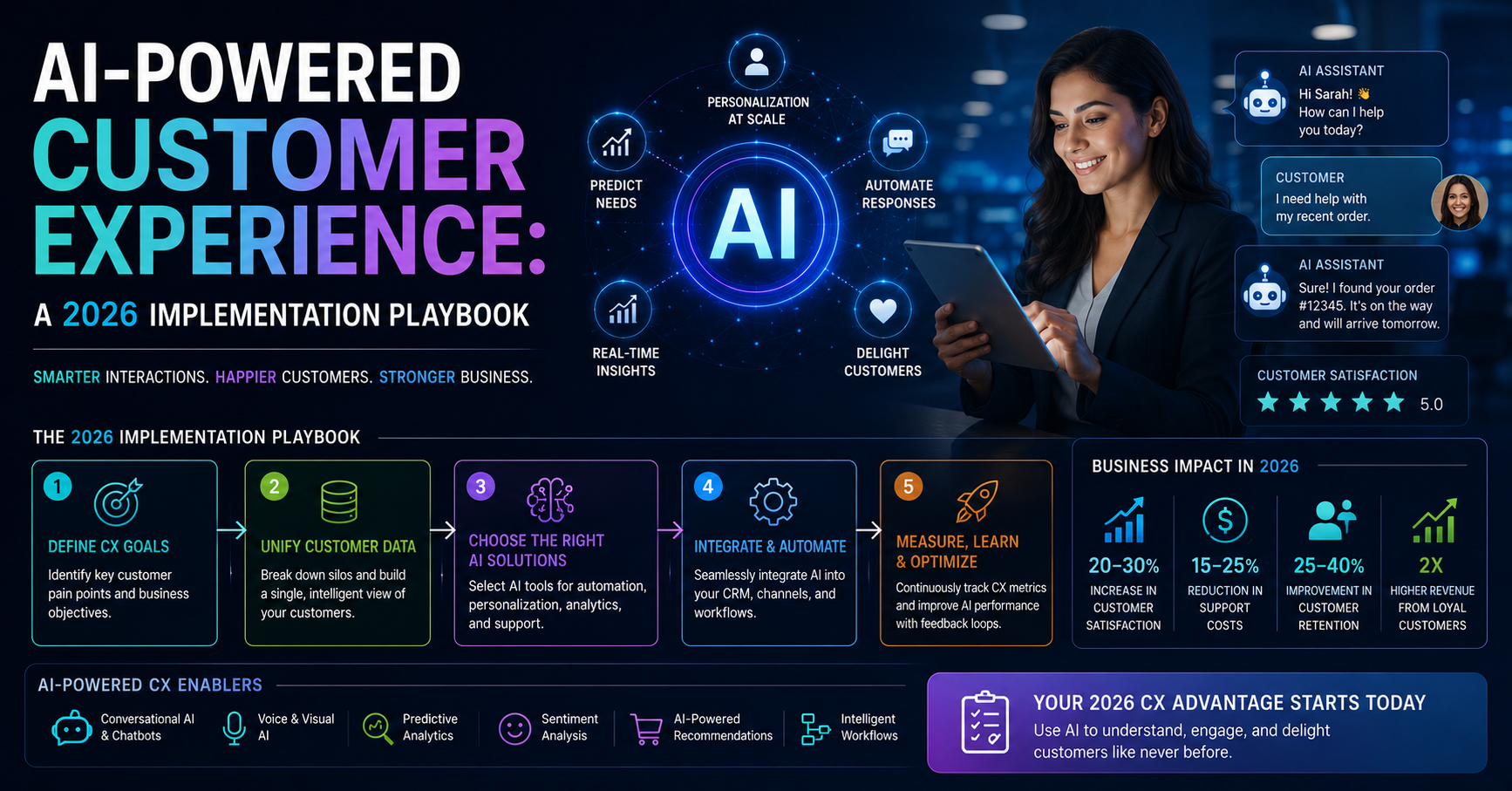
Summary. AI-powered customer experience moved past proof-of-concept in 2024 and past pilot in 2025. In 2026 it is operating at scale: 75% of customers now prefer AI chatbots for routine interactions, the per-interaction cost gap between human and AI service runs roughly 12x ($6 vs $0.50), and enterprises deploying AI in customer experience report average returns of $3.50 for every $1 invested, with some hitting 340% ROI in the first year. The global AI customer service market is on track to reach approximately $15.12 billion in 2026. This playbook walks through how to implement AI-powered CX in 2026 — what to build, in what order, and how to measure whether it is working.
The strategic question is no longer whether to deploy AI in customer experience but how to sequence the build so the early wins fund the later phases. Get the sequence right and the program self-finances inside 12 months. Get it wrong and the program stalls at proof-of-concept while competitors compound their CX advantage.
This guide is built for CMOs, Heads of CX, support directors and product leaders running customer-facing operations. The research base comes from Gartner, McKinsey, eCorpIT's own coverage and a cross-section of 2026 industry surveys. The implementation patterns come from CX deployments across India, the US and the UK.
The state of AI customer experience in 2026
A few numbers ground the rest of the article.
Customer preference. Roughly 75% of customers now prefer AI chatbots for routine interactions — for scalability, immediate response and the ability to understand and adapt to the customer's context. This is a complete reversal from 2022, when "speak to a human" was the most common request after any chatbot interaction.
Economics. Human-handled support interactions cost roughly $6 each. AI chatbot interactions cost roughly $0.50 — a 12x difference. Gartner projects $80 billion in global contact-centre labour savings by 2026.
ROI evidence. Companies report average returns of $3.50 for every $1 invested in AI customer service. Some organisations achieve 340% ROI in the first year. The aggregate cost reduction in customer support across deployed AI typically runs 30-40%, with response-time improvements of 37% being typical.
Market size. The global AI customer service market is projected at approximately $15.12 billion in 2026 — a meaningful enterprise software category in its own right.
What is interesting in 2026 is not the headline AI chatbot — that is widely deployed. It is what comes after the chatbot: personalisation, predictive support, voice AI, omnichannel orchestration and the agentic workflows that connect them all.
The five capabilities of AI-powered CX in 2026
A complete AI-powered CX stack in 2026 has five distinguishable capabilities. Most enterprises ship them in phases.
1. Conversational AI (chatbots and copilots)
The foundation. A conversational interface that handles routine enquiries autonomously, escalates to humans with full context, and uses memory of prior interactions to reduce repetitive effort. In 2026 the meaningful distinction is between chatbots that retrieve over your real knowledge base (good) and chatbots that hallucinate from a base model with no grounding (poor).
Deployment timeline. A basic FAQ-style chatbot deploys in 2-4 weeks. A production-grade chatbot with CRM integration, multilingual support, sentiment analysis and intelligent routing typically takes 8-12 weeks.
What good looks like in 2026. RAG over your help centre, product documentation and order/account systems. Sentiment detection that routes frustrated customers immediately to senior agents. Memory of prior conversations across sessions. Multilingual support for at least your top three customer languages. Clear escalation paths that hand off the full conversation context to a human agent — not a "let me transfer you" cold start.
2. Personalisation engines
AI that understands each customer's behaviour, purchase history and preferences, then tailors the experience accordingly — product recommendations, content surfacing, email subject lines, in-app messaging, price testing and offer targeting.
Deployment timeline. A basic personalisation engine deploys in 4-8 weeks. A production-grade engine integrated with marketing automation, ecommerce, customer data platform and analytics typically takes 12-20 weeks.
What good looks like in 2026. Real-time personalisation across channels — the website, the mobile app, the email program, the in-store kiosk and the support interaction all reflect the same customer understanding. A/B testing infrastructure is in place to validate that personalisation produces measurable lift, not just personalised-feeling content. Privacy and consent are integrated end-to-end (GDPR, India's DPDP, US sectoral regulations).
3. Predictive support
AI that anticipates customer issues before they become support tickets. Predictive churn models flag at-risk accounts for proactive outreach. Predictive failure models on connected products trigger replacement orders before the customer notices a problem. Predictive entitlement models surface warranty and support eligibility at the right moment.
Deployment timeline. Predictive support requires more data engineering than other capabilities. First production models typically deploy in 16-24 weeks. The work is heavier on data plumbing than on model selection.
What good looks like in 2026. Models are integrated with operational systems so the prediction triggers an action automatically — not a dashboard somebody has to look at. The CFO sees the avoided cost of prevented churn or prevented support contacts. Customer satisfaction surveys distinguish proactive outreach (high satisfaction) from reactive support (lower satisfaction) and the data informs investment.
4. Voice AI
AI-driven voice interfaces handle inbound calls, outbound calls and in-IVR routing. 2026 voice AI is meaningfully better than 2024 voice AI on three dimensions: latency (near-real-time response), natural prosody (conversation that does not sound like a robot), and turn-taking (the AI knows when to pause and when to continue).
Deployment timeline. A basic voice AI in IVR deploys in 6-12 weeks. A production-grade voice AI handling end-to-end conversations typically takes 16-28 weeks because the integration surface (telephony, CRM, knowledge base, fulfilment systems) is large.
What good looks like in 2026. The voice AI handles routine calls autonomously, transfers to humans with conversation summary and customer context already in front of the agent, and uses sentiment to route appropriately. Quality monitoring runs on every call — both AI calls and human calls — and the AI itself drafts call summaries for the CRM.
High-performance agent infrastructure. Implementing production-grade voice AI requires platforms that can manage complex telephony integrations while maintaining the natural prosody and low-latency responses that customers expect in 2026. Parloa provides the infrastructure to build these AI agents at scale, ensuring they remain grounded in enterprise data and compliant with security standards like SOC 2 and ISO 27001. By automating high-volume routine calls and providing seamless human handoffs, such platforms reduce staff phone time and allow CX teams to focus on higher-value customer interactions while driving long-term customer loyalty.
5. Omnichannel orchestration
The capability that ties the first four together. AI that knows what happened to a customer across web, mobile, email, voice, social, in-store and chat — and orchestrates the next interaction accordingly.
Deployment timeline. Omnichannel orchestration is rarely a separate project — it emerges as the other four capabilities integrate around a customer data platform (CDP). The data engineering work to build the CDP typically takes 16-32 weeks depending on the messiness of source systems.
What good looks like in 2026. A customer who started a return request on the website and called the contact centre five minutes later finds the agent already aware of the return request, the order details and the customer's history. The customer does not repeat themselves. The agent does not re-discover context. The interaction is short and the customer ends it pleased.
The implementation sequence that works in 2026
Across CX deployments observed in 2025-26, one sequence consistently outperforms others.
Phase 1 (Weeks 1-12): Conversational AI as the foundation. Ship the chatbot first. The economics are clear, the data engineering is contained, and the early ROI funds the rest of the program. Aim for 30-50% containment rate (the share of enquiries fully handled without human escalation) by week 12.
Phase 2 (Weeks 13-24): Real-time agent assist. With the chatbot operating, deploy AI tools that help human agents — knowledge surfacing, suggested responses, automatic call summaries. This produces measurable handle-time reduction without requiring deep system integration. Average handle time should drop 15-25% within six weeks of rollout.
Phase 3 (Weeks 25-40): Personalisation engine. With the conversational layer mature, start the personalisation work. Begin with recommendation systems on the highest-traffic surfaces (product page, home page, email program), then expand. Measure incremental revenue per visitor.
Phase 4 (Weeks 41-60): Predictive support. With the conversational and personalisation layers operating, predictive support layers on top. Churn models, proactive outreach and entitlement surfacing all benefit from the data already flowing.
Phase 5 (Weeks 61-80): Voice AI and omnichannel orchestration. The most complex capabilities ship last. By the time you reach this phase, the data infrastructure, the integration patterns and the governance discipline are mature enough to support the complexity.
This sequence works because each phase produces measurable value before the next begins, the data and engineering capability compound across phases, and the team learns governance discipline progressively rather than facing it all at once.
The measurement framework the CFO will accept
Five metrics distinguish CX programs that get continued funding from those that get cut.
Containment rate. The percentage of customer enquiries fully resolved by AI without human escalation. Strong programs run 40-60%. Weak programs run below 25%.
Cost per interaction. Total cost (AI infrastructure, governance, human escalations, training) divided by total interactions. Track the trend, not the absolute number. Healthy programs see this falling 5-10% quarter over quarter for the first 18 months.
Customer satisfaction. Net Promoter Score, CSAT or customer effort score — measured separately on AI-handled, AI-assisted and human-only interactions. Goal: AI-handled and human-handled interactions should produce comparable satisfaction.
Containment quality. Of contained enquiries, what share lead to a follow-up contact within seven days? Strong programs run under 10%. Weak programs run over 30% and indicate the AI is "containing" without actually resolving.
Revenue impact. Personalisation, proactive outreach and reduced friction produce measurable revenue effects. Define the experiment, measure the result, attribute to the AI program. Healthy programs see double-digit lift in revenue per customer over 12-24 months.
If the program does not move these five numbers, the CFO will rightly question continued investment. If it moves all five, the CFO will fund the next phase.
Governance and risk management
AI in customer experience touches more customer data, more regulated workflows and more brand exposure than almost any other AI deployment. Three governance items distinguish mature programs.
Brand-voice guardrails. The AI's outputs are reviewed for tone, accuracy and brand alignment — both at deployment and continuously through sampling. A drift detection system flags when the AI's outputs start sounding different from the brand standard, which happens regularly as models update or fine-tuning data shifts.
Data privacy and consent. Customer interaction data flows through the AI in real time. Every flow needs a documented lawful basis (GDPR, India's DPDP, US state laws) and a clear consent path. Personalisation specifically requires care — what was personalisation in 2022 can be surveillance in 2026 if the data lineage is not transparent.
Escalation discipline. Customers in distress, customers with sensitive issues (health, finance, vulnerability), and customers asking for human contact get escalated to humans immediately. AI-only handling of these cases is a brand and reputational risk that is not worth the cost saving.
Common implementation failures
Five failure modes show up repeatedly in 2024-26 deployments.
Generic chatbot, no retrieval. A chatbot deployed without grounding over the actual knowledge base hallucinates plausible-sounding wrong answers. Customers churn faster than they did before.
No escalation handoff. The chatbot escalates by saying "let me transfer you" and dumps the customer into a queue with no context. The agent picks up cold and the customer repeats everything. AI made the experience worse, not better.
Vanity metrics. "Tickets handled by AI" is a vanity metric. "Net cost reduction" and "CSAT on AI-handled interactions" are the metrics that matter. Programs reporting only volume metrics usually do not survive their second budget review.
Personalisation without consent. A personalisation engine that uses data beyond what the customer consented to creates regulatory liability and brand damage when revealed. The 2026 lesson is that consent infrastructure has to be built before the personalisation engine, not after.
Voice AI deployed too early. Voice AI is the most complex CX capability. Enterprises that deploy it before the conversational and data layers are mature struggle to integrate it, and the customer experience suffers.
India-specific considerations
Three notes for Indian enterprises building AI-powered CX in 2026.
Multilingual quality matters. Indian customer service spans Hindi, English, Tamil, Telugu, Bengali, Marathi, Kannada, Malayalam, Gujarati, Punjabi and many more. AI models that handle one or two languages well and others poorly produce uneven CX. Test multilingual quality explicitly and choose models accordingly.
DPDP shapes data flow. Personal data processing under India's DPDP requires consent, purpose specification and data minimisation. Personalisation, predictive support and voice AI all need DPDP-aligned consent and data handling from day one.
Cost economics are favourable. Indian implementation cost for AI-powered CX runs meaningfully lower than US or UK equivalents because of engineering talent costs. Indian enterprises can afford to build deeper integration and more sophisticated personalisation than the comparable US or UK case would justify.
FAQ
How eCorpIT can help
eCorpIT builds AI-powered customer experience systems for clients across India, the US and the UK. Our work covers conversational AI, personalisation engines, predictive support, voice AI and omnichannel orchestration — across financial services, healthcare, retail, education and B2B SaaS.
If you are planning an AI CX program in 2026 — or moving from chatbot to agentic CX — our team can help. Reach us at ecorpit.com/contact-us/ or contact@ecorpit.com.
References
- eCorpIT — "AI Chatbots for Customer Service: Real Cost Savings in 2026": ecorpit.com
- Dante AI — "AI Customer Service Statistics 2026: 47 Data Points": dante-ai.com
- Bayelsa Watch — "AI Customer Service Statistics by Market Size and Trends (2026)": bayelsawatch.com
- The CX Lead — "10 AI Customer Experience Personalization Tools in 2026": thecxlead.com
- Gleap — "AI Chatbot Experiences in Customer Support: Trends for 2026": gleap.io
- Brainx Tech — "Revamping Customer Experiences With AI Chatbots in 2026": brainxtech.com
- Gartner — Strategic Predictions for 2026: gartner.com
- McKinsey — "The state of AI in 2025": mckinsey.com
- eCorpIT — "How AI Is Transforming Business Operations in 2026": ecorpit.com
- eCorpIT — "Generative AI Enterprise Strategy 2026": ecorpit.com
Last updated 8 June 2026 by the eCorpIT Editorial team.