On this page · 11 sections
- What Apple shipped, and when
- Agent versus assistant: the distinction that decides everything
- How to set up each agent
- What each agent actually costs to run
- Which agent for which iOS job
- Privacy, source code and on-device models
- India-specific considerations
- Limits and gotchas worth knowing
- FAQ
- How eCorpIT can help
- References
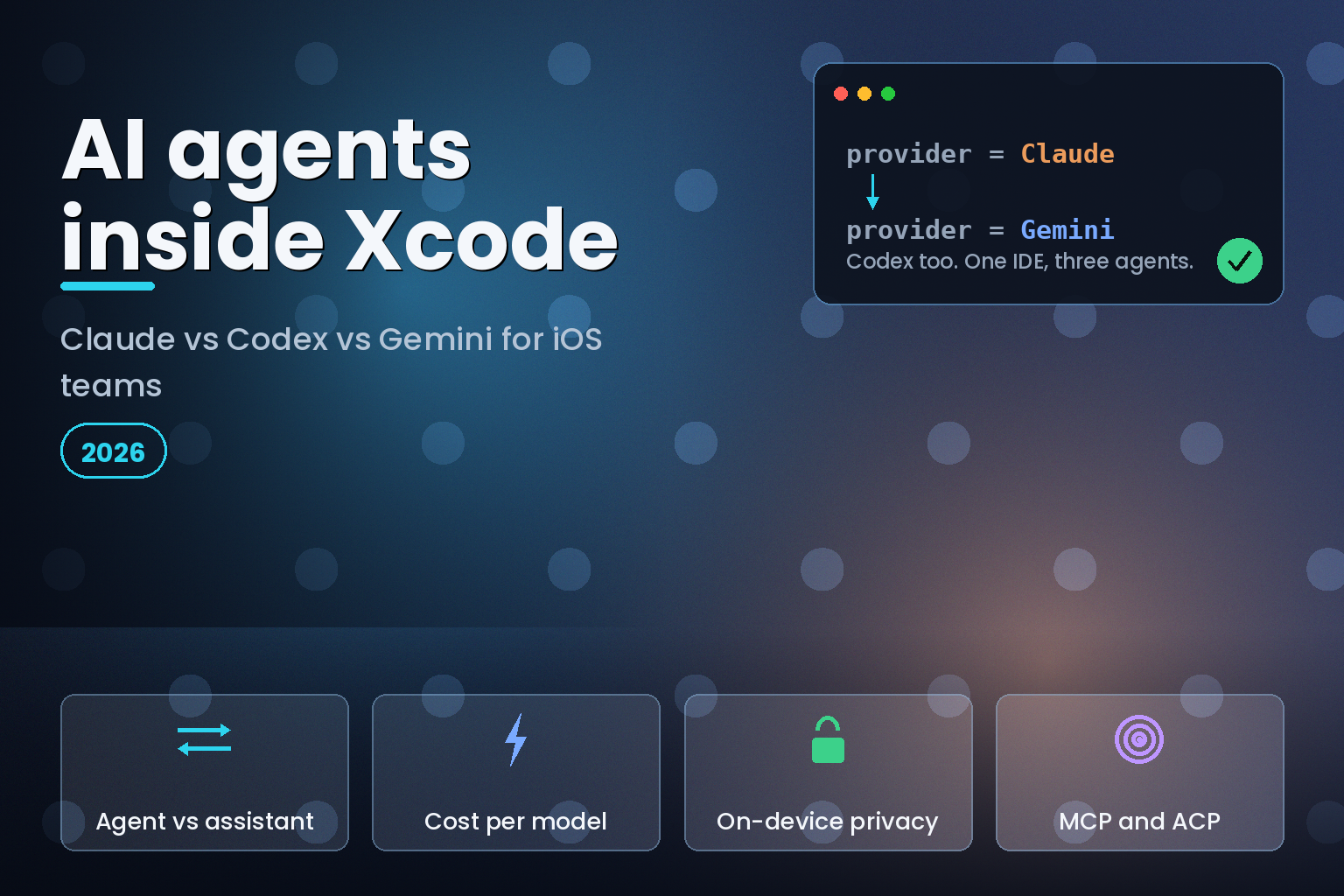
Summary. Apple shipped agentic coding in Xcode 26.3 on 3 February 2026 with two preconfigured agents, Anthropic's Claude Agent and OpenAI's Codex, and added Google Gemini as a third provider in Xcode 26.6 on 25 June 2026. Only the three preconfigured providers get full agent behaviour inside the IDE; any model you add by hand runs as a plain assistant unless it speaks the Agent Client Protocol. Cost is the deciding factor for most teams: as of July 2026 Claude Sonnet 5 runs at $2 per million input and $10 per million output tokens on introductory pricing through 31 August 2026, GPT-5.6 Terra behind Codex is $2.50 and $15, and Gemini 3.1 Pro is $2 and $12. This guide compares the three agents on setup, agent-versus-assistant behaviour, privacy and real running cost so an iOS team can pick one without a week of trial and error.
Agentic coding is the biggest change to the iOS toolchain since SwiftUI. Instead of typing a prompt and pasting back a snippet, you hand the agent a goal and it works across your project: it reads files, edits Swift, changes build settings, runs the build, reads the errors and tries again. Apple built this on the same open standard, the Model Context Protocol, that powers agent tools elsewhere, so the mechanics are familiar if you have used a coding agent in a terminal. What is new is that the agent now sees your real Xcode project, your Previews and your build results, not a copy pasted into a chat window.
That access is exactly why the choice of agent matters. The wrong pick costs you money on every run, leaks proprietary Swift to a cloud you did not vet, or quietly drops to assistant-only completions when you thought you were driving an agent. This article is the decision guide we give iOS teams: what each agent does, how to set it up, what it costs, and which one fits which job.
What Apple shipped, and when
Xcode 26.3 arrived on 3 February 2026 and introduced agentic coding with two agents configured out of the box, according to Apple's own announcement: Claude Agent from Anthropic and Codex from OpenAI. Susan Prescott, Apple's vice president of Worldwide Developer Relations, said in that announcement that "our goal is to make tools that put industry-leading technologies directly in developers' hands so they can build the very best apps." The release let an agent break a task into steps, search documentation, explore the file structure, update project settings, and verify its work by capturing Xcode Previews and iterating through builds and fixes, as 9to5Mac reported.
The important design detail, confirmed by MacRumors and Help Net Security, is that Apple worked directly with Anthropic and OpenAI to wire their agents into the full range of Xcode features, and that Xcode is compatible with any agent that speaks the Model Context Protocol. Preconfigured does not mean locked, but it does mean the two launch agents behave differently from anything you bolt on yourself.
Four months later, Xcode 26.6 shipped on 25 June 2026 and widened the roster. Google Gemini joined as a third provider, and Apple added support for the Agent Client Protocol so other tools can integrate through a standard interface rather than being second-class citizens. AppleMagazine and iClarified both note that Gemini arrived as a coding-assistant provider, which is the distinction that trips up most teams and the one worth getting straight before you commit.
Apple's Xcode 27 beta, shown at the June 2026 WWDC, extends all of this further; our guide to Xcode 27 and Swift 6.4 developer features covers what is changing in the next major release. This comparison stays on the shipping tools, Xcode 26.3 and 26.6, because that is what your team can install today.
Agent versus assistant: the distinction that decides everything
The single most useful thing to understand about coding intelligence in Xcode is that "provider" and "agent" are not the same word. A provider supplies a model. An agent uses that model to act on your project. Xcode gives full agent behaviour only to the providers Apple preconfigured, and Codex and Claude Agent both require a paid account to use.
Add a model by hand, whether a cloud endpoint or a local server, and you get assistant-level help: inline completions and chat about code, but not the autonomous loop that reads your files, edits them, changes build settings and re-runs the build. Community write-ups from developers who tried it, including a Medium walkthrough of local models in Xcode, found that manually added providers do not carry the same agentic support even when the underlying model can operate agentically elsewhere. The Agent Client Protocol added in 26.6 is Apple's answer: a provider that implements it can, in principle, plug in with fuller behaviour, which is how tools like the Gemini command-line integration reach into the IDE.
For an iOS team the practical rule is short. If you want the agent to actually build and fix your app, use one of the three preconfigured providers. If you only want completions and chat, or you must keep code on a local machine, a manually added or locally hosted model is fine, but do not expect it to drive the project on its own.
| Provider in Xcode | Behaviour in the IDE | Account needed | Best for |
|---|---|---|---|
| Claude Agent (Anthropic) | Full agent: edits files, changes build settings, runs and fixes builds | Paid Claude subscription or API key | Multi-file refactors and long agentic tasks |
| Codex (OpenAI) | Full agent, tuned with Apple for Xcode features | Paid ChatGPT plan or API key | Everyday feature work and test generation |
| Gemini (Google) | Preconfigured provider added in 26.6; assistant-forward, agent access via ACP | Google account or API key | Chat, explanations, cost-sensitive completions |
| Manually added cloud model | Assistant only: completions and chat, no autonomous loop | Any Chat Completions endpoint | Using a model Apple has not preconfigured |
| Locally hosted model (LM Studio) | Assistant only, runs on-device on Apple silicon | Free, local | Keeping proprietary Swift off the cloud |
How to set up each agent
Setup lives in one place: Xcode's settings, under Intelligence. From there you sign in to a preconfigured provider or add a model provider of your own.
For Claude, the fastest route to full agent behaviour is a paid Claude account signed in directly. If you would rather pay per token through the API, Simon B. Støvring's setup notes describe the path: generate a key at the Anthropic console, then in Xcode choose Intelligence, add a model provider, enter the URL https://api.anthropic.com/, paste the key, and set the API key header to x-api-key. A restart is sometimes needed before the provider appears. Note that a hand-added Anthropic endpoint gives assistant behaviour; the signed-in Claude Agent is what unlocks the full loop.
Codex is the other preconfigured agent. Sign in with a ChatGPT plan that includes Codex, or supply an OpenAI API key, and it is ready. Because Apple tuned Codex jointly with OpenAI for Xcode, it tends to need the least configuration to reach agent behaviour.
Gemini arrived in 26.6 as a provider you select and authenticate with a Google account or key. For fuller agent behaviour outside the preconfigured path, the Agent Client Protocol and the Gemini command-line tool are the supported bridge.
Local models use the same "add a model provider" flow with the Locally Hosted option. Start an LM Studio server that exposes the Chat Completions API on your Mac, point Xcode at the port, and your on-device model shows up. This keeps every token on your machine, at the cost of the autonomous agent loop.
What each agent actually costs to run
Running an agent is not free, and the bill scales with how much your team leans on it. Agentic tasks are token-hungry because the agent reads files, thinks, edits, builds and repeats, so output tokens dominate. The table below lists indicative public API prices as of July 2026; if you use a bundled subscription instead of the API, your effective cost differs, but the API rate is the honest yardstick for heavy use.
| Model behind the agent | Input per 1M tokens | Output per 1M tokens | Notes (as of July 2026) |
|---|---|---|---|
| Claude Sonnet 5 | $2.00 | $10.00 | Introductory rate through 31 Aug 2026, then $3/$15 |
| Claude Opus 5 | $5.00 | higher tier | Top-ranked on Artificial Analysis in July 2026 |
| GPT-5.6 Terra (Codex) | $2.50 | $15.00 | Luna variant is cheaper at $1/$6 |
| Gemini 3.1 Pro | $2.00 | $12.00 | Gemini 3 Flash is $0.50/$3 for lighter work |
| Local model (LM Studio) | $0 | $0 | Hardware and electricity only; assistant behaviour |
The figures for Claude Sonnet 5's introductory pricing and the wider July 2026 API table come from public pricing trackers, so treat them as directional and confirm against each vendor's own page before you budget. Two points matter more than the exact cents. First, output pricing is where agentic work gets expensive, and all three cloud options charge $10 to $15 per million output tokens, so a chatty agent on a large codebase adds up fast. Second, Claude Sonnet 5's promotional rate reverts on 31 August 2026, which is a real date to plan around if you standardise on it now.
On raw capability, Anthropic's Opus 5 was the top-ranked model overall on Artificial Analysis's rebased v4.1 leaderboard on 25 July 2026, leading both the Intelligence Index at 61 and the Agentic Index at 55.3. That does not automatically make it the right agent for every Xcode task, because most feature work does not need the most expensive model, but it explains why teams reach for Claude on the hardest refactors.
Which agent for which iOS job
The honest answer is that all three preconfigured agents can build an iOS feature. The differences show up at the edges, and a small team is usually better off standardising on one and knowing it well than switching per task.
Reach for Codex when you want the least friction for everyday feature work, test generation and small refactors. Apple tuned it with OpenAI for Xcode, so it tends to stay inside the IDE's grain. Reach for Claude Agent on long, multi-file changes: renaming a concept across a large module, untangling a view hierarchy, or a migration where the agent needs to hold a lot of context and keep iterating through build failures. Use Gemini when cost or explanation matters more than autonomous editing, for example onboarding a junior engineer who needs the code explained, or high-volume completions where the cheaper Flash tier is enough.
If your constraint is that source code cannot leave the machine, a locally hosted model on Apple silicon is the only option that keeps every token on-device, and you accept assistant-level help in exchange. For a deeper look at that trade, our guide to on-device versus cloud AI in mobile apps walks through where local models are and are not worth it.
Whichever you pick, treat the agent like a junior engineer with commit access. Our write-up on sandboxing AI coding agents with VM isolation explains why an agent that can change build settings and run scripts deserves the same guardrails you would put around any process with that power, and how the terminal-based CLI coding agent harnesses approach the same problem outside the IDE.
Privacy, source code and on-device models
Every cloud agent sends parts of your codebase to a third-party model to do its job. For a side project that is a non-issue. For a fintech app under contractual confidentiality, or health software handling patient data, it is a decision that belongs to your security team, not a default you accept by clicking "sign in."
Three questions decide it. What code does the agent transmit, and can you scope it to a target rather than the whole workspace? Does the provider train on your inputs, and can you turn that off on the plan you are on? And where is the data processed, which matters the moment your contracts or your regulator care about residency. A locally hosted model answers all three by never leaving the Mac, which is why regulated teams keep one in the mix even though it cannot run the full agent loop.
India-specific considerations
For an Indian product team the cost picture is the same dollar API rate, but the budgeting is sharper because engineering salaries are lower, so the agent's monthly bill is a larger share of a developer's fully loaded cost. A heavy agentic user can add tens of thousands of rupees a month in output tokens alone, so the difference between a $10 and a $15 output rate is not rounding. Standardising on one agent and one tier, and using the cheaper Gemini Flash or Claude Sonnet tier for routine work, keeps that predictable.
Source-code residency is the other India-specific point. Under the Digital Personal Data Protection Act 2023, personal data your app handles carries obligations regardless of where your coding agent runs, but the code itself and any embedded secrets or sample data are a separate exposure. Teams building for regulated Indian sectors, or for clients with data-localisation clauses, should treat a cloud coding agent as a data processor and keep a locally hosted option for anything sensitive. eCorpIT designs applications aligned with DPDP Act requirements, and the same discipline applies to the tools that touch the source.
Limits and gotchas worth knowing
A few things surprise teams in the first week. Manually added providers are assistant-only, so if the agent will not edit files you have probably added a model by hand rather than signing in to a preconfigured one. The preconfigured agents need paid accounts, so "free" is not on the table for full agent behaviour unless you count a local model that cannot drive the project. The Agent Client Protocol in 26.6 is the supported way to bring other tools closer to agent behaviour, but it is newer and less proven than the built-in three. And because the agent can change build settings and run your project, review its diffs the way you would review a colleague's pull request, not the way you skim autocomplete.
None of this makes agentic coding a gimmick. It genuinely compresses the boring parts of iOS work, the migrations, the test scaffolding, the repetitive refactors. The teams getting value from it are the ones that picked one agent, learned its habits, and put the same review discipline around it that they use for any code that reaches main.
FAQ
How eCorpIT can help
eCorpIT is a Gurugram-based, senior-led iOS and cross-platform engineering organisation, founded in 2021 and certified for CMMI Level 5, MSME and ISO 27001:2022. We help iOS teams adopt agentic coding without the security and cost surprises: choosing the right agent for your codebase, setting up local models for confidential source, and putting review and sandboxing discipline around agents that can change build settings. If you are rolling out Claude, Codex or Gemini across an iOS team, or weighing a cloud agent against a locally hosted one for regulated work, contact us to scope it with engineers who ship production iOS apps.
References
- Apple Newsroom, "Xcode 26.3 unlocks the power of agentic coding," February 2026 — https://www.apple.com/newsroom/2026/02/xcode-26-point-3-unlocks-the-power-of-agentic-coding/
- 9to5Mac, "Apple releases Xcode 26.3 with support for agentic coding," February 2026 — https://9to5mac.com/2026/02/26/apple-releases-xcode-26-3-with-support-for-agentic-coding/
- MacRumors, "Apple Releases Xcode 26.3 With Support for AI Agents From Anthropic and OpenAI," February 2026 — https://www.macrumors.com/2026/02/26/apple-releases-xcode-26-3/
- Help Net Security, "Apple Xcode 26.3 adds coding agent support from OpenAI and Anthropic," February 2026 — https://www.helpnetsecurity.com/2026/02/04/apple-xcode-26-3-agentic-coding/
- 9to5Mac, "Apple adds Google Gemini coding assistant in Xcode 26.6 update," June 2026 — https://9to5mac.com/2026/06/25/apple-adds-google-gemini-coding-assistant-in-xcode-26-6-update/
- AppleMagazine, "Xcode 26.6 Adds Gemini to Apple's Coding Assistant," June 2026 — https://applemagazine.com/xcode-gemini/
- iClarified, "Apple Releases Xcode 26.6 With Google Gemini AI Coding Assistant," June 2026 — https://www.iclarified.com/101301/apple-releases-xcode-266-with-google-gemini-ai-coding-assistant
- Simon B. Støvring, "Using Claude with Coding Assistant in Xcode 26," 2026 — https://simonbs.dev/posts/using-claude-with-coding-assistant-in-xcode-26/
- Smart Cat (KAIRI), "Use Local Models with Claude Agent in Xcode 26.3," Medium, 2026 — https://medium.com/kairi-ai/use-local-models-with-claude-agent-in-xcode-26-3-cd21aaafb3b6
- SquaredTech, "Xcode 26.6 Adds Google Gemini as a New AI Coding Assistant," 2026 — https://www.squaredtech.co/xcode-266-adds-google-gemini-as-a-new-ai-coding-assistant
- Price Per Token, "Claude Sonnet 5 API Pricing 2026," July 2026 — https://pricepertoken.com/pricing-page/model/anthropic-claude-sonnet-5
- TLDL, "LLM API Pricing (July 2026)," July 2026 — https://www.tldl.io/resources/llm-api-pricing
- Artificial Analysis, "Claude Opus 5: the new leader in agentic knowledge work," July 2026 — https://artificialanalysis.ai/articles/claude-opus-5-leader-agentic-knowledge-work
_Last updated: 1 August 2026._