On this page · 13 sections
- What the cold start actually costs
- What container caching does
- The benchmark, in numbers
- Where it fits in SageMaker's scaling suite
- Container caching versus the alternatives
- The FinOps math
- How to turn it on
- India-specific considerations
- Security and isolation
- The bottom line
- FAQ
- How eCorpIT can help
- References
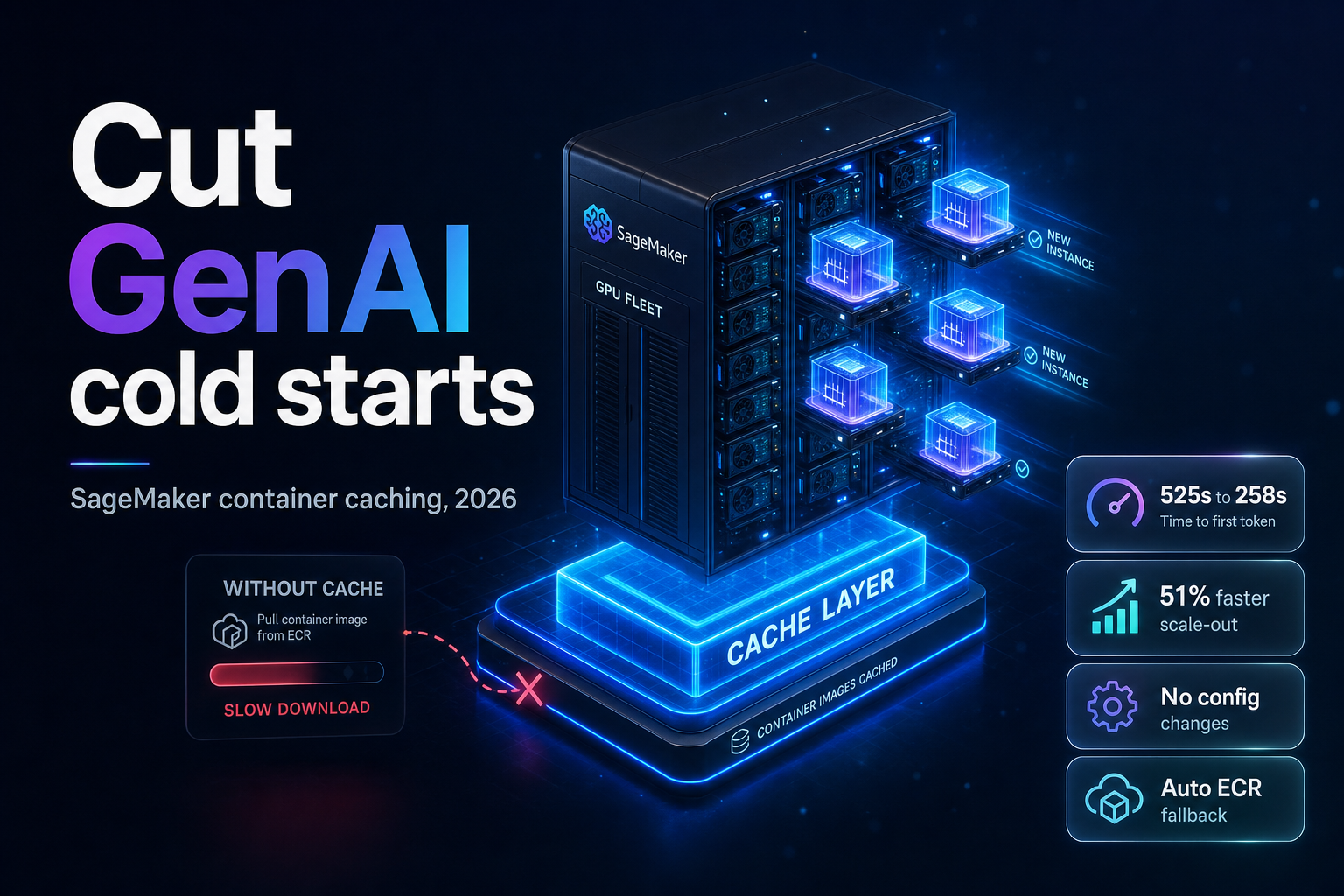
Summary. On 16 June 2026 AWS turned on container image caching for Amazon SageMaker AI inference, and in its own published test a generative AI endpoint's cold start dropped from 525 seconds to 258 seconds, about a 51 percent cut. The gain comes from removing one step: pulling a 10 GB-plus container image from Amazon ECR every time a new instance launches. Three early-access customers saw P50 scale-out times fall 38 to 65 percent. It activates automatically on supported accelerator instances, needs no config change, and falls back to a normal ECR pull if a cached image is missing. For teams that today keep GPU instances such as an ml.g5.2xlarge (around $1.52 per hour) idle just to hide slow scaling, that is real money. This guide covers how it works, the AWS benchmarks, how it compares to warm replicas and scale-to-zero, and how to set it up.
Cold starts are the quiet tax on generative AI inference. A large language model container built on vLLM or NVIDIA Triton is often 15 to 18 GB. When traffic spikes and SageMaker adds an instance, that instance has to pull the image from Amazon ECR, download model weights from Amazon S3, load the model into GPU memory, and pass health checks before it serves a single request. Independent write-ups in 2026 put a full GPU cold start at 10 to 14 minutes for some open models. Most teams paper over the delay by paying for idle capacity. Container caching attacks the largest single piece of that delay for new-instance scaling.
What the cold start actually costs
When a SageMaker endpoint scales out by launching a new instance, four things happen in sequence, though two of them overlap. The instance is provisioned. The container image is pulled from Amazon ECR. The model artifact is downloaded from Amazon S3. Then the inference server starts, loads the model, and answers health checks. AWS notes that the image pull and the model download run in parallel, so they compete for the same network bandwidth on a fresh instance.
The image pull is frequently the biggest contributor for generative AI, because the containers are large. SageMaker's own Large Model Inference container, powered by vLLM, and images built around NVIDIA Triton routinely exceed 10 GB. Every new instance downloads the full image before it can help with the traffic that triggered the scale-up.
Because that delay is measured in minutes, teams overprovision to hide it. The common pattern is to keep a minimum number of GPU replicas running so the first request always hits a warm pod, then let the autoscaler add capacity in the background. That works, but you pay for the idle GPU the whole time. Third-party 2026 figures for keeping one replica warm run to roughly $2 per hour for an NVIDIA T4, $8 for an A10G, and $32 for an A100. On SageMaker, an ml.g5.2xlarge lists at about $1.52 per hour. Multiply idle headroom across several models and several regions and the bill grows fast, which is why GPU spend keeps topping FinOps surveys. Our own view on that pattern is blunt: most GPU overspend is not the model, it is the idle capacity teams buy to hide slow scaling.
What container caching does
Container caching pre-pulls your container image so a newly launched instance starts with the image already present on local storage. The container image pull step, which used to add several minutes, becomes close to zero. As Dmitry Soldatkin, worldwide leader for specialist solutions architecture on SageMaker Inference at AWS, and his co-authors write in the launch post, container caching "removes the image pull from the scale-out path and eliminates network bandwidth contention."
That second half matters as much as the first. With the image already local, the model-weight download from Amazon S3 no longer fights the image pull for bandwidth, so it finishes faster too. You get two savings from one change: the eliminated pull, and a quicker model download.
You do not opt in and you do not modify anything. SageMaker automatically caches whatever image URI is set in your endpoint or inference component configuration. It works with single-model endpoints and inference component-based endpoints, with any image hosted in Amazon ECR including custom images, on supported accelerator instance types. If a cached image is not available for some reason, SageMaker falls back to pulling from Amazon ECR, so a scale-out is never blocked by the cache.
The benchmark, in numbers
AWS published a worked example: the Qwen3-8B model (16 GB of weights) on an ml.g6.2xlarge instance, using the Large Model Inference container that compresses to 17.7 GB. The table below is AWS's before-and-after for that single endpoint.
| Scaling step | Before caching | After caching |
|---|---|---|
| Container image pull from Amazon ECR | 333 seconds | 0 seconds (pre-cached) |
| Model artifact download from Amazon S3 | 168 seconds | 77 seconds |
| Bandwidth contention during launch | Image and model compete | Model download only |
| End-to-end startup latency | 525 seconds | 258 seconds |
| Net result | Baseline | About 51 percent faster |
Two things stand out. The image pull went to zero, as expected. Less obvious, the model download fell from 168 to 77 seconds purely because it stopped sharing bandwidth with the image pull. The end-to-end number, 525 down to 258 seconds, is the one to quote to your own stakeholders.
AWS also shared P50 results from three early-access customers. The magnitude of the win depends on the instance type, the image size, and the model size, so the range is wide.
| Instance and image / model size | P50 before to after | Improvement |
|---|---|---|
| ml.g4dn.xlarge, 15.7 GB image, 0 GB model | 381s to 134s | -65% |
| ml.g5.2xlarge, 17.5 GB image, 5.8 GB model | 346s to 164s | -52% |
| ml.g5.xlarge, 10.6 GB image, 6.5 GB model | 346s to 216s | -38% |
The customer with no separate model artifact, where the weights ship inside the image, saw the largest cut at 65 percent, which fits the mechanism: when the image is the whole payload, removing the pull removes almost everything.
Where it fits in SageMaker's scaling suite
Container caching is the third piece of a scaling optimization set AWS has built for generative AI inference. Each piece removes a different source of delay, and they stack.
| Optimization | What it removes | How to enable |
|---|---|---|
| Sub-minute metrics | Slow load detection, up to 6x faster | Set a ConcurrentRequestsPerModel or ConcurrentRequestsPerCopy target-tracking policy |
| Instance-store data cache | Image and model pull when reusing running instances | Automatic for inference component endpoints on supported accelerators |
| Container image cache | Image pull when launching new instances | Automatic for any endpoint on supported accelerator instances |
The two caches cover different scaling paths. When SageMaker can place a new model copy on an instance that is already running, the instance-store data cache removes the image and model download. When SageMaker has to launch a fresh instance, the new container image cache removes the image pull. Sub-minute CloudWatch metrics sit in front of both, detecting the need to scale up to 6 times faster than standard one-minute metrics so the decision itself does not cost you a minute. If you serve GenAI on SageMaker and you have not moved to the concurrency-based target-tracking policy, that is the one change here you actually have to make by hand.
Container caching versus the alternatives
If you have solved cold starts before, you have used one of a few playbooks. Here is how container caching changes the trade-off. This is the decision table.
| Approach | Cold-start latency | Idle GPU cost |
|---|---|---|
| Scale to zero on Kubernetes (KEDA or Knative) | Full cold start, reported at 10 to 14 minutes | Lowest, nothing runs at idle |
| Keep one warm replica | Near zero for the first request | Continuous, roughly $32 per hour for an A100 |
| Overprovision spare headroom | Hidden by extra capacity | Highest |
| SageMaker container caching | About 51 percent lower new-instance scale-out | Pay only while scaling, no permanent warm pool needed |
Container caching does not make the other tools pointless. If you run your own serving stack on Kubernetes, patterns such as pre-pulled image caches, NVMe weight loading, KEDA for metric-driven scaling, and Knative for scale-to-zero remain the way to attack cold starts yourself, and we cover the state side of that in our note on Kubernetes patterns for stateful AI agents. What container caching changes is the SageMaker-managed path: you get a large chunk of the warm-replica benefit without paying to keep a replica warm around the clock. For a fleet that scales up and down through the day, that is the cheaper shape.
There is a caveat worth stating plainly. Container caching speeds up the new-instance path, but it does not remove model loading into GPU memory or health checks, and it does nothing for the detection lag unless you also adopt sub-minute metrics. It shrinks the biggest slice, not the whole pie.
The FinOps math
The reason this is a budget story, not just a latency story, is what it lets you stop paying for. If your only defence against a 500-second cold start was a permanent warm pool, you were buying GPU hours to sit idle. Cut new-instance scale-out roughly in half and, for many traffic shapes, you can shrink or drop that idle headroom and let SageMaker scale on demand.
The numbers make it concrete. An ml.g5.2xlarge on SageMaker lists at about $1.52 per hour. One instance kept warm all month is roughly 730 hours, near $1,100, and larger A100-class capacity kept warm runs closer to $32 per hour, or well over $20,000 a month per instance. Trimming even one always-on instance per model, across a handful of models, is the kind of line item that shows up in a quarterly review. For Indian teams watching cloud spend in rupees, the same logic holds: idle GPU is the most expensive way to buy latency insurance. We go deeper on this in our guides to why GPU spend tops FinOps concern lists and cloud cost moves for Indian teams on AWS, Azure and GCP.
One honest limit: the savings only appear if your traffic actually varies. A steady, always-busy endpoint keeps its instances hot anyway and rarely triggers the scale-out that caching accelerates. This is a win for spiky, bursty, and daily-cycle workloads, not for flat ones.
How to turn it on
There is almost nothing to configure, which is the point.
- Deploy your generative AI workload to a SageMaker AI inference endpoint on a supported accelerator instance type. Container caching activates automatically. There is no flag, and no change to your container.
- Confirm your instance type and Region are supported. The feature is available in all commercial AWS Regions where SageMaker AI inference runs, but the exact accelerator instance list is in the SageMaker documentation, so check it against the family you use.
- Adopt sub-minute metrics if you have not. Configure a ConcurrentRequestsPerModel or ConcurrentRequestsPerCopy target-tracking scaling policy so detection is not your bottleneck once the image pull is gone.
- Re-measure and re-tune your minimums. This is the step teams skip. If you previously kept two or three instances warm to hide cold starts, test whether you can drop to one or to zero-plus-caching now that scale-out is faster. The saving is in the minimum you can safely remove.
- Watch the fallback. If a cached image is unavailable, SageMaker pulls from ECR as before, so an occasional slow scale-out is expected rather than a fault.
A few gotchas. Container caching only helps the container image pull; if most of your startup time is model-weight loading into GPU memory, your gain will be smaller than AWS's headline example. Very small images benefit less in absolute terms. And because caching is per endpoint, a brand-new endpoint's first scale-out may still pull from ECR while the cache warms.
India-specific considerations
For teams building in India, two points matter. First, Region support: container caching runs in all commercial AWS Regions where SageMaker AI inference is available, which includes the Asia Pacific (Mumbai) Region, so latency-sensitive Indian workloads can keep inference in-country and still get the faster scaling. Second, data handling. Model artifacts live in your Amazon S3 buckets and the image cache is dedicated to your endpoint, not shared across accounts, so keeping weights and endpoints in an Indian Region is compatible with a data-residency posture under the Digital Personal Data Protection Act, 2023. Container caching does not change where your data sits; it changes how fast new instances start. Design your Region and bucket placement for residency first, then let caching do its work inside that boundary.
Security and isolation
AWS states that container caching keeps the same tenant isolation SageMaker already provides. Each cache is dedicated to a single customer endpoint and is not shared across AWS accounts or endpoints, and when you delete an endpoint its image cache is automatically purged. That means the feature does not widen your attack surface or create a shared artifact you have to reason about separately. It is the same image you already trust in Amazon ECR, cached closer to the instance.
The bottom line
Container caching is a rare kind of cloud feature: it is on by default, costs nothing extra, and removes real latency without asking you to re-architect. AWS's own test shows a 51 percent cut in new-instance scale-out, from 525 to 258 seconds, and early customers saw 38 to 65 percent. The work on your side is not enablement, it is the follow-through: move to concurrency-based metrics, then re-test how low you can set your warm minimums. The latency win is free. The budget win is only real if you act on it and stop paying for idle GPUs you no longer need.
FAQ
How eCorpIT can help
eCorpIT is a senior-led technology consultancy in Gurugram, founded in 2021, that builds and runs AI and cloud infrastructure for teams on AWS. We help you measure real scale-out latency, adopt SageMaker's concurrency-based autoscaling, and safely lower the warm minimums you no longer need once container caching is in place, so you cut GPU spend without missing SLAs. As an AWS partner and a CMMI Level 5, MSME-certified organisation, we design deployments aligned with your data-residency requirements. To review your inference cost and scaling setup, contact our team.
References
_Last updated: 27 July 2026._