On this page · 10 sections
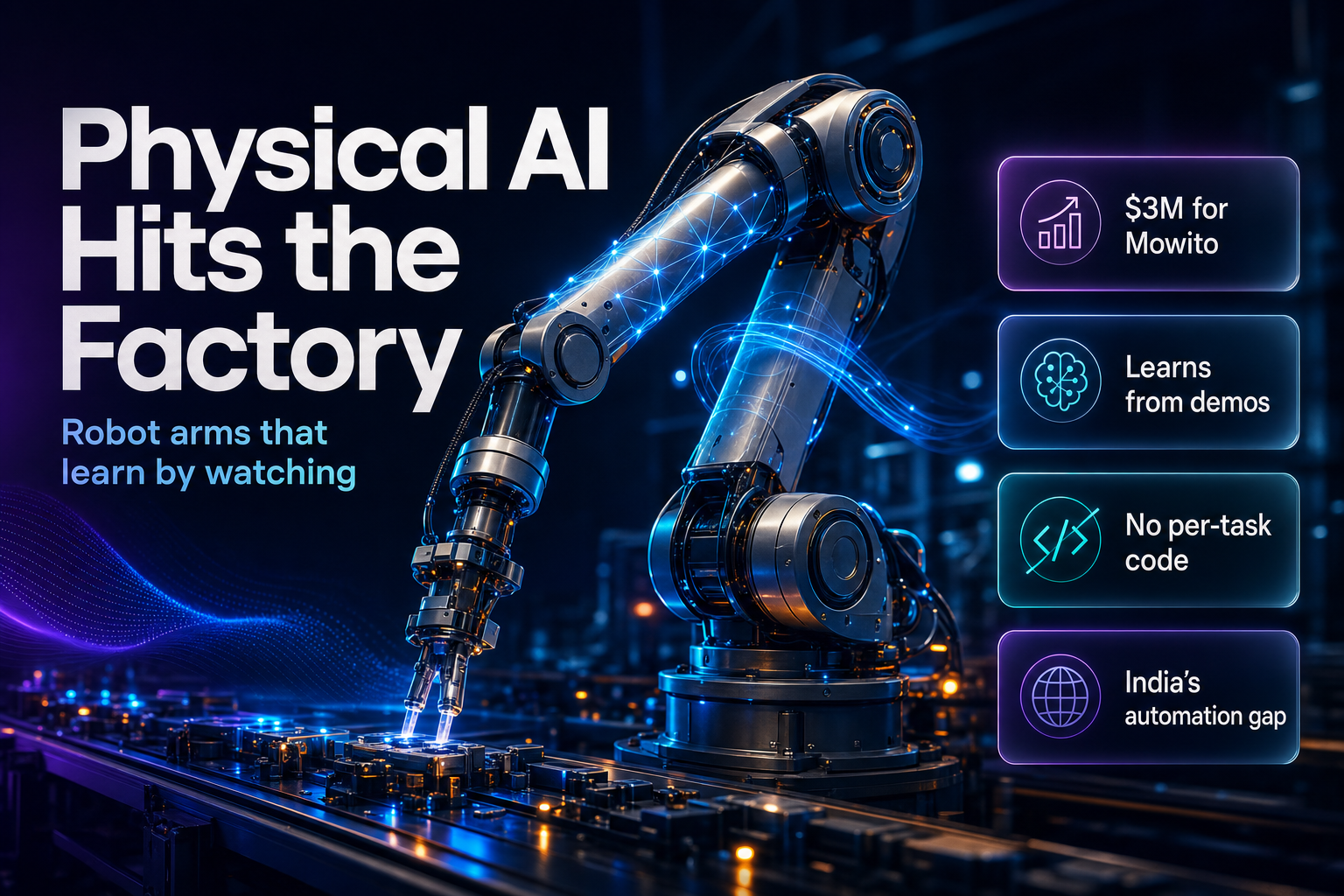
Summary. Bengaluru robotics startup Mowito raised $3 million in a pre-seed round led by Version One Ventures on July 7, 2026, to scale foundation models that let industrial robot arms learn tasks by watching demonstrations instead of being hand-coded. The round drew angels including Soumith Chintala, creator of PyTorch. This lands against a stark local backdrop: India's robot density sits near the bottom among major Asian economies, roughly 67 robots per 10,000 manufacturing workers by one estimate, against 415 in South Korea, even as the India robotics market grows about 34% a year toward $480 million in 2026. At the frontier, NVIDIA unveiled Cosmos 3, a world foundation model trained on 20 trillion tokens of multimodal data, with partners such as Skild AI, ABB Robotics, and Universal Robots building on it. Physical AI, robots that generalise across tasks, is moving from demo to production. This piece explains what changes and what it means for Indian factories.
What Mowito raised, and why it matters
Mowito, founded in 2024 with teams in Bengaluru and Detroit, closed a $3 million pre-seed on July 7, 2026, led by Version One Ventures, with All In Capital, Unisol, iSeed, and angels including Soumith Chintala of Thinking Machines Lab, Adarsh Kulkarni of Foundry Robotics, and Vaibhav Domkundwar of Better Capital. The money funds US expansion, engineering and go-to-market hiring, and wider deployment across automotive and electronics manufacturers, as Business Standard and Inc42 reported.
The proof point is that Mowito's robots already run on production lines. The company says its arms operate at a major global automotive maker and one of the world's largest electronics contract manufacturers, handling high-precision assembly. Co-founder and chief executive Puru Rastogi put the thesis plainly: "Manufacturing has reached a point where hardware is no longer the bottleneck, software is. Factory robots shouldn't need to be reprogrammed every time production changes. We believe robots should learn the same way people do: by observing and repeating."
What robot-arm foundation models actually do
Traditional industrial robots are precise and dumb. An engineer scripts every motion, and any change to the part, fixture, or line means reprogramming. That works for high-volume, unchanging production and fails for the high-mix, low-volume work that dominates modern electronics and auto-component plants.
A physical AI foundation model flips the setup. The robot learns a task from demonstrations, human or teleoperated, and generalises to variations without new code. Change the part and the robot adapts rather than halting for a reprogramming cycle. That is the same shift language models brought to text: one general model handling many tasks instead of one script per task.
| Dimension | Traditional programmed robot | Foundation-model robot |
|---|---|---|
| Setup for a new task | Manual reprogramming, days | Demonstration, hours |
| Handles part variation | Poorly, needs rework | Adapts by generalisation |
| Best fit | High-volume, fixed lines | High-mix, changing lines |
| Engineering skill needed | Robotics programming | Task demonstration |
| Downtime on changeover | High | Lower |
The bigger wave behind Mowito
Mowito is one node in a fast-moving field. At GTC 2026, NVIDIA announced Cosmos 3, which it calls the first world foundation model to unify synthetic world generation, vision reasoning, and action simulation, trained on 20 trillion tokens of multimodal data including nearly a billion images and 400 million real and synthetic videos. NVIDIA lined up a roster of physical AI partners.
| Player | Role in physical AI |
|---|---|
| NVIDIA | Cosmos world foundation models, Omniverse simulation |
| Skild AI | Generalised robot intelligence layer across systems |
| ABB Robotics, Universal Robots | Deploying shared intelligence into industrial and cobot arms |
| FANUC, KUKA, YASKAWA | Established arm makers adopting AI control |
| Mowito | Foundation models for industrial robot arms, demo-to-deploy |
Skild AI is embedding a shared intelligence layer into widely deployed industrial and collaborative robots with ABB and Universal Robots, so manufacturers can extend automation into variable applications without task-specific code. The pattern across all of them is the same: less bespoke programming, more learned generalisation.
Why this matters for Indian manufacturing
India automates from a low base, which is exactly why demonstration-taught robots could matter more here than in already-saturated markets. India recorded 8,510 industrial robot installations in 2023, ranking seventh worldwide, yet robot density remains far below leaders like South Korea. The market is the fastest-growing major one in Asia, expanding around 34% a year to roughly $480 million in 2026, pulled by the China-plus-one sourcing shift, production-linked incentive schemes, and rising labour costs.
| India robotics snapshot | Figure |
|---|---|
| Robot density | ~67 per 10,000 workers (one estimate), vs 415 in South Korea |
| Industrial robot installs, 2023 | 8,510, seventh globally |
| Market size, 2026 | ~$480 million |
| Annual growth | ~34% |
| Main drivers | China-plus-one, PLI schemes, labour costs |
The barrier to Indian automation has never been only price; it is the engineering effort to program and re-program robots for the country's high-mix production. A robot that learns a new task from a demonstration lowers that effort, which is the exact bottleneck Rastogi named. Our deep dive on the AI-enabled factory floor in India covers the broader Industry 4.0 shift, and our note on AI predictive maintenance in Indian manufacturing covers the uptime side.
The honest constraints
Physical AI is not plug and play, and manufacturers should plan for four frictions. Data and demonstrations still take effort to capture cleanly; a model is only as good as the tasks it has seen. Safety and certification for AI-controlled arms working near people demand rigorous validation, and the standards are still maturing. Integration with existing programmable logic controllers, vision systems, and manufacturing execution systems is real engineering, not a download. Finally, skills: teaching by demonstration is easier than robotics programming, but it is a new discipline that lines will need to build. The realistic path is a pilot cell on one high-mix task, measured against the current programmed baseline, before any line-wide rollout.
India-specific considerations
For Indian plants, three points deserve attention. First, intellectual property and data: demonstration data captures how you build your product, so treat it as sensitive and keep clear ownership and residency terms with any vendor, consistent with the Digital Personal Data Protection Act, 2023 where personal data of workers is involved. Second, MSME reach: physical AI's promise is lowering the setup cost that has kept smaller manufacturers off automation, so watch for cell-level, lease-friendly deployments rather than full-line capex. Third, skilling: pair any pilot with operator training so the capability stays in-house rather than locked to a vendor. The technology suits India's high-mix reality, but only if the adoption plan is built around it.
What manufacturers should do now
Start narrow and measured. Pick one high-mix, high-changeover task where reprogramming already costs you real downtime, and run a physical AI pilot cell against the current baseline on cycle time, changeover time, and defect rate. Keep demonstration data owned and documented. Choose vendors whose robots already run in production environments similar to yours, and insist on a safety validation plan before any human-adjacent deployment. If the pilot beats the baseline, expand by task rather than by whole line, and build operator demonstration skills in parallel so the gains compound.
How eCorpIT can help
eCorpIT is a Gurugram technology consultancy, founded in 2021, that helps manufacturers adopt AI without betting the line on it. Our senior-led teams scope physical AI and automation pilots, design the data capture and integration with existing PLC, vision, and MES systems, and set measurement against your current baseline so decisions are evidence-based. We build data-ownership and governance terms aligned with Digital Personal Data Protection Act, 2023 requirements. To scope a factory-floor AI pilot, contact us.
FAQ
References
- Physical AI startup Mowito raises $3 million to scale industrial robots — Business Standard
- NVIDIA collaborates with global robotics leaders to make physical AI real — The Robot Report
- India robotics market 2026: fastest growing in Asia — Robotics Center of Silicon Valley
- Global robot density, IFR: India impact — Industrial Automation India
- How robotics is transforming Indian manufacturing — Forbes India
_Last updated: July 14, 2026._