On this page · 9 sections
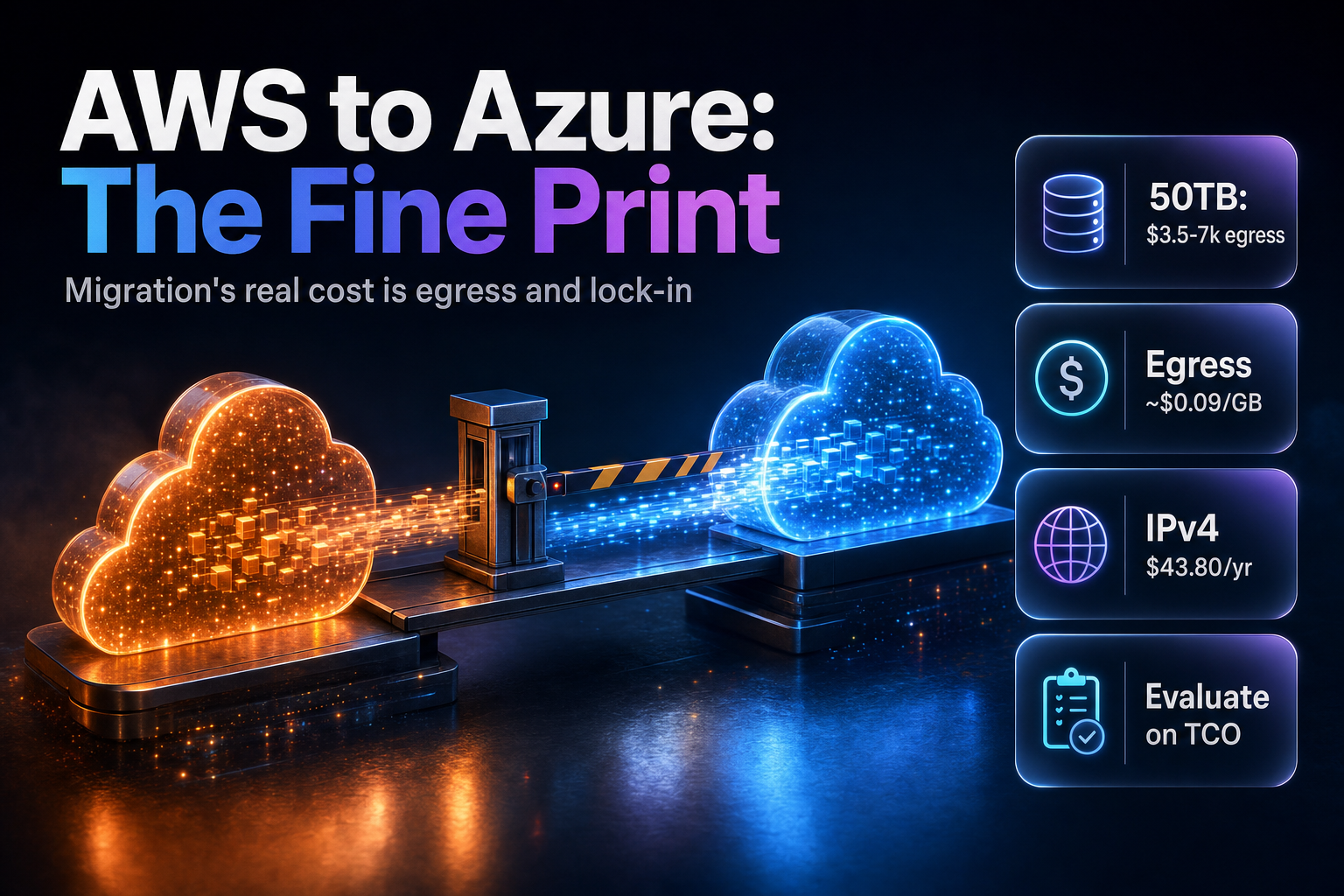
Summary. Microsoft has made moving off AWS easier, and that is exactly why you should slow down before you do it. In 2026 Microsoft expanded its AWS-to-Azure migration tooling: Azure Storage Mover moves data directly from Amazon S3 to Azure Blob Storage, and Azure Migrate added agentic AI capabilities with GitHub Copilot integration, dependency mapping, and expanded database and Linux support. Lower friction is real, but the dominant cost of leaving a cloud is not the tooling; it is egress and lock-in. AWS egress runs about $0.09 per GB, so moving 50 TB costs roughly $3,500 to $7,000 in transfer fees alone, and a 1 PB dataset would run about $92,000. Add downtime, retraining, and parallel-running, and the marketing-friendly "easy migration" gets expensive fast. This piece explains what Microsoft actually shipped and how to evaluate a migration on total cost, not a vendor's demo.
What Microsoft actually shipped
The news is a set of tools, not a single button. Azure Storage Mover reached general availability as a cloud-to-cloud migration service that transfers data directly from AWS S3 to Azure Blob Storage, with parallel transfers, preserved file metadata, encryption in transit, and incremental sync after the first pass so only changed files move. It is driven from the Azure portal, CLI, or REST API rather than hand-rolled scripts.
Alongside it, Azure Migrate gained agentic AI capabilities: automated guidance, integration with GitHub Copilot for connected workflows, default application-awareness for dependency mapping, and broader support for databases and Linux distributions, with a Copilot Migration Agent to help plan moves. Together these lower the manual effort of a lift-and-shift. What they do not change is the economics of moving data out of a cloud you are already paying to leave.
Why Microsoft wants your AWS workloads
The competitive logic is plain: cloud is a share game, and making AWS exit cheaper in effort is how a challenger wins workloads. That is fair play, and better tooling genuinely helps teams that have already decided to move. The risk for a buyer is mistaking lower migration effort for a lower total cost of switching. A tool that automates the mechanics does not waive the egress bill, remove the retraining, or de-risk the cutover. Read the offer as what it is, a competitive incentive, and run your own numbers.
The hidden cost of migration
Egress fees are the financially enforced part of lock-in, and they are easy to underestimate. The headline rates are only the start.
| Cost item | Typical 2026 rate | Notes |
|---|---|---|
| AWS egress to internet | ~$0.09 per GB | Azure ~$0.087, GCP ~$0.12 |
| Egress, 50 TB migration | ~$3,500 to $7,000 | Transfer fees alone |
| Egress, 1 PB dataset | ~$92,000 | From AWS |
| IPv4 public address | $0.005 per hour (~$43.80 per year) | Charged even when idle |
| NAT Gateway data | ~$0.045 per GB | Adds up on busy egress paths |
Egress and IPv4 charges together can reach 10% to 15% of a cloud bill. Moving a large dataset out is a one-time hit that can dwarf the tooling savings: a petabyte at roughly $92,000 is real money that never appears in a migration demo. AWS and Google have offered to waive egress for customers closing accounts, but only for 60 days, only for full migrations, and with conditions, so treat that relief as narrow, not a free exit. Our guide to controlling AI and cloud cost across providers covers where these charges hide.
How to evaluate a migration objectively
The right question is not "can we move?" but "does the total cost of moving beat the cost of staying, over three years?" Build a real total-cost-of-ownership comparison before committing.
| TCO factor | Include in the comparison |
|---|---|
| Egress and transfer fees | One-time cost to move data out |
| Downtime and cutover risk | Lost revenue and engineering hours |
| Retraining and hiring | New platform skills for the team |
| Parallel running | Paying two clouds during transition |
| Re-architecting | Proprietary services that do not port |
| Steady-state price delta | The recurring saving that justifies it all |
Design for portability where it matters: use open standards such as Kubernetes over a proprietary container service and open-source databases over proprietary ones, so future moves are cheaper. Accept lock-in pragmatically for commodity services where switching will never pay off. For very large transfers, physical shipping options can beat egress above a threshold, though they carry their own minimum fees. Our note on multicloud management across AWS and Azure covers running both deliberately rather than migrating in a panic.
When migration makes sense, and when it does not
A migration is worth it when the recurring price or capability delta is large enough to repay the one-time switching cost within a sensible window, when you are consolidating to a primary cloud your team already knows, or when a specific Azure capability is materially better for your workload. It is usually not worth it when the driver is a discount that a renegotiation could match, when the workloads lean on proprietary services that will need re-architecting anyway, or when the egress and parallel-running bill exceeds a couple of years of projected savings. Microsoft's tools change the effort side of that equation, not the economics, so let the three-year TCO decide.
India-specific considerations
For Indian enterprises, two local factors sharpen the analysis. Data residency: any migration of regulated or personal data must keep it in India-region infrastructure where required and follow the Digital Personal Data Protection Act, 2023, with a documented compliance basis and attention to cross-border transfer rules. Cost discipline: rupee-denominated budgets feel egress and IPv4 charges acutely, and a migration that looks cheap on a slide can blow a quarter's cloud budget once transfer and parallel-running costs land. Model the full TCO in your own currency and volumes before you commit, and treat vendor migration incentives as a starting point for negotiation, not a decision.
How eCorpIT can help
eCorpIT is a Gurugram technology consultancy, founded in 2021 and a partner across AWS, Microsoft, and Google, that helps enterprises make cloud decisions on evidence rather than vendor marketing. Our senior-led teams build a real three-year TCO comparison including egress, downtime, retraining, and parallel-running, run migrations with the right tooling when the numbers justify them, and design for portability so you are not trapped next time. We align any data migration with Digital Personal Data Protection Act, 2023 requirements. To evaluate an AWS-to-Azure move objectively, contact us.
FAQ
References
- Microsoft releases AWS-to-Azure migration tool — SDxCentral
- Announcing migration and modernization agentic AI tools — Microsoft Azure Blog
- Plan your workload migration from AWS to Azure — Microsoft Learn
_Last updated: July 14, 2026._