On this page · 9 sections
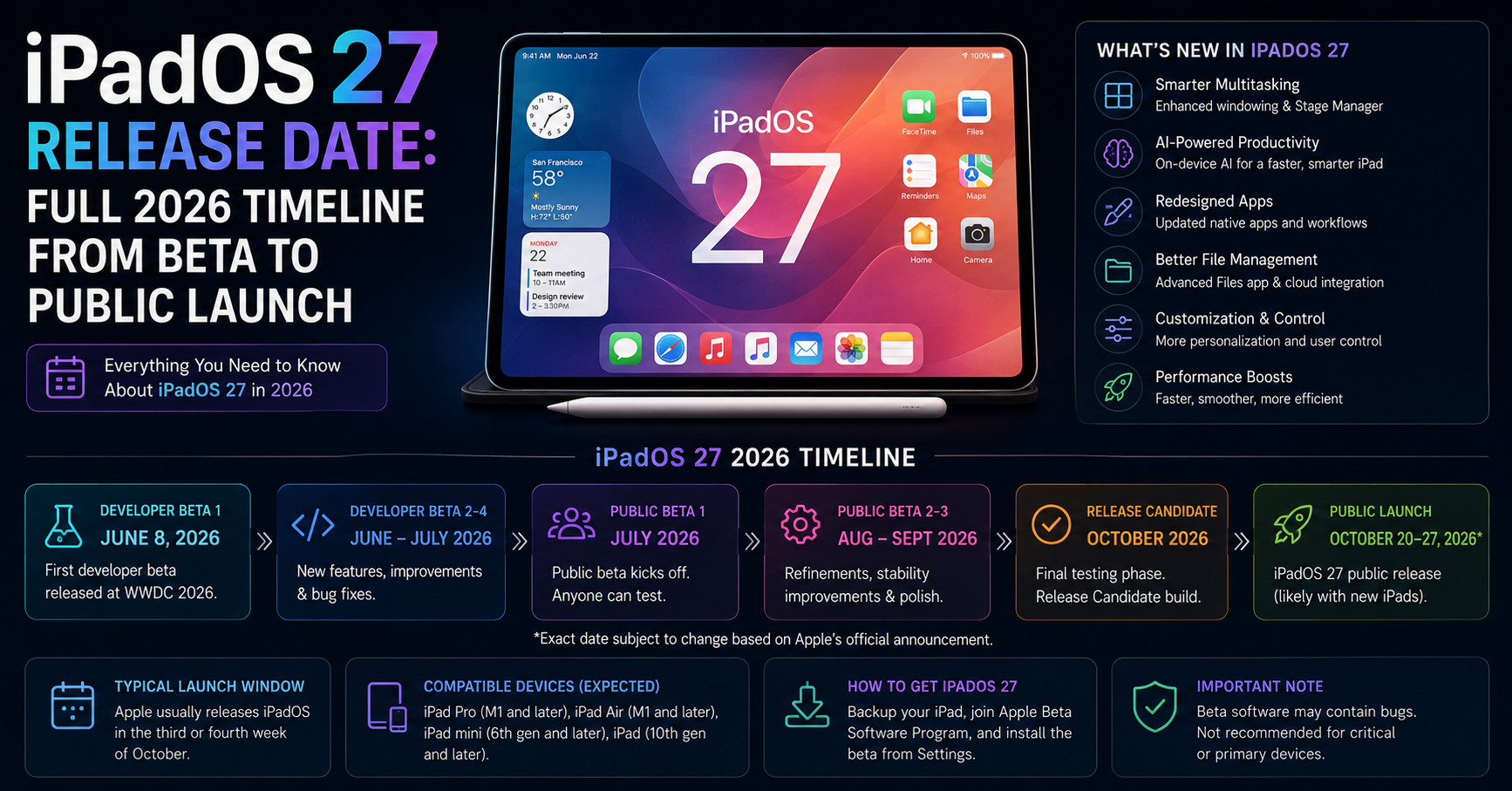
Summary. iPadOS 27 was announced on June 8, 2026, at the annual Worldwide Developers Conference alongside iOS 27, macOS, watchOS 27, visionOS 27, and tvOS 27. The developer beta shipped the same day, a public beta is planned for July, and a public launch will follow this September.
Apple's 37th Worldwide Developers Conference ran June 8 to June 12, 2026, opening with a keynote on Monday, June 8. For context, iPadOS 26 was announced on June 9, 2025, and released on September 15, 2025. That four-milestone cadence has now repeated for eight straight years. This guide gives the full timeline, the supported-iPad list, regional caveats for India and the EU, and a fleet-rollout plan for IT teams.
The four-stage iPadOS 27 timeline at a glance
Apple's release calendar is one of the most predictable in technology. There are four milestones from announcement to the update landing on your iPad, and the first three are already confirmed or strongly signalled.
| Milestone | Date / window (2026) | Who gets it | Status |
|---|---|---|---|
| Announcement + developer beta 1 | June 8, 2026 | Registered developers | Confirmed |
| Public beta | July 2026 | Apple Beta Software Program | Planned by Apple |
| Beta refresh cadence | Every ~2 weeks, June–September | Developers, then public | Historical pattern |
| Public launch | Mid-September 2026 | All supported iPads | Expected |
Apple demoed iPadOS 27 at WWDC, it is now available to developers, a public beta is coming in July, and the launch will follow this September. The exact public-launch date is not set at WWDC. Apple does not announce a specific date at the conference; the final date comes at the new iPhone event in early September.
Stage 1 — Announcement and developer beta (June 8, 2026)
Apple ran an unusual WWDC on June 8, 2026: instead of breaking out each operating system, it grouped announcements by topic, and everything coming to iOS 27 is also coming to iPadOS 27. The developer build reaches testers fast. Apple confirmed WWDC 2026 ran June 8 to June 12, with the keynote at 10 a.m. Pacific on June 8, and developer beta 1 historically drops within hours of the keynote.
Access to the developer beta is no longer gated behind a paid account. Apple's developer documentation states that basic access for installing betas is free with any Apple ID; you only need the $99/year paid tier to distribute apps on the App Store.
Stage 2 — Public beta (July 2026)
Registered developers can download iPadOS 27 now, and Apple plans to release a public beta in July. Based on prior cycles, the public beta program typically opens around mid-July, four to six weeks after the initial developer seed. Through the rest of the summer, developer builds ship every two weeks and public betas trail by two to three days.
To join the public beta, end users do not need a developer account. Users visit beta.apple.com and sign up with their Apple account, then install a beta profile to access prerelease updates.
Stage 3 — Public launch (mid-September 2026)
iPadOS 27 is Apple's next update, in developer beta now ahead of a September 2026 release. The most likely date sits in the third week of the month. Based on Apple's release pattern since iOS 13, the public update drops on the Monday or Tuesday of the third week of September, and across 10 consecutive release cycles the public launch landed between September 12 and September 20 every time. One forecaster narrows it further: for the 2026 cycle, that puts the window at September 14 to September 17, 2026.
iPadOS does not ship on its own. iOS, iPadOS, watchOS, and tvOS ship together on the same day, while macOS trails by one to four weeks. The launch is timed to the new iPhone, too: the full public release is expected around September 15, 2026, the week before new iPhones go on sale.
How this compares to last year's cadence
The 2026 schedule is a near-exact copy of 2025, which is why the September projection is reliable rather than guesswork.
| Cycle | WWDC announce | Public launch | Gap |
|---|---|---|---|
| iPadOS 26 (2025) | June 9, 2025 | September 15, 2025 | ~14 weeks |
| iPadOS 27 (2026) | June 8, 2026 | Mid-September 2026 (expected) | ~14 weeks |
| iPadOS 25 era naming | n/a (skipped) | n/a | — |
iPadOS 26's release date was set for Monday, September 15, 2025, with new features heavily skewed toward productivity such as the Mac-like windowing system, upgraded dock, menu bar, and new cursor. If you are puzzled by the version number, the naming changed last year. Apple moved from iPadOS 18 to iPadOS 26 to simplify naming: the "26" represents the release season between September 2025 and September 2026. By the same logic, the "27" in iPadOS 27 covers the September 2026 to September 2027 season.
Which iPads support iPadOS 27
This is the most consequential part of the release for fleet owners, because iPadOS 27 drops several models that ran iPadOS 26.
iPadOS 27 drops support for the fifth-generation iPad mini, the 8th-generation iPad, the 3rd-generation iPad Air, the first-generation 11-inch iPad Pro, and the 3rd-generation 12.9-inch iPad Pro. The chip floor moved up a generation: iPadOS 27 drops support for all devices with an Apple A12 or A12X chip, including the iPad (8th generation), iPad mini (5th generation), iPad Air (3rd generation), and iPad Pro (3rd generation), although the iPad Pro (4th generation), which uses an A12Z chip, remains supported.
| Supported (runs iPadOS 27) | Dropped from iPadOS 26 | Apple Intelligence eligible |
|---|---|---|
| iPad (9th gen) and later | iPad (8th generation) | iPad Air (5th gen) and later |
| iPad mini (6th gen) and later | iPad mini (5th generation) | iPad mini (A17 Pro) |
| iPad Air (4th gen) and later | iPad Air (3rd generation) | iPad Pro (5th gen / M1) and later |
| iPad Pro 11-inch (2nd gen) and later | iPad Pro 11-inch (1st generation) | Models with A17 Pro or M1+ chip |
| iPad Pro 12.9-inch (4th gen) and later | iPad Pro 12.9-inch (3rd generation) | — |
Here is the official support boundary in Apple's own framing: iPadOS 27 is available on the 6th-generation iPad mini and later, the 9th-generation iPad and later, the 2nd-generation 11-inch iPad Pro and later, the 4th-generation 12.9-inch iPad Pro and later, and the 4th-generation iPad Air or later.
Apple Intelligence has a stricter floor than the base OS. Apple Intelligence features require at least an A17 Pro or M1 chip, as found on the iPad mini (A17 Pro), iPad Air (5th generation), iPad Pro (5th generation), or newer. Some advanced features go higher still: improved Siri voices and improved on-device dictation are only available on iPad models with an M4 chip or later with at least 12 GB of unified memory.
What is new in iPadOS 27
The headline is a rebuilt assistant. iPadOS 27's marquee additions are a smarter Siri AI, a dedicated Siri app, Visual Intelligence, a revamped Liquid Glass, new Apple Intelligence features, and performance improvements. The assistant behaves more like a modern chatbot: Siri AI uses generative AI models and performs more like ChatGPT or Claude than the prior version, holding full back-and-forth conversations and reaching your personal data to complete complex tasks.
Performance is the other theme, and Apple put real numbers behind it. Browsing files on iPad and transferring them to an external USB drive is up to five times faster, and is just as fast as Finder on a Mac. Apple expanded the CPU scheduler to all iPadOS 27-supported iPads for faster performance. The testing methodology is dated and specific: testing was conducted by Apple in April and May 2026 using an iPad Pro 11-inch (M4) with iPadOS 26.4.2 and prerelease iPadOS 27, and an APFS-formatted USB4 external SSD drive.
For families and schools, parental controls were overhauled. Screen Time was redesigned so parents can see the apps and websites children visit and make adjustments in real time, and Time Allowances let parents set how long children can use categories like Entertainment, Games, and Social Media. Communication Safety now blocks gore and violence in addition to nudity in Messages and FaceTime.
Regional availability: India, the EU and China
Where you are changes what you get on day one. For the EU: Siri AI for iPhone and iPad will not initially be available in the European Union because of issues with the Digital Markets Act. And Siri AI and the new Apple Intelligence features are not available in China. The feature also launches in one language first: Siri AI is available in English and will expand to other languages in the future.
India-specific considerations
India is not on Apple's restricted list, so iPadOS 27 and its English-language Siri AI features should be available to Indian users at launch, unlike the EU and China carve-outs above. Indian enterprises and schools running iPad fleets should still treat the rollout as a data-governance event. Apple Intelligence and the new Siri route some requests to Apple's servers, so organisations handling personal data should check whether those flows align with the Digital Personal Data Protection Act, 2023 (DPDP) before enabling AI features on managed devices, particularly in regulated sectors like financial services, healthcare and education. We design device and data-handling policies aligned with DPDP requirements rather than asserting blanket compliance, because the right answer depends on your data categories and consent model.
A rollout plan for IT teams managing iPad fleets
A consumer can install the beta on day one. An organisation should not. The right move is a staged rollout built on Apple's update-deferral controls.
1. Block betas on production devices
Beta software can introduce instability and compatibility issues with enterprise apps, so admins should prevent beta installations on managed devices. On supervised iPads, restricting the "Allow installing configuration profiles" option blocks users from installing the beta enrolment profile and from enabling beta updates in Settings.
2. Test through the right channel
Do not test on personal hunches. AppleSeed for IT is a specialised beta testing program for admins managing devices in MDM environments, and organisations enrol through it using a Managed Apple Account. Apple's own guidance is consistent: always have a plan to pilot new operating system upgrades and major updates before broad rollout.
3. Defer the public release while you validate
Apple gives you up to three months of runway. The maximum delay Apple supports for the visibility of software updates is 90 days. A common posture: set the iOS/iPadOS update delay to 30 days, which prevents users from updating for a month after Apple's public release. A practical routine many MacAdmins use is a 30-day testing-to-production cycle, testing each new release for 30 days before rolling it out and deferring updates to catch and fix issues.
4. Stagger the rollout, then enforce
Begin with a small test group to find issues before deploying organisation-wide, which limits disruption. Apple's deferrals support exactly this phased approach: deferrals can be used to verify an update with a test group before allowing all users to install it, or to deploy different deferrals to different groups to phase the rollout. Modern Apple management increasingly uses declarative device management for this. With declarative device management, the MDM server declares the desired OS version, and devices automatically download, install, and report progress without constant server polling.
One operational note for managed-update windows: OTA software updates are typically available for up to 180 days after their initial release date, so an update is always available for managed devices set to the maximum deferral value. Microsoft Intune users should also plan for a tooling shift. Microsoft recommends using declarative device management to manage and install Apple software updates as it winds down older MDM-based update policies.
If your organisation is also reworking its broader AI posture this year, our generative AI enterprise strategy guide pairs well with on-device decisions about Apple Intelligence and Siri AI.
FAQ
How eCorpIT can help
eCorpIT's senior engineering teams help organisations plan and execute Apple fleet upgrades without disrupting day-to-day work, from MDM and declarative device management configuration to staged deferral policies and app-compatibility testing ahead of major iPadOS releases. As a CMMI Level 5, MSME-certified, multi-disciplinary organisation, we also map AI-feature rollouts like Siri AI and Apple Intelligence to your data-governance obligations, including DPDP. Talk to our team to build your iPadOS 27 readiness plan.
References
Last updated: June 17, 2026. Release timing beyond the WWDC announcement reflects Apple's stated plans and historical patterns; the exact public-launch date is confirmed by Apple at its September event.