On this page · 15 sections
- What changed in iOS 27
- How SynthID works
- SynthID and C2PA do different jobs
- Where provenance breaks
- What app developers should do
- What content teams should do
- What a verification check actually returns
- Common misconceptions
- Building a provenance step into a pipeline
- Expect the standards to keep moving
- India-specific considerations
- What to build first
- FAQ
- How eCorpIT can help
- References
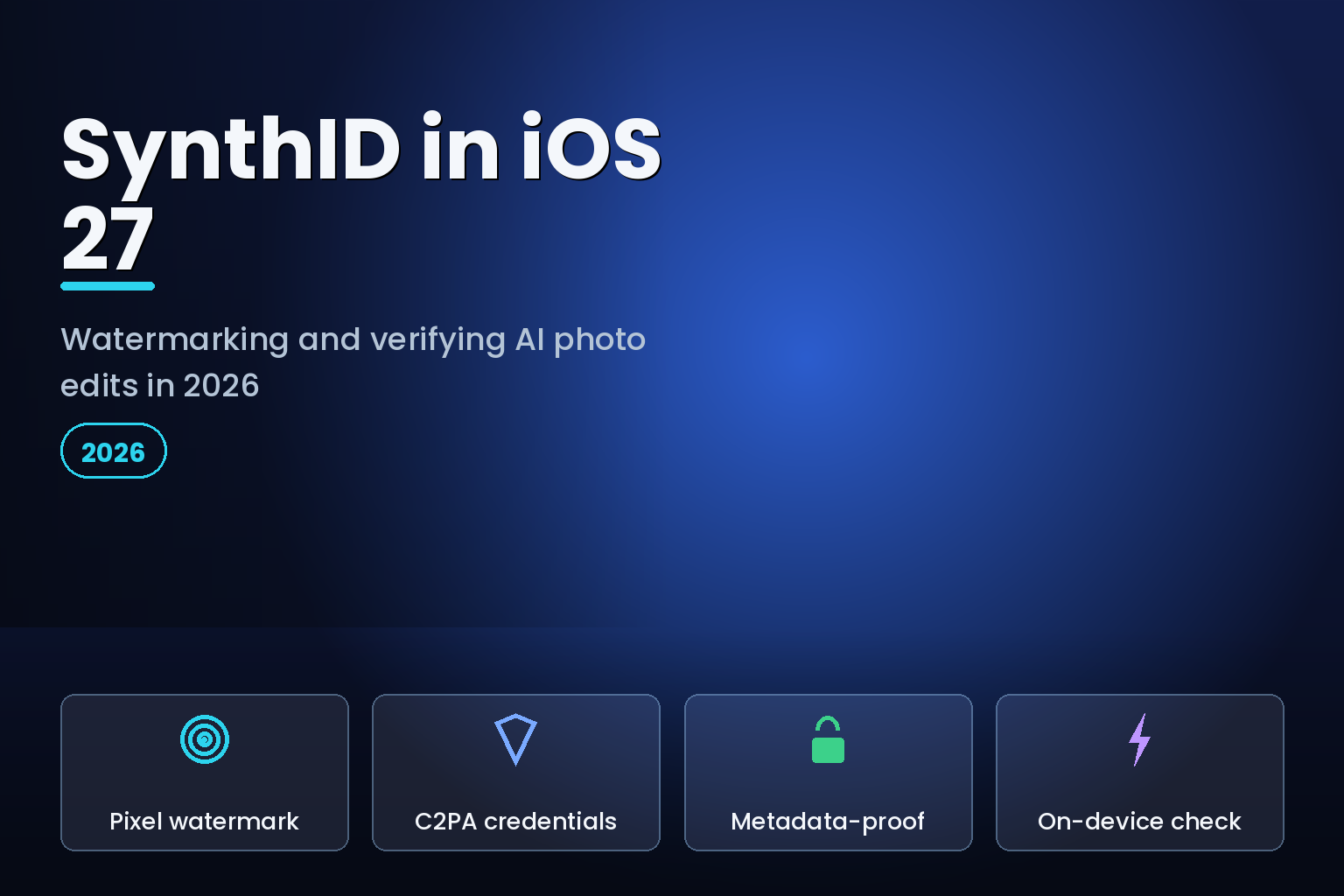
Summary. At WWDC 2026 on June 8, Apple built Google DeepMind's SynthID watermark into iOS 27, the first time Apple has adopted a third-party invisible watermarking standard for Apple Intelligence. Any photo edited with Cleanup, Extend, or Spatial Reframing now carries a SynthID marker embedded in its pixels, alongside C2PA Content Credentials, the open provenance standard also used by OpenAI. SynthID, first shown by Google in 2023, hides a signal two trained models can read even after cropping or compression. On an iPhone 15 Pro, C2PA validation runs in under 500 milliseconds for a 12-megapixel image. None of this proves a photo is true, and under India's Digital Personal Data Protection Act 2023 a mishandled breach can cost up to ₹250 crore, so provenance is now a compliance question, not only a trust one. Here is what app and content teams should do.
Two signals now travel with an AI-edited iPhone photo, and they answer different questions. SynthID is a pixel-level watermark that survives when metadata is stripped. C2PA Content Credentials are signed metadata that records who and what touched the file. Neither is a lie detector. Together they tell you whether AI was involved and who signed the result, which is exactly the question a moderation pipeline, a newsroom, or a marketplace listing needs answered before it trusts an image. This guide explains how both work in iOS 27, where they break, and the concrete steps for teams that handle user media.
It pairs with our look at Apple's wider AI architecture and the privacy model behind it.
What changed in iOS 27
Before iOS 27, Apple's photo provenance story was thin. With this release, Apple Intelligence edits are tagged. According to reporting on the WWDC 2026 announcement, any image processed through Cleanup, Extend, or Spatial Reframing carries a SynthID watermark, and AI-generated images created with Apple's photo tools carry the marker as the feature set expands, per TechTrends and Streamlinefeed. Apple's VP of Camera and Photos Software Engineering described the marker as invisible to the eye but instantly identifiable by verification systems, according to that coverage.
The strategic read is that Apple stopped trying to own the standard. By adopting SynthID, which Google built, and pairing it with C2PA, which an industry coalition maintains, Apple chose interoperability over a proprietary mark. For developers, that is good news: the same detection logic that reads a SynthID signal or a Content Credential from a web image works on an iPhone export.
How SynthID works
SynthID embeds a watermark directly into the pixels of an image during generation, not as a tag bolted on afterward, so the signal is part of the image data. Google DeepMind uses two deep-learning models trained together, one to embed the watermark and one to detect it, as the DeepMind SynthID page explains. The watermark is distributed across the whole image rather than parked in one corner, which is why a cropped fragment can still carry enough signal to be read.
The design goal is resilience. SynthID is meant to survive common changes such as cropping, filters, frame-rate changes, and lossy compression, and because the mark lives in the pixels it remains detectable even when a file's metadata is wiped, per Google DeepMind's image-watermarking work. That property is the whole point: metadata is trivial to strip, so a pixel-level signal is the part that tends to survive a screenshot or a re-encode.
There is a hard boundary, though. SynthID detection works on content made with Google's tools and partners that adopt it. It is not a universal detector for every image from every model, so a photo from another generator without its own watermark will not light up a SynthID check.
SynthID and C2PA do different jobs
The most common mistake is treating SynthID and C2PA as competitors. They are layers. C2PA, the Coalition for Content Provenance and Authenticity, defines Content Credentials: tamper-evident, cryptographically signed metadata that records who or what signed a file, which tool created or edited it, whether AI was involved, and whether the signed data still validates against the current bytes, as the C2PA explainer sets out. SynthID is the pixel watermark that persists when that metadata is gone.
| Dimension | SynthID watermark | C2PA Content Credentials |
|---|---|---|
| What it is | A signal embedded in pixels | Signed provenance metadata |
| Where it lives | Inside the image data | In the file's metadata, cryptographically sealed |
| Survives metadata loss | Yes, it is in the pixels | No, stripping metadata removes it |
| Survives heavy editing | Designed to, within limits | Breaks if the signed bytes change without re-signing |
| What it proves | AI involvement from a supporting tool | Who signed, what edited, whether it still validates |
| Who backs it | Google DeepMind | An industry coalition, used by OpenAI and others |
Read together, they cover each other's gaps. C2PA gives you a rich, verifiable history when the metadata is intact. SynthID gives you a fallback signal when it is not. A serious verification step checks both.
Where provenance breaks
Provenance is useful, but overselling it is dangerous. Researchers have repeatedly shown that SynthID and similar systems can be weakened or defeated through ordinary manipulation such as aggressive cropping, recompression, and colour changes, and whether an iOS 27 SynthID mark survives a screenshot-to-message round trip, a social-media upload, or a third-party export is not established in any published documentation so far. Treat survival as likely-but-not-guaranteed, and design for the case where the signal is gone.
Google's own leadership has been candid about the ceiling. Demis Hassabis, CEO of Google DeepMind, said that "while SynthID isn't a silver bullet for misinformation, it's a promising technical solution to some of today's pressing AI safety issues," as reported at launch. C2PA carries the same caveat from the other direction: it is not a truth machine and does not classify content as real or fake. It asserts positive provenance, that a given entity signed a file at a given time with given claims. Absence of a credential proves nothing, because the credential may simply have been stripped.
The engineering takeaway is to treat provenance as evidence, not verdict. A present, valid signal raises confidence. A missing one is inconclusive, not proof of forgery.
What app developers should do
If your app accepts user images, provenance belongs in the ingestion path. The good news is that checking it is fast. An on-device C2PA validation completed in under 500 milliseconds for a 12-megapixel image on an iPhone 15 Pro, with metadata parsing under 50 milliseconds, in the Origin Lens research framework, so reading a credential need not slow down an upload.
| Surface in iOS 27 | Provenance signal | What your app or team should do |
|---|---|---|
| Cleanup edit | SynthID watermark | Record that AI editing occurred; keep the credential |
| Extend | SynthID watermark | Same, and note that pixels were synthesised |
| Spatial Reframing | SynthID watermark | Treat reframed regions as AI-modified |
| AI-generated image | SynthID watermark | Label clearly in your UI |
| Imported third-party image | C2PA, if present | Validate the credential; do not assume absence means real |
| Screenshot or re-export | Often none | Fall back to SynthID detection; expect gaps |
Three rules follow. First, never strip provenance metadata in your processing pipeline; if you re-encode an image, preserve or re-sign its Content Credentials so the chain survives. Second, do not treat a missing signal as a negative result; surface "no provenance found" honestly rather than implying the image is authentic. Third, keep detection on-device where you can, both for speed and because sending user media to a server adds a privacy and compliance burden you may not want.
What content teams should do
For editorial, marketing, and trust-and-safety teams, the change is procedural. Decide a disclosure policy now: which AI edits you will label, in what words, and where. Build a verification step into publishing so an image's credentials are checked before it ships, and log the result so you can show your work later. When you publish AI-edited media, keep the Content Credentials intact through your CMS rather than letting an export pipeline quietly strip them.
The discipline matters most for anything where authenticity carries weight, such as journalism, insurance claims, marketplace listings, identity verification, and legal evidence. In those settings, a documented provenance check is part of due diligence, and the absence of one is the gap an adversary or an auditor will find.
What a verification check actually returns
It helps to know what each check hands back, because the two signals report different things. A C2PA validation returns a manifest: the chain of claims attached to the file, each naming a signer, a timestamp, and the action taken, plus a cryptographic result that says whether the signed bytes still match the file in front of you. If someone edited the image after signing without re-signing, validation fails, and that failure is itself information. A SynthID check returns something simpler: a likelihood that a supporting model's watermark is present. It does not tell you who made the image or when; it tells you that an AI tool that supports SynthID was probably involved.
Designing around those return types keeps your product honest. Surface the C2PA manifest as a readable history when it exists, show the validation state plainly, and treat a SynthID hit as a single "AI involved" flag rather than a full account. When both agree, confidence is high. When they disagree, for example a valid credential but no detectable watermark, present the facts rather than forcing a single verdict, because legitimate workflows can produce exactly that combination.
Common misconceptions
A few beliefs cause more trouble than the technology itself. The first is that a watermark guarantees detection forever; it does not, because heavy editing can degrade the signal and a non-supporting tool never adds one. The second is that stripping metadata removes all provenance; it removes the C2PA layer but not a pixel-level SynthID mark, which is the entire reason both exist. The third is that the absence of any signal proves an image is camera-real; it proves nothing, since signals are routinely lost in ordinary sharing. The fourth, and most damaging in a product, is showing users a binary real-or-fake badge. That badge will be wrong often enough to erode trust, and it misrepresents what provenance can actually establish.
The accurate mental model is a spectrum of evidence. A valid Content Credential from a known signer is strong. A SynthID hit is a useful corroborating signal. A clean image with no signals is unknown, not innocent. Build your UI and your policies around that spectrum and you will not overpromise.
Building a provenance step into a pipeline
A workable pipeline has four stages. On ingestion, read any C2PA manifest and run a SynthID check, and store both results next to the asset. On processing, if you re-encode or resize, preserve the existing credential or re-sign so the chain is not quietly broken. On display, show provenance in plain language where it matters to the user, and avoid jargon such as manifest or soft binding in consumer surfaces. On retention, keep the verification result in your records so you can show, months later, what you knew at publish time.
The reason to log results is practical. Disputes about an image usually arrive long after publication, and a stored verification record turns an argument into a lookup. For regulated or high-stakes media, that record is the difference between demonstrating diligence and asserting it.
Expect the standards to keep moving
Provenance is an active field, and the 2026 state is not the final one. C2PA continues to revise its specification, SynthID research keeps extending coverage to text, audio, and video, and detector quality improves on both sides of the contest between watermarking and removal. The safe assumption is that your verification logic will need updating, so isolate it behind a single module rather than scattering checks through your codebase. When a new signal or a stronger detector ships, you want to change one component, not ten.
India-specific considerations
For Indian teams, provenance and data protection now sit in the same conversation. The Digital Personal Data Protection Act 2023 (DPDP) sets a tiered penalty structure that runs up to ₹250 crore for a breach caused by inadequate safeguards, with a separate penalty for failing to notify the Data Protection Board, per a breakdown of DPDPA penalties. Image provenance is not a DPDP requirement on its own, but the same control mindset applies: when your app handles user media, you want documented, on-device checks and a record you can produce, not a promise.
There is a practical reason to keep verification on-device in India too. Processing user photos locally avoids shipping personal media to a server, which reduces both latency and the data-handling surface a DPDP review would scrutinise. We design applications aligned with DPDP requirements and build media pipelines that preserve provenance rather than strip it. For the broader picture, see our guide to generative AI enterprise strategy.
What to build first
If you are starting this quarter, add a provenance reader to your upload path before anything else, because it is cheap and it changes what you know about every incoming image. Next, fix your pipeline so it preserves Content Credentials instead of dropping them on re-encode. Then write the disclosure policy your product and legal teams can stand behind. Watermarks and credentials will keep improving, and adversaries will keep probing them, so the durable investment is the habit: check provenance, preserve it, and never present a missing signal as proof of anything.
FAQ
How eCorpIT can help
eCorpIT (eCorp Information Technologies Private Limited) is a Gurugram-based, CMMI Level 5 technology organisation whose senior engineering teams build media and AI pipelines for mobile and web. We help product and content teams add on-device provenance checks, preserve C2PA Content Credentials through processing, and design applications aligned with DPDP requirements. Read more about us, or contact our team to review your media provenance workflow.
References
- TechTrends, Apple Adopts SynthID for AI Photos in iOS 27, June 16, 2026.
- Streamlinefeed, Apple Integrates Google SynthID to Label AI Photos in iOS 27, 2026.
- Google DeepMind, SynthID, 2026.
- Google DeepMind, Identifying AI-generated images with SynthID, 2023.
- C2PA, Content Credentials Explainer, 2026.
- The Next Web, Google DeepMind unveils AI watermarking tool, 2023.
- DataCamp, Google's SynthID: A Guide With Examples, 2026.
- OpenAI Help Center, C2PA and SynthID in OpenAI-generated images, 2026.
- Gadget Hacks, iOS 27 Photos AI Features Explained: Spatial Reframing, Extend, and Apple's Guardrails, 2026.
- DPDPA.com, DPDPA Penalties Explained: Rs 50 Crore to Rs 250 Crore Fines, 2026.
- Apple Security Research, Expanding Private Cloud Compute, June 8, 2026.
_Last updated: June 22, 2026._