On this page · 13 sections
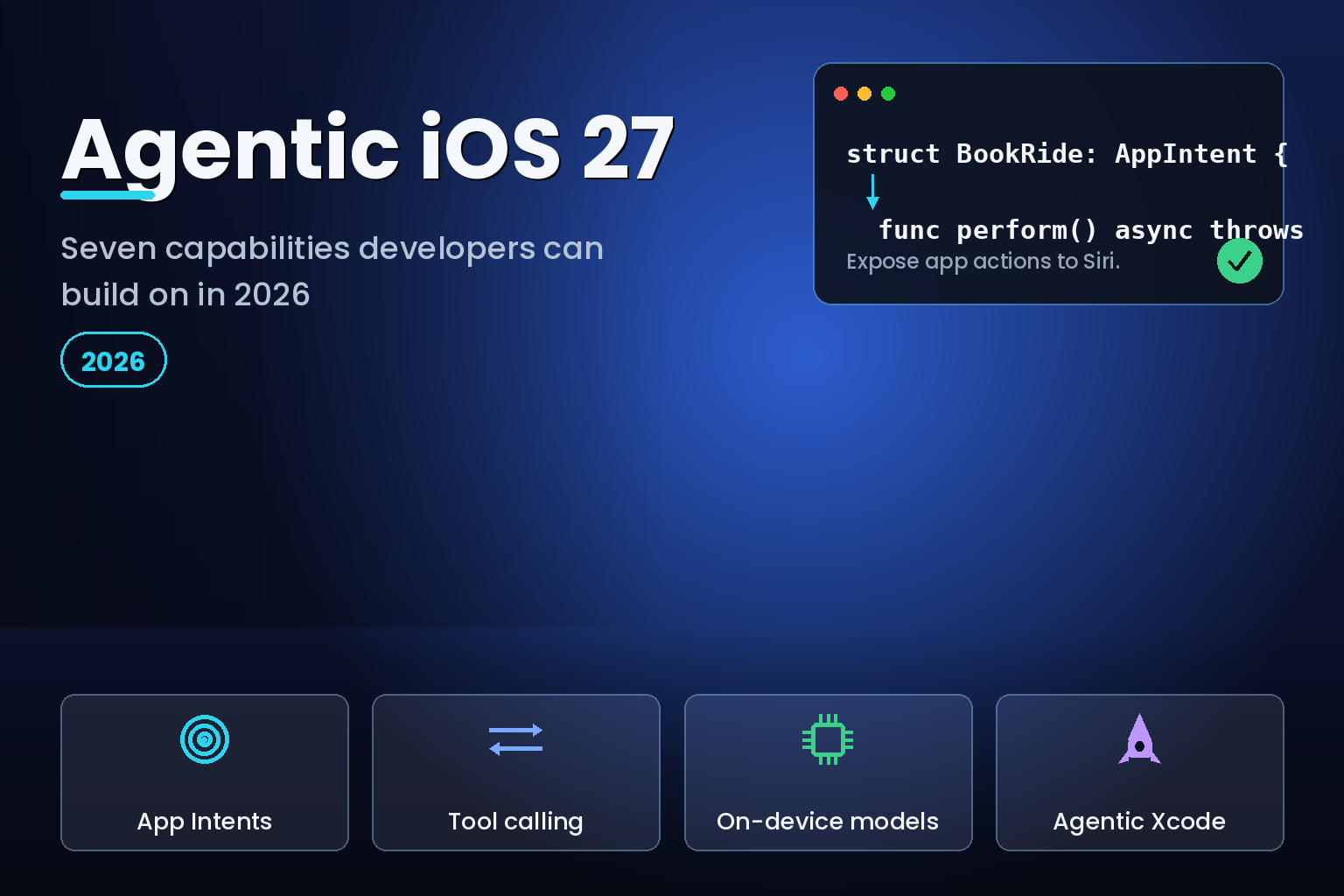
- 1. App Intents: the gateway to agentic Siri actions
- 2. Conversational follow-ups and on-screen references
- 3. Foundation Models tool calling and a swappable model protocol
- 4. Dynamic Profiles for multi-step agents
- 5. Core AI: run your own model on-device
- 6. Passwords: an agent that fixes compromised logins
- 7. Xcode 27: build with agents, not just for them
- The one deprecation you cannot ignore
- India-specific considerations
- Where to start
- FAQ
- How eCorpIT can help
- References
Summary. At WWDC 2026 on June 8, Apple turned iOS 27 into an agentic platform for developers, not only for users. The rebuilt Siri routes exclusively through App Intents, the Foundation Models framework can call Apple's models or third-party ones such as Claude and Gemini through one protocol, and even the Passwords app now acts on a user's behalf to fix compromised logins. A new on-device framework, Core AI, lets you run full-scale models locally, and Xcode 27 brings coding agents from Anthropic, Google, and OpenAI into the editor. The on-device model is free, with no cloud API cost for developers under 2 million first-time App Store downloads, while the cloud tier runs on GPUs billed at $2.12 to $14.24 per GPU-hour as of June 2026. Here are seven agentic capabilities you can build on, and the one deprecation you cannot ignore.
Apple framed the release around developers. "Developers are at the heart of the Apple ecosystem, and our goal is to provide them with the best possible tools and technologies to build the future," said Susan Prescott, Apple's vice president of Worldwide Developer Relations, in Apple's developer announcement. The through-line is agency: the system now takes actions, not just answers, and it gives your app structured ways to participate. This guide walks the seven capabilities and what each one is good for. For the App Intents foundation, see our iOS 27 App Intents and Siri AI developer guide.
1. App Intents: the gateway to agentic Siri actions
App Intents is the single most important framework to adopt, because the rebuilt Siri routes through it exclusively. Apple's developer post is explicit that App Intents now connects your app to Siri AI capabilities including personal context understanding, app actions, and onscreen awareness, so a user can ask the assistant to do something in your app and have it happen. If your app exposes its actions as intents, it can participate in agentic flows that the orchestrator assembles across apps. If it does not, it is invisible to the new Siri.
The practical move is to model your app's key actions and entities as App Intents now, with clear names and parameters, because that vocabulary is what the assistant reasons over. Treat intents as the public API your app offers to the system's agent, not as a Siri afterthought.
2. Conversational follow-ups and on-screen references
The iOS 27 evolution of App Intents adds the pieces that make actions feel agentic rather than scripted: richer entity types, streaming responses for long-running actions, multi-turn conversational follow-ups, and a View Annotations API that lets users reference on-screen elements naturally in a voice command. Together these let a user start a task, refine it in follow-up turns, and point at something on screen, with your app supplying the structured handlers.
The design lesson is to plan for dialogue, not a single command. Expose intents that can ask a clarifying question, return partial progress for a long task, and resolve a reference such as "this one" to the entity the user is looking at. That is the difference between an app the agent can drive and one it can only launch.
3. Foundation Models tool calling and a swappable model protocol
The Foundation Models framework is the in-app model layer, and in iOS 27 it is a single Swift API that reaches the on-device models with image input, server models on Private Cloud Compute, and any third-party provider that implements the new LanguageModel protocol, including Claude and Gemini, as TechTimes reported. Its tool-calling support is what makes it agentic: the model can call functions you define and fold the results into its answer.
The benefit for builders is that the call site is identical across providers, so you can prototype on the free on-device model and move a feature to a cloud model by changing a dependency. Apple's next-generation models were custom-built in collaboration with Google and its Gemini models, and developers in the App Store Small Business Program with fewer than 2 million first-time downloads can use them on Private Cloud Compute at no cloud API cost.
4. Dynamic Profiles for multi-step agents
Dynamic Profiles let an app change the model, tools, and instructions during a single continuous session, which Apple describes as a way to update how models interact with your app on the fly. That is the building block for a small agent: one conversation can shift from a fast on-device profile for routine turns to a more capable cloud profile with extra tools for a hard step, then back, without tearing down the session.
The takeaway is to treat a profile as a mode your agent switches into, scoped to the task at hand. Keep the cheap, private profile as the default and escalate deliberately, because every escalation to a cloud profile has a latency and cost it should earn.
5. Core AI: run your own model on-device
For teams that want to bring their own model rather than use Apple's, iOS 27 introduces Core AI, a new framework Apple calls the best way to run models on device. It provides an architecture tuned for the unified memory and Neural Engine of Apple silicon, so developers can deploy full-scale large language models locally, per Apple's announcement. That is a meaningful addition, because it gives you a supported path to a custom on-device model without building your own runtime.
The lesson is to match the framework to the need. Use Foundation Models when Apple's models or a hosted provider will do, and reach for Core AI when you have a specific model you must run locally for privacy, latency, or differentiation. Both keep inference on the device, which is the cheapest and most private place to run it.
| Capability | What it does | Framework or API |
|---|---|---|
| App Intents | Exposes app actions to agentic Siri | App Intents |
| On-screen and follow-ups | References UI, multi-turn, streaming | View Annotations, App Intents |
| Model tool calling | Model calls your functions, any provider | Foundation Models, LanguageModel protocol |
| Dynamic Profiles | Swap model, tools, instructions mid-session | Foundation Models |
| Core AI | Run a full-scale model on-device | Core AI |
| Password automation | Agentically fix compromised logins | Passwords credential-update API |
| Agentic coding | Build with agents in the editor | Xcode 27 |
6. Passwords: an agent that fixes compromised logins
The clearest consumer example of agency is in the Passwords app. Apple Intelligence now detects weak or compromised credentials and, with the user's go-ahead, uses Safari to navigate to a site, sign in, and upgrade the account to a strong password, as The Register and BleepingComputer reported. Crucially for developers, Apple exposes an API so apps and sites can support these automated credential updates, and how widely it is adopted decides how smoothly the fix works across the ecosystem.
The action item is concrete: if you run a site or app with accounts, adopt the password-change API so the system agent can rotate a compromised password cleanly on your service. An app that supports it gives users a one-tap fix; one that does not forces a manual, error-prone path.
7. Xcode 27: build with agents, not just for them
The seventh capability is about how you build. Xcode 27 brings coding agents from Anthropic, Google, and OpenAI into the workflow, with interactive planning, multi-turn questions, and a canvas that renders Markdown and shows code changes and previews side by side. The agents can validate their own work by writing and running tests, trying ideas in Playgrounds, checking previews, and driving the simulator through a new Device Hub, so they run autonomously for longer. Plug-ins extend the editor through the Model Context Protocol and the Agent Client Protocol, with GitHub and Figma first to integrate.
The takeaway is that agentic coding is now first-party, so the skill to develop is directing agents well: writing clear plans, reviewing diffs, and letting the agent verify itself against tests. Xcode 27 is also Apple silicon only and about 30 percent smaller, with Xcode Cloud up to twice as fast.
| Aspect | SiriKit (deprecated) | App Intents (iOS 27) |
|---|---|---|
| Status | Deprecated at WWDC 2026 | The supported path |
| Siri surfacing | Will not appear in the new Siri | Routes through it exclusively |
| Model routing | None | On-device, PCC, third-party |
| Entity types | Limited domains | Richer, app-defined entities |
| Follow-ups | Single-shot | Multi-turn, streaming |
The one deprecation you cannot ignore
Apple gave SiriKit a formal deprecation notice at WWDC 2026. Existing SiriKit code still compiles, but it emits deprecation warnings in Xcode 27, and old SiriKit apps will not surface in the rebuilt Siri, which routes only through App Intents. The blunt consequence is that an app which has not migrated will not respond to the assistant that hundreds of millions of users get with iOS 27. Treat migration to App Intents as the prerequisite for every other agentic feature in this list, because it is the door the rest depend on.
India-specific considerations
For Indian developers, two points matter. First, the free on-device tier and Core AI keep AI features off the network, which lowers cost in rupees and fits the data-minimisation expectation under the Digital Personal Data Protection Act 2023 (DPDP). Where a feature does call the cloud, classify the data first and keep personal information on-device by default. Second, availability varies: Apple Intelligence features ship only in supported regions, and Siri AI is delayed in some markets, so build capability checks and graceful fallbacks rather than assuming every user has the agent.
We help teams adopt App Intents, Foundation Models, and Core AI, and design applications aligned with DPDP requirements. For the architecture behind the cloud tier, see our piece on Apple Intelligence on Nvidia GPUs.
Where to start
Adopt App Intents first, because nothing else reaches the new Siri without it. Add Foundation Models tool calling for in-app intelligence, reach for Dynamic Profiles when a flow needs more than one model, and use Core AI when you must run a specific model locally. If you own accounts, adopt the password-change API. And learn to direct Xcode's agents well, because that skill now shapes how fast you ship the rest. The platform moved from answering to acting, and the apps that expose clean, structured actions are the ones the system can act through.
FAQ
How eCorpIT can help
eCorpIT (eCorp Information Technologies Private Limited) is a Gurugram-based, CMMI Level 5 technology organisation whose senior engineering teams build iOS apps and agentic features. We help teams migrate to App Intents, adopt Foundation Models and Core AI, integrate the Passwords credential-update API, and design applications aligned with DPDP requirements. Read more about us, or contact our team to plan your iOS 27 agentic roadmap.
References
- Apple Newsroom, Apple accelerates app development with new intelligence frameworks and advanced tools, June 8, 2026.
- Apple Developer, WWDC26 Apple Intelligence guide, 2026.
- The Register, Apple's iOS 27 goes all agentic on compromised passwords, June 9, 2026.
- BleepingComputer, New Apple feature automatically changes your compromised passwords, 2026.
- Mac O'Clock (Medium), iOS 27 for Developers: Siri AI, Apple Intelligence, App Intents, Foundation Models, June 2026.
- Apple Developer, What's new in the Foundation Models framework (WWDC26), 2026.
- TechTimes, WWDC 2026 Developer Tools: Foundation Models Now Swaps AI Providers Without Code Changes, June 9, 2026.
- Lushbinary, WWDC 2026: iOS 27, New Siri and Dev Tools, 2026.
- Apple Machine Learning Research, Introducing the Third Generation of Apple's Foundation Models, 2026.
- Explosion, Apple's Passwords App Has a Quietly Powerful AI Security Feature, 2026.
- Spheron, GPU Cloud Pricing 2026, 2026.
- Apple Newsroom, Due to DMA, Siri AI delayed in EU for iOS 27 and iPadOS 27, June 8, 2026.
_Last updated: June 22, 2026._