On this page · 11 sections
- Why most AI agent projects die
- Lesson 1: scope narrow, ship narrow
- Lesson 2: fix the data and the metric before the model
- Lesson 3: make evaluation the plan, not the QA step
- Lesson 4: keep the model a configuration, not a commitment
- Lesson 5: ship behind guardrails, with a human fallback
- A delivery sequence that works
- India-specific considerations
- FAQ
- How eCorpIT can help
- References
Summary. The failure rate for AI projects is the number every CTO should start from: 88% of enterprise AI pilots never reach production, MIT found that 95% of pilots deliver zero measurable profit impact, and Gartner expects over 40% of agentic AI projects to be cancelled by the end of 2027. The projects that do ship share a delivery pattern, not a model. Success tracks scope: single-task agents succeed about 54% of the time while large-scale transformations succeed only 8%. The economics reward discipline too, with LLM prices down roughly 80% from 2025 to 2026 and a spread from about $0.10 to $25 per million tokens. These five engineering delivery lessons are how eCorpIT approaches shipping AI agents that survive contact with production, drawn from the same evidence that explains why most do not.
The through-line is that the hard part is delivery, not the demo. A prototype that dazzles in a meeting is not the milestone; a narrow, evaluated, guarded agent running for real users is. Every lesson below moves effort from the demo toward the boring controls that decide whether a pilot becomes a product.
Why most AI agent projects die
The failure is rarely the model. It is organisational and it is about scope. Research on enterprise pilots found that 57% of leaders who reported failure blamed expecting too much too fast, and that most pilots fail on data readiness, missing success metrics, and change-management debt rather than model quality, per analysis of why AI pilots fail. Gartner separately predicts over 40% of agentic AI projects will be cancelled by the end of 2027 due to escalating costs, unclear value, and inadequate risk controls, per its 2027 forecast.
The most useful single data point is that narrower scope wins. Single-task agents show about 54% success and narrow process automation 53%, while large-scale AI transformation lands at just 8%. That one fact should shape how you scope, staff, and sequence every AI delivery. The five lessons follow from it.
Lesson 1: scope narrow, ship narrow
The first delivery decision is the most important one. Pick a single, well-bounded task that you can define, evaluate, and improve, and ship that before you widen. The evidence is blunt: single-task agents succeed roughly seven times more often than sweeping transformations. A narrow agent that reliably does one job is a product; an open-ended assistant that does everything a little is a demo that will stall, per reporting on why agentic projects stall.
In delivery terms, this means resisting the scope creep that hollows out AI projects. Write down what the agent will not do. Ship the narrow version to real users, learn from it, and only then expand. The 57% of failures that came from expecting too much too fast are avoidable with a scope you can actually finish.
Lesson 2: fix the data and the metric before the model
The second lesson is that AI delivery is a data project wearing a model's clothes. Gartner expects 60% of AI projects that lack AI-ready data to be abandoned through 2026, and MIT's finding that 95% of pilots deliver zero measurable profit points at a missing success metric as much as a weak model. If you cannot state, before you build, what number this agent will move and where the clean data for it lives, you are not ready to start.
For a delivery lead, this reorders the plan. Spend the first phase defining the success metric and getting the data into shape, not prompting. A pilot that cannot prove profit impact is, by MIT's measure, indistinguishable from the 95% that quietly die. The metric is the contract that keeps the project honest.
Lesson 3: make evaluation the plan, not the QA step
The third lesson is where teams most often mis-budget. In successful AI product teams, evaluation consumes an estimated 60 to 80% of development time, most of it spent understanding failures, per context-engineering research. A delivery plan that treats evaluation as a final QA pass has the schedule inverted, and it will discover in production what a real eval suite would have caught in development.
Build evaluation into the timeline from the start. That means unit evals on discrete steps, regression suites for output quality, and production trace sampling, with every failure turned into a gating test case, per agent evaluation guidance. When evals gate deployment, quality stops being a hope and becomes a checkpoint. This is the single biggest difference between a team that ships reliably and one that ships and then firefights.
Lesson 4: keep the model a configuration, not a commitment
The fourth lesson protects your delivery against a market that moves every quarter. LLM prices fell roughly 80% from 2025 to 2026, and providers now range from about $0.10 to $25 per million tokens, per CloudZero's comparison. Apple's third-generation Foundation Models even put on-device, cloud, and third-party models behind one interface. If your delivery hard-codes one model, a mid-project price cut or a better model becomes a rewrite instead of a config change.
Put a thin provider interface in front of every model call, keep prompts and tools model-agnostic where you can, and use vendor-neutral instrumentation. Then a model change is a Tuesday, not a delay. We cover the architecture behind this in our companion piece on shipping AI agents before Apple's Foundation Models v3. For delivery, the point is simple: never let one vendor's model become a schedule dependency.
Lesson 5: ship behind guardrails, with a human fallback
The fifth lesson is what makes an agent safe to release. Reliability comes from architecture, not the model: most incidents are tool-call failures, context truncation, and runaway loops, which standard monitoring cannot see without agent-aware instrumentation, per production agent analysis. So ship with strict tool contracts, deterministic state, loop and budget caps, trace-level observability, and a clear human fallback for the cases the agent should not handle alone.
The delivery lesson underneath is that the operating model is part of the build. The pilots that die are often technically fine but organisationally orphaned, with no owner, no monitoring, and no escalation path. Name the owner, stand up the observability, and define what happens when the agent is unsure, before launch. An agent with a fallback and a dashboard is a product; one without is an incident waiting to happen.
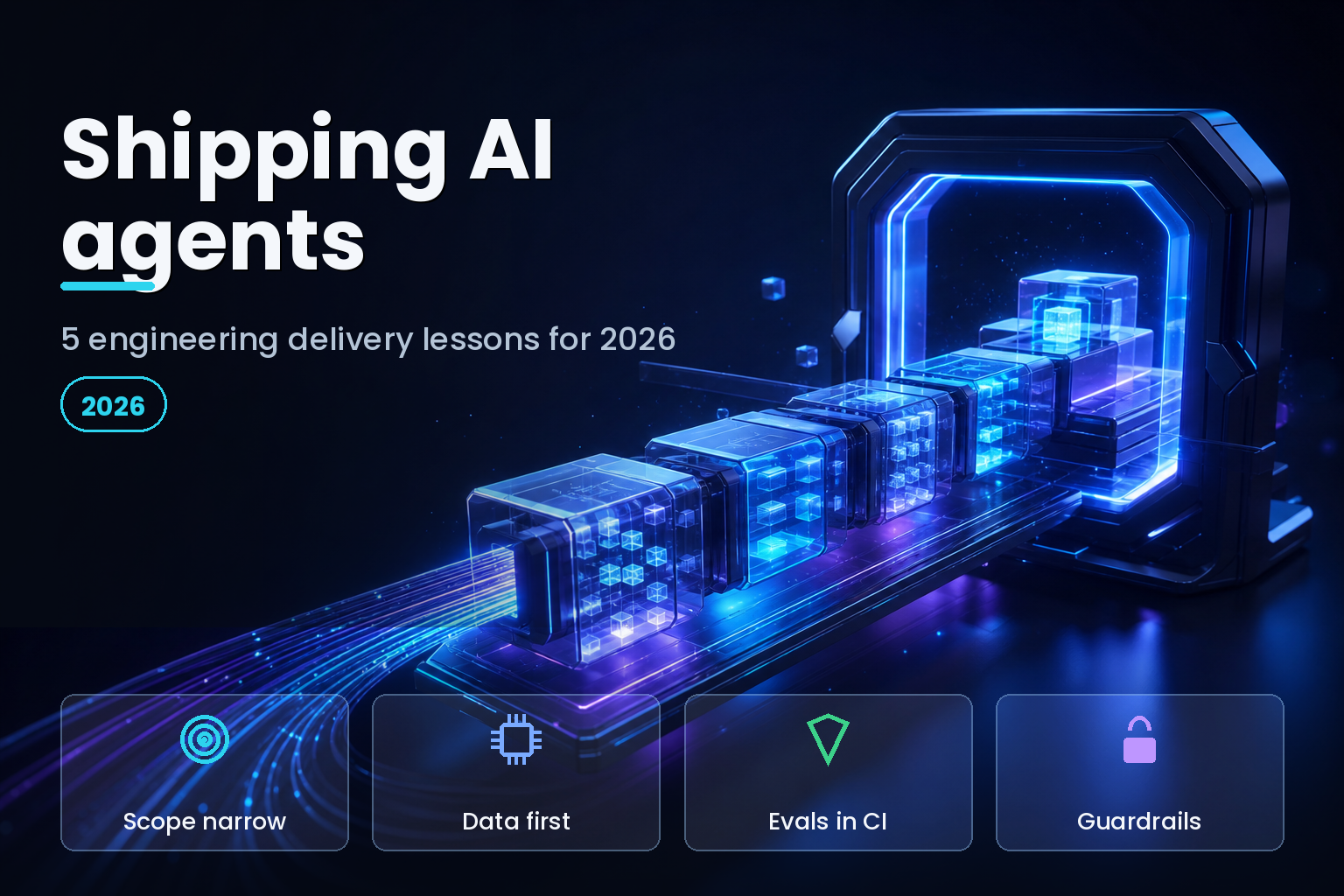
| Lesson | The failure it prevents | The delivery action |
|---|---|---|
| Scope narrow | Over-scoped pilots that stall | Ship one evaluable task first |
| Data and metric first | No measurable profit impact | Define the metric, ready the data |
| Evaluation is the plan | Finding failures in production | Evals in CI as a gate |
| Model is configuration | A model change resets the schedule | A provider interface, not lock-in |
| Guardrails and fallback | Orphaned, unsafe agents | Owner, observability, escalation |
A delivery sequence that works
These lessons compose into a sequence. Start by writing the narrow scope and the success metric, and confirm the data exists to serve both. Stand up the evaluation harness early, because it will shape everything after. Build the agent behind a provider interface so the model stays swappable, and wrap it in tool contracts, caps, and tracing. Ship the narrow version to real users behind a human fallback, watch the traces, and let the failures your evals surface drive the next iteration.
| Phase | Focus | Output |
|---|---|---|
| Define | Narrow scope, success metric, data | A task you can evaluate |
| Instrument | Evaluation harness and tracing | A quality gate, not a hope |
| Build | Provider interface, guardrails | A swappable, contained agent |
| Ship | Narrow release, human fallback | A product, not a pilot |
| Iterate | Failures become test cases | A roadmap driven by evidence |
India-specific considerations
For CTOs and engineering leads in India building production AI, two factors sharpen these lessons. First, cost discipline is an advantage: with token prices down about 80% and a wide provider spread, an Indian team that routes cheap models for routine steps and reserves expensive models for hard reasoning can deliver production AI at a fraction of a single-model design, which matters when pricing to an India-cost base for a global market. Second, data governance under the Digital Personal Data Protection Act, 2023 (DPDP) belongs in lesson 2: getting the data ready also means getting consent and handling right, and keeping sensitive inference on-device where a task's data sensitivity, not just its difficulty, decides the model. Our blog covers related delivery practices.
FAQ
How eCorpIT can help
eCorpIT is a Gurugram-based technology organisation with senior-led engineering teams that deliver production AI agents. We scope narrowly to an evaluable task, get your data and success metric right first, build evaluation into the timeline, keep the model swappable behind a provider interface, and ship behind guardrails with a clear operating model. If you want AI delivery that reaches production rather than stalling as a pilot, contact us. You can also browse the eCorpIT blog or read about our team.
References
_Last updated: July 5, 2026._