On this page · 10 sections
- The context: what Foundation Models v3 changed
- Lesson 1: reliability comes from architecture, not the model
- Lesson 2: the model layer is a commodity you will swap
- Lesson 3: evaluation, not prompting, is most of the work
- What this means for your next AI build
- A short delivery checklist
- India-specific considerations
- FAQ
- How eCorpIT can help
- References
Summary. Building AI agents that survive production is less about the model and more about the system around it. At WWDC 2026 on June 9, Apple introduced its third-generation Foundation Models, putting on-device models, Private Cloud Compute, and third-party models such as Claude and Gemini behind one Swift API, which validates a lesson teams learned the hard year before: plan to swap the model. The economics moved just as fast, with LLM API prices falling roughly 80% from 2025 to 2026 and Gemini 3.1 Flash-Lite now at $0.10 and $0.40 per million input and output tokens against Claude Opus at $5 and $25. Three engineering lessons hold across that change: reliability comes from architecture, not the model; the model layer is a commodity you will swap; and evaluation, not prompting, is most of the work. This is eCorpIT's read on why.
The reason these three matter is that they are where real projects fail, and where demos hide the failure. A slick prototype hides tool-call flakiness, model lock-in, and a total absence of evaluation. Production surfaces all three at once. The teams that ship treat the agent as a system, not a prompt.
The context: what Foundation Models v3 changed
Apple's third-generation Foundation Models, detailed in Apple's machine learning research, include AFM 3 Core, a three-billion-parameter on-device model, and a more capable AFM 3 Core Advanced that uses a sparse design activating one to four billion parameters per request. More important than the model is the framework around it. At WWDC 2026 the Foundation Models framework became one Swift API for on-device, Private Cloud Compute, and third-party models, with Anthropic and Google shipping their own Swift packages for Claude and Gemini. Apple also added multimodal image input, agentic primitives such as Dynamic Profiles, and open-sourced much of the framework, extending it to Linux.
For a team that had already been shipping agents, this was less a surprise than a confirmation. The industry converged on the same idea we had built toward: the model is a swappable component behind a stable interface. The three lessons below are what that year taught, and why AFM 3 reads as a validation rather than a reset.
Lesson 1: reliability comes from architecture, not the model
The single most expensive misconception is that a better model makes a reliable agent. In production, most incidents are not model errors at all. They are tool-call failures, context truncation, and runaway loops, and standard application monitoring cannot see them without agent-aware instrumentation, per analysis of production agent failures. An agent that calls the wrong tool with the right confidence is worse than one that fails loudly.
The fix is systems engineering, not prompt tuning. Define strict tool contracts so the agent cannot pass malformed inputs. Make state transitions deterministic so a run is reproducible. Add trace-level observability so you can see every step, tool call, and token, and cap loops so a planning agent cannot spin forever. The evidence for this is stark: harness-only changes, meaning the scaffolding around the model, can move an agent more than twenty ranking positions without swapping the model at all, per agent observability research. The model is strong; reliability comes from architecture and guardrails.
The organisational lesson is to staff and schedule accordingly. If your plan treats the agent as a prompt with a model behind it, you have under-scoped the work. The real build is the contracts, the state machine, the observability, and the guardrails that make a probabilistic component behave predictably enough to trust.
Lesson 2: the model layer is a commodity you will swap
Coupling your product tightly to one model is a bet against your own economics. LLM prices fell roughly 80% between 2025 and 2026, per CloudZero's pricing comparison, and the spread across providers is now enormous. Gemini 3.1 Flash-Lite runs $0.10 and $0.40 per million input and output tokens; Gemini 3.1 Pro is $2 and $12; Claude Opus 4.8 is $5 and $25; GPT-5.4 sits at $2.50 and $15. Prompt caching reads price at about 10% of base input, and batch processing can halve costs again. A design that hard-codes one model forfeits all of that.
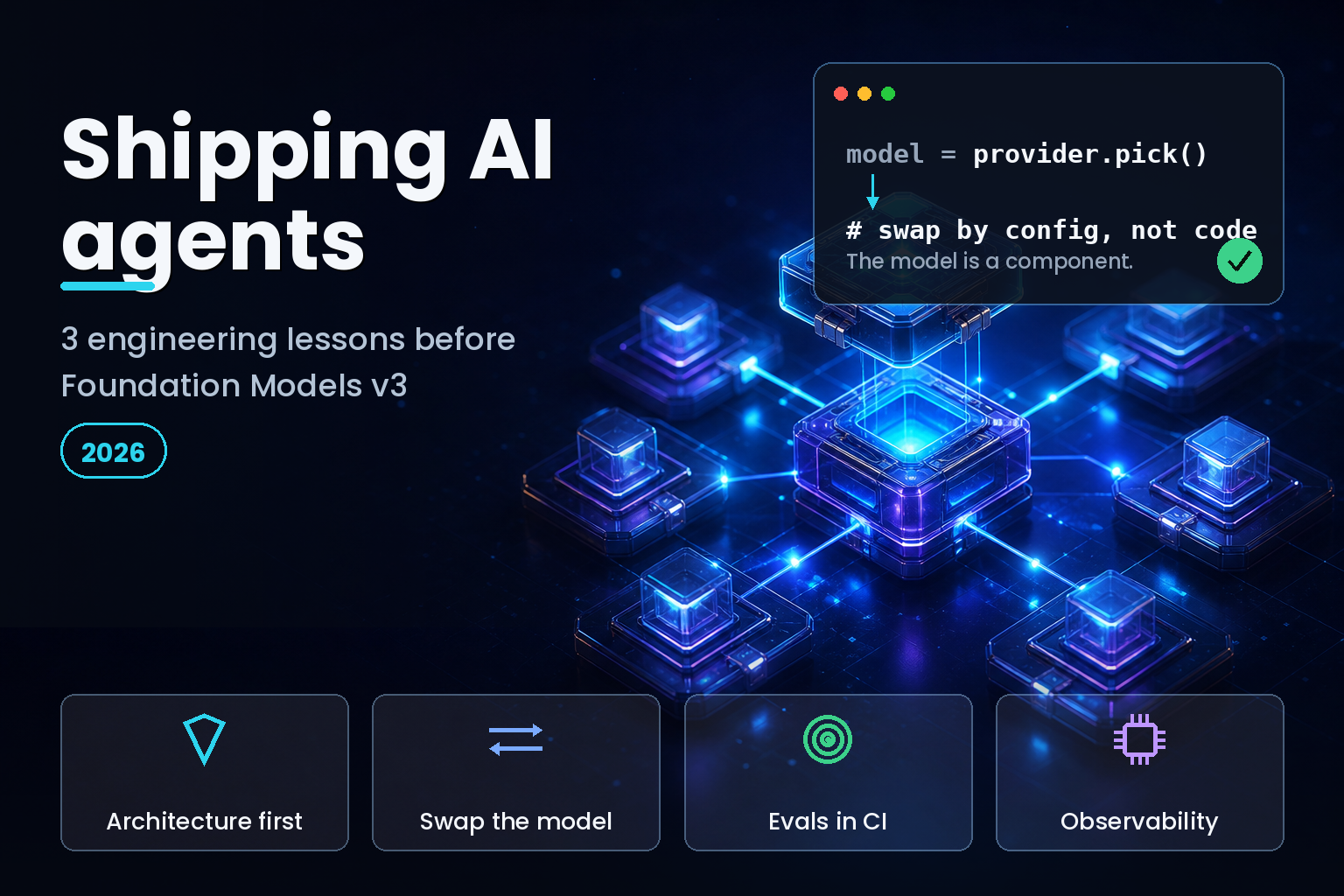
Apple's third-generation Foundation Models make the point at the platform level: one Swift API now fronts on-device, Private Cloud Compute, and third-party Claude and Gemini models. The right architecture treats the model as configuration, not code. Put a thin provider interface in front of every model call, keep prompts and tools model-agnostic where you can, and use vendor-neutral instrumentation such as the OpenTelemetry generative-AI conventions so you can swap or stack providers without rewriting your telemetry.
This is not only about price. Different tasks want different models: a cheap fast model for routing and extraction, a stronger model for hard reasoning, an on-device model for private or offline work. A swappable layer lets you route per task and re-route as prices and capabilities move, which in this market they do every quarter. The lesson learned before AFM 3 landed was to never let a single vendor's model become load-bearing in your codebase.
Lesson 3: evaluation, not prompting, is most of the work
The hardest lesson to accept is where the time goes. In successful AI product teams, evaluation consumes an estimated 60 to 80% of development time, and most of that is spent understanding failures rather than writing automated checks, per context-engineering research. A team that budgets days for evals and weeks for prompting has the ratio backwards.
Real evaluation has layers. You need unit evals on discrete steps, such as whether the agent called the right tool with the right inputs; LLM-as-judge regression suites for subjective output quality; and continuous sampling of production traces to catch drift once real users arrive, per agent evaluation guidance. Planning metrics matter as much as tool-calling metrics: was the route the agent chose a good one, and did it follow the route once tool outputs came back. The operational discipline is simple to state and hard to keep: every failure becomes a test case, and test cases gate deployment.
Underneath evaluation sits context engineering. The Anthropic Applied AI Team defined it as "the set of strategies for curating and maintaining the optimal set of tokens (information) during LLM inference, including all the other information that may land there outside of the prompts." Managing what the model sees, and when, is the discipline that separates a working agent from a demo, and it is exactly what you tune using the failures your evals surface.
What this means for your next AI build
Put together, the three lessons point at one architecture. Treat the model as a swappable component behind a stable interface, spend your engineering on the harness and guardrails that make it reliable, and invest most of your schedule in evaluation and context engineering rather than prompt wording. Apple's Foundation Models v3 did not create this pattern; it standardised it, which is the clearest signal yet that the industry has settled on the same answer.
| Lesson | The trap | The engineering response |
|---|---|---|
| Reliability is architecture | Assuming a better model fixes failures | Tool contracts, deterministic state, observability, loop caps |
| Swap the model | Hard-coding one vendor's model | A thin provider interface and vendor-neutral telemetry |
| Evaluation is the work | Budgeting days for evals, weeks for prompts | Layered evals in CI; failures become gating test cases |
| Model (2026) | Input / output per 1M tokens | Typical agent role |
|---|---|---|
| Gemini 3.1 Flash-Lite | $0.10 / $0.40 | Routing, extraction, high volume |
| GPT-5.4 | $2.50 / $15.00 | General reasoning |
| Gemini 3.1 Pro | $2.00 / $12.00 | Balanced reasoning |
| Claude Opus 4.8 | $5.00 / $25.00 | Hardest reasoning steps |
| Apple AFM 3 (on-device) | On-device compute | Private or offline tasks |
A short delivery checklist
Before you call an agent production-ready, confirm the fundamentals rather than the demo. Are your tool contracts strict enough that malformed inputs are impossible rather than merely unlikely. Is every run traceable end to end, with each tool call and token visible. Can you swap the underlying model by changing configuration, not code, and does your telemetry survive that swap. Do failures automatically become test cases, and do those tests gate your deployments. Have you capped loops and set budgets so a single run cannot burn unbounded tokens or time.
If any answer is no, the agent is a prototype, however well it demos. The gap between a prototype and a product is precisely these controls, and closing it is where a senior engineering team earns its keep. For a related view on delivery discipline, see our note on engineering delivery for AI in 2026.
India-specific considerations
For founder-engineers and AI delivery leads in India building for global users, two points matter. First, the cost architecture is a competitive advantage: with token prices down roughly 80% and a wide provider spread, a team that routes cheap models for routing and reserves expensive models for hard reasoning can run production AI at a fraction of a naive single-model design, which matters when pricing to an India-cost base and a global market. Second, on-device and Private Cloud Compute options, now unified in Apple's Foundation Models framework, help with data-residency and the Digital Personal Data Protection Act, 2023 (DPDP), because keeping private inference on-device reduces the personal data that leaves the user's control. Design the provider layer so a task's data sensitivity, not just its difficulty, decides which model runs it.
FAQ
How eCorpIT can help
eCorpIT is a Gurugram-based technology organisation with senior-led engineering teams that build production AI agents. We design the architecture that makes them reliable: strict tool contracts, deterministic state, trace-level observability, a swappable provider layer, and evaluation pipelines that gate deployment. If you want an agent that survives real users rather than one that only demos well, contact us. You can also browse the eCorpIT blog or read about our team.
References
_Last updated: July 5, 2026._