On this page · 8 sections
- Lesson 1: the model is rarely why the project dies — value is
- Lesson 2: buy the specialised thing before you build the generic one
- Lesson 3: the agent is your new security surface, and prompt injection owns it
- Lesson 4: you cannot ship what you cannot measure, and evals lag badly
- Lesson 5: token economics decides whether the agent survives finance
- FAQ
- How eCorpIT can help
- References
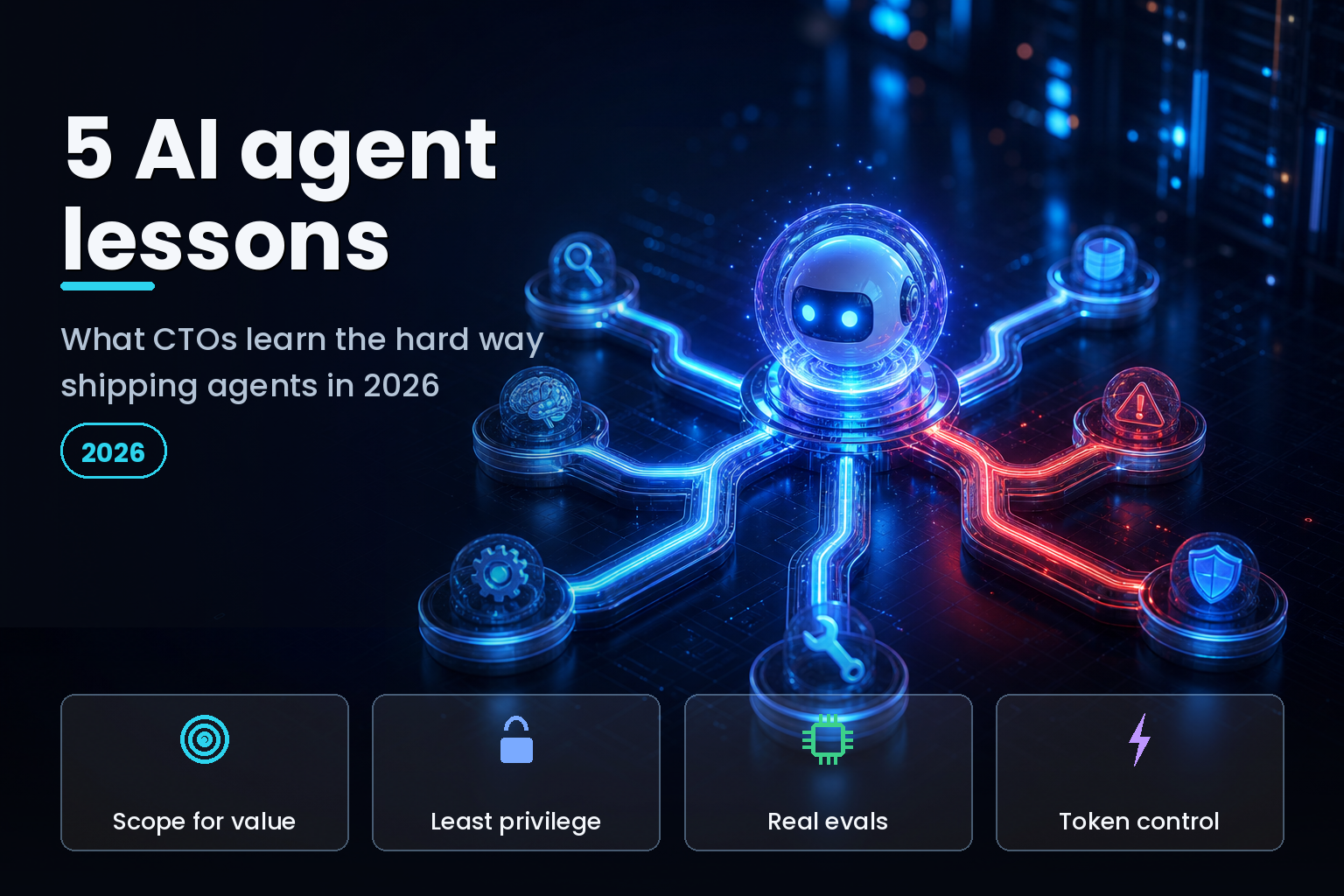
Summary. The uncomfortable data first. Gartner predicts that more than 40% of agentic AI projects will be canceled by the end of 2027, on escalating cost, unclear value and weak risk controls, from a June 2025 poll of over 3,400 organisations. MIT's "GenAI Divide" study, published in August 2025, found that 95% of enterprise generative AI pilots delivered no measurable return despite $30-40 billion in spending. Prompt injection sits at number one on the OWASP LLM risk list again in 2026. And a production agent can burn 5 to 30 times more tokens per task than a chatbot, pushing unoptimised sessions to $10-100 each. None of those failures are really about the model. They are engineering and judgement failures — in scope, security, measurement and cost. Below are five lessons that recur across teams shipping agents in 2026, each with the number that makes the case, aimed at the CTO who has to make this work rather than demo it.
The pattern is consistent enough to name. A capable model gets wired to a vague goal, no eval harness, broad tool permissions and an open token budget, and it demos beautifully. Then it meets real inputs, real adversaries and a real finance review, and it stalls. The lessons are about closing that gap before it opens.
| Lesson | The hard-won reality | 2026 data point |
|---|---|---|
| 1. Value, not the model | Projects die on unclear ROI | 40% canceled by 2027 (Gartner) |
| 2. Buy before you build generic | Specialised vendors win | Vendor buys succeed ~67% (MIT) |
| 3. Security is the agent surface | Prompt injection ranks #1 | OWASP LLM01, 2026 |
| 4. Evals lag observability | You ship what you cannot measure | 89% observe, 52% evaluate |
| 5. Token cost decides survival | Agents multiply spend | 5-30x tokens per task |
Lesson 1: the model is rarely why the project dies — value is
The single most common post-mortem finding is that the agent worked and the business case did not. Gartner's Anushree Verma, Senior Director Analyst, put it plainly: "Most agentic AI projects right now are early stage experiments or proof of concepts that are mostly driven by hype and are often misapplied." That mismatch is what stalls projects before production, and it is why Gartner expects the 40% cancellation rate by 2027.
Part of the problem is "agent washing" — vendors rebranding assistants, chatbots and robotic process automation as agents without real agentic capability. Gartner estimates that of the thousands of vendors claiming agentic solutions, only around 130 offer genuine ones. For a CTO, the defensive move is boring and effective: define the specific decision the agent will make, the metric it will move, and the human who owns the outcome, before writing a line of orchestration. If you cannot name the P&L line, you do not have a project; you have a demo. Our view on where agents fit a wider plan sits in our enterprise generative AI strategy guide.
Lesson 2: buy the specialised thing before you build the generic one
Teams love to build. The data says buy first. MIT's study, built from 150 executive interviews, a 350-person survey and 300 public deployments, found that purchasing from specialised vendors and building partnerships succeeded about 67% of the time, while internal builds succeeded roughly one-third as often. The same research located the biggest returns in back-office automation — cutting outsourcing and agency cost — not in the sales and marketing tools that absorbed more than half of GenAI budgets.
The lesson is not "never build." It is that a generic in-house agent competing with a focused commercial one usually loses on time-to-value and maintenance. Build where you have a real data or workflow advantage the vendor cannot replicate; buy the rest. And treat the "shadow AI" signal seriously: MIT found about 90% of workers already use personal AI tools daily even though only 40% of firms hold official subscriptions. That gap tells you where demand actually is inside your own company.
Lesson 3: the agent is your new security surface, and prompt injection owns it
The moment an agent can call tools, read email, or hit an API, a manipulated input can become a manipulated action. Prompt injection has held the number-one spot on the OWASP LLM Top 10 since the list began, and it holds it again in 2026. Agentic systems make it worse: a single injected instruction can hijack an agent's planning, trigger privileged tool calls, persist in memory and propagate across connected systems. The 2026 OWASP update added System Prompt Leakage and Vector/Embedding Weaknesses, and elevated Excessive Agency to critical status. This is not theoretical — in March 2026, Unit 42 researchers documented the first large-scale indirect prompt injection attacks in the wild, including system-prompt leakage on live commercial platforms.
The engineering response is defence-in-depth, not a cleverer system prompt. Give tools least-privilege access. Sandbox them. Validate inputs from every data source, including retrieved documents. Put a human approval step in front of any high-impact action. And run adversarial testing on a schedule, because the attacks evolve. An agent with broad permissions and no human-in-the-loop is a breach waiting for the right input.
Lesson 4: you cannot ship what you cannot measure, and evals lag badly
Agents are non-deterministic. Give the same input twice and the agent may reason differently, pick different tools and land on different outcomes. Traditional test suites assume determinism, so they miss most agent failures. The tooling gap is measurable: roughly 89% of teams with agents in production have some observability, but only about 52% run proper evaluations, and most failures live in the space between those two numbers.
Two practices separate teams that trust their agents from teams that hope. First, average evaluation scores across three or more runs to absorb non-deterministic variance, and separate deterministic logic — routing, parsing — from the probabilistic LLM output so you can test each on its own terms. Second, run eval metrics continuously against production traffic, treating evaluation as a form of observability, so you catch quality degradation between scheduled test runs. The real cost of skipping this is not a failed test; it is a silent regression your users find before you do.
Lesson 5: token economics decides whether the agent survives finance
An agent that reasons, plans, calls tools, validates and loops is a stack of separate API calls, and each call resends the accumulated context. That is why agentic workflows consume 5 to 30 times more tokens per task than a chat, and why an unoptimised production agent can cost $10-100 or more per session. Left alone, the bill scales with usage in a way that ambushes the next budget review.
| Cost driver | Effect on token spend |
|---|---|
| Long context vs short | 128K context costs ~16x an 8K context for the same task |
| Multi-turn accumulation | A 10-turn agent can hit 500K+ input tokens per task |
| Output vs input | Output tokens run 3-5x the price of input tokens |
| Agent vs chat | 5-30x more tokens per task overall |
Four levers actually work, and they are engineering decisions, not procurement ones: cap spend per user, cache system prompts so you stop paying to resend them, route by difficulty so a cheap model does the grunt work and an expensive one only handles hard reasoning, and prune the context window aggressively instead of resending everything. The real cost of an agent is usually the context you forgot to trim, not the model you chose. Build cost observability in from day one, next to your quality evals — more of our thinking lives on the eCorpIT blog.
FAQ
How eCorpIT can help
eCorpIT builds and hardens AI agents that survive production, not just demos. We scope agents to a measurable decision, wire least-privilege tools with human-in-the-loop controls aligned to OWASP guidance, stand up eval and cost observability, and design data handling in line with DPDP Act 2023 requirements. As a senior-led engineering organisation, we ship systems your finance and security teams can sign off. If you are moving an agent from pilot to production, talk to our team.
References
- Gartner, "Gartner Predicts Over 40% of Agentic AI Projects Will Be Canceled by End of 2027" (June 25, 2025) — gartner.com
- Fortune, "MIT report: 95% of generative AI pilots at companies are failing" (August 18, 2025) — fortune.com
- MarTech, "Gartner: 40% of agentic AI projects will fail, making humans indispensable" — martech.org
- Securance, "Prompt injection: the OWASP #1 AI threat in 2026" — securance.com
- DeepTeam, "OWASP Top 10 for Agents 2026" — trydeepteam.com
- Towards AI, "Agent Observability and Evaluation: A 2026 Developer's Guide" — towardsai.net
- SitePoint, "Testing AI Agents: Validating Non-Deterministic Behavior" — sitepoint.com
- Fastio, "AI Agent Token Cost Optimization: Complete Guide for 2026" — fast.io
- LeanOps, "AI Agents Burn 50x More Tokens Than Chats" — leanopstech.com
- Unit 42 / OWASP coverage, "OWASP LLM Top 10: AI Security Risks to Know in 2026" — elevateconsult.com
- Forbes, "MIT Finds 95% Of GenAI Pilots Fail Because Companies Avoid Friction" (August 26, 2025) — forbes.com
_Last updated: July 5, 2026._