On this page · 11 sections
- Status check: what is confirmed and what is not
- What C-DAC's RFE actually asks for
- Timeline: from RFE to usable GPUs
- The IndiaAI compute portal today: rates, subsidy and access
- How the portal compares with Indian GPU clouds and hyperscalers
- Worked cost example
- Decision table
- India data residency and DPDP notes
- Checklist before you apply or buy
- How eCorpIT can help
- References
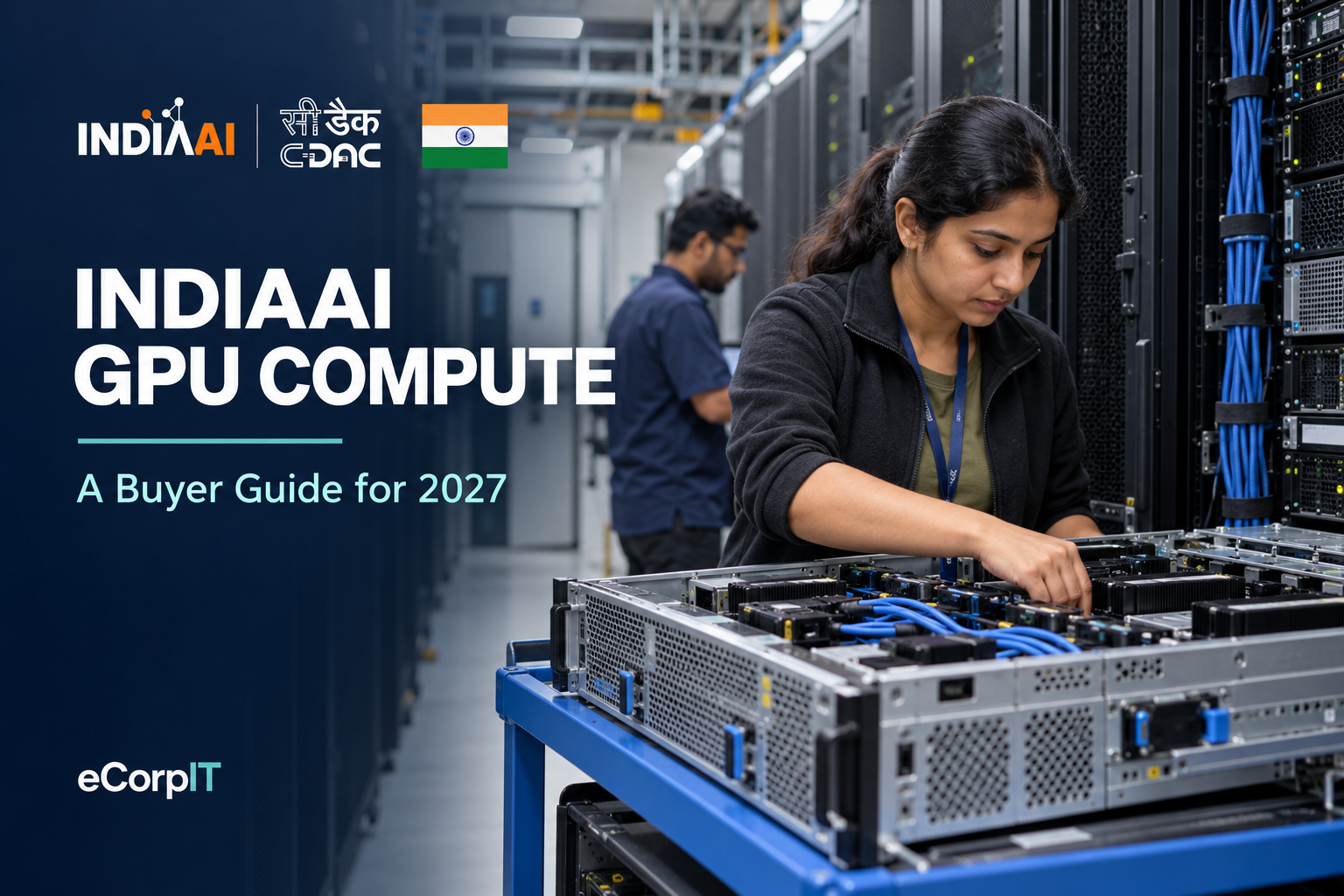
Summary. C-DAC's request for empanelment for up to 10,000 IndiaAI GPUs is still open. Published on 7 October 2026 as C-DAC/GPU/01/2026, it seeks AI service providers for five years of compute, in clusters of 4,000, 1,000 or 512 units. A second corrigendum moved bid closing from 29 October to 15:30 IST on 13 November 2026, and technical bid opening to 14 November. Stage 1 is technical qualification with no prices. Prices, service levels and quantities come later, in Stage 2 through GeM. No panel or award date exists, so any 2027 result is expected, not confirmed. The minister has said the first tender would cover 5,000 GPUs; the RFE does not say so. For buyers, the live route is the IndiaAI compute portal: an H100 SXM at ₹153 per GPU-hour on demand (₹117 on a 12-month reservation), an H200 SXM at ₹140 and a B200 at ₹290.70, before GST and a subsidy capped at 40%. Public list prices are higher: E2E ₹379.05, Yotta ₹356 and an AWS Capacity Block in Mumbai $5.970 per H100-hour. Eligible startups, researchers and government bodies should use the portal now. Everyone else should treat the C-DAC process as a 2027 signal, not a purchasing route.
About this article. For Indian CTOs, founders, research leads and public-sector buyers planning GPU capacity. On 1 November 2026 we checked tender details against C-DAC's RFE of 7 October 2026 and its corrigenda of 13 and 27 October 2026, GPU counts and rates against the portal, PIB and vendor rate cards, and DPDP dates against the Gazette copy of G.S.R. 846(E). This is not legal, procurement or financial advice. Rates change, so re-check before you commit. No vendor paid for inclusion. Researched with AI assistance and reviewed by our editorial team.
Status check: what is confirmed and what is not
The dates are the main trap. The RFE gives 29 October for closing and 30 October for opening, and C-DAC's second corrigendum of 27 October replaced both. C-DAC's own listing now shows 13 November. At least one trade report on 30 October still described submissions as closed, so go by the corrigendum.
| Claim | Status on 1 November 2026 | Source |
|---|---|---|
| RFE for up to 10,000 AI Compute Units, published 7 October 2026 | Confirmed | C-DAC RFE |
| Closing moved to 13 November 2026, opening to 14 November 2026 | Confirmed | Corrigendum 2, 27 October 2026 |
| First tender to cover 5,000 GPUs | Reported from the minister's remarks; not in the RFE | MediaNama, Outlook Business |
| Empanelled provider list and Stage 2 dates | Not published | None yet |
| How end users will request the new capacity | Not published | RFE requires a provider-run allocation portal, no user process |
The 5,000 figure comes from remarks reported on 8 October 2026. If you read that a winner has been named, check C-DAC's listing and GeM before acting.
What C-DAC's RFE actually asks for
The document is short on prices but long on obligations, which show what the 2027 capacity should look like.
Scope. Empanelled AI service providers (ASPs) deliver end-to-end compute for five years: hardware, networking, storage, multi-tenant orchestration, observability, round-the-clock operations, a NOC and a SOC. A unit can be a GPU, TPU or other accelerator. The RFE names H100 and H200 plus later or equivalent accelerators, in ultra-high-end, high-end and mid-end tiers. Exact hardware is left to Stage 2, and C-DAC may scale beyond 10,000 units on demand. On later generations, see our note on Rubin Ultra and Kyber.
Ring-fenced, not shared. Committed capacity must be reserved, identifiable and verifiable. Providers may own the hardware or use a lease or colocation, but they remain the single point of responsibility and cannot subcontract the service or act merely as a pass-through. That shuts out a pure reseller, not a provider in a leased hall.
Data sovereignty. The data plane and control plane, plus data, metadata, logs, backups, disaster recovery and telemetry, must stay in India.
Eligibility. A bidder must be an Indian company, LLP or partnership with average audited turnover of at least ₹120 crore over FY 2023-24 to 2025-26, positive net worth on 31 March 2026, a Tier-III or Rated-3 data centre in India, ISO/IEC 27001 certification, and a NOC and SOC in India. It needs 512 units installed at one Indian site, or an OEM-accepted purchase order to install them within six months of its bid, backed by a ₹10 crore guarantee that is forfeited if the hardware does not arrive.
Scoring. Bidders need 60 of 100 marks: installed capacity 30 (20 for 512 units, 10 more for another 512, or only 10 for a purchase order), data centre 15, security certifications 15, SASE 5, finances 15, government GPU projects 10, and a technical presentation 10.
Terms. Empanelment lasts three years and can be extended by up to three more. Bid validity is 180 days from submission. The Stage 2 winner posts a performance security of 5% of contract value, valid for 66 months (six months to implement, then five years of service). Empanelment guarantees no business. C-DAC's stated principles start billing only once it accepts the commissioned infrastructure.
Timeline: from RFE to usable GPUs
Dates come from the RFE and both corrigenda.
| Date | Event | Status |
|---|---|---|
| 7 Oct 2026 | RFE published on CPPP (Tender ID 2026_DIT_929273_1) | Done |
| 13 and 27 Oct 2026 | Corrigenda move the pre-bid to 22 Oct, then closing and opening | Done |
| 13 Nov 2026 | Bid submission closes at 15:30 IST | Upcoming |
| 14 Nov 2026 | Technical bids open at 16:00 IST | Upcoming |
| Not published | Stage 1 evaluation and empanelment list | Pending |
| About 12 May 2027 | 180-day validity ends for a bid filed on the closing day | Our calculation |
| About 13 May 2027 | Six-month install deadline for a purchase-order bid filed that day | Our calculation |
| Not published | Stage 2 GeM bids with prices, SLAs, quantities and locations | Pending |
- Dates can still move. C-DAC has changed them twice and reserves the right to amend timelines. The CPPP record adds two days if fewer than three bids are in.
- Hardware comes first. Stage 2 only includes providers with operational capacity, so a purchase-order bidder cannot win work until its 512 units run.
- May 2027 is an outer marker. The validity window suggests Stage 1 should finish by about 12 May 2027. That is our inference.
- Usable capacity may come later. The security clause assumes six months of implementation, so a May 2027 contract could mean go-live around November 2027, or sooner with hardware already running. This is arithmetic, not a schedule.
Stage 2 runs in rounds between C-DAC and empanelled providers, so on the RFE's terms an ordinary company will not buy from this panel directly.
The IndiaAI compute portal today: rates, subsidy and access
The RFE adds capacity to an existing programme. The IndiaAI compute portal, built by BISAG-N for MeitY, lists 14 empanelled bidders, including E2E Networks, Yotta, Tata Communications, CtrlS, NxtGen, Sify and Netmagic/NTT with Neysa. Its GPU sheet, a file dated 2 September 2026, adds up to 45,081 units, led by 16,496 H100, 8,192 B200 and 7,916 H200. PIB's backgrounder of 29 October 2026 agrees, at more than 45,000.
In early 2026 the government cited 38,000+ GPUs with 20,000 more due within weeks. By our arithmetic the sheet shows roughly 7,000 of that so far. For the wider picture, see our July 2026 overview of sovereign AI.
Published rates (L1 bidder, per hour, excluding GST)
These come from the portal's calculator, read on 1 November 2026. Its footer shows a last update of 14 October 2026.
| Instance | On demand | 1-month reserved | 12-month reserved | Per GPU on demand |
|---|---|---|---|---|
| H100 SXM 1x | ₹153.00 | ₹134.10 | ₹117.00 | ₹153.00 |
| H100 SXM 8x | ₹1,224.00 | ₹1,072.80 | ₹936.00 | ₹153.00 |
| H200 SXM 1x | ₹140.00 | ₹135.00 | ₹100.00 | ₹140.00 |
| H200 SXM 8x | ₹1,125.00 | ₹1,100.00 | ₹785.00 | ₹140.63 |
| B200 SXM 1x | ₹290.70 | ₹277.20 | ₹251.10 | ₹290.70 |
| B300 SXM 1x | ₹351.00 | ₹342.00 | ₹319.50 | ₹351.00 |
| L40S 1x | ₹67.50 | ₹49.50 | ₹45.00 | ₹67.50 |
Additional block or file storage costs ₹1.10 per GB-month and object storage ₹0.78. The subsidy is capped at 40%, subject to IndiaAI approval.
The H200 SXM 2x and 4x work out to ₹255 per GPU, against about ₹140 for the 1x and 8x. The H100 PCIe 1x lists at ₹252, above the SXM part. Rates also move: the March 2026 Ready Reckoner listed a B200 1x at ₹323. An hourly rate is not a unit cost either, as our B200 and H100 cost-per-token comparison shows. The calculator also checks capacity and can report that no bidder has your quantity, so confirm availability before planning around a rate.
Who can apply
The portal sets seven user categories, grouped here:
- Researchers and academia: h-index of 5 or more, a paper in an ML/AI journal with impact factor above 2.5, or 150+ citations.
- Startups and MSMEs: DPIIT recognition, AI/ML experience, and annual revenue of ₹50 lakh or funding of ₹1 crore.
- Early-stage startups: four years of AI/ML experience plus a letter from the IndiaAI CEO or a Joint Secretary-rank officer or above.
- Students, IndiaAI Fellows and early-stage researchers: an AI/ML project or profile, or the fellowship.
- Government entities: a letter from a Director, MD, GM or other authorised officer.
How the process works
The portal's FAQs and service-level page set out these steps.
- Log in through Meri Pehchaan (DigiLocker, e-Pramaan or Jan Parichay), register and upload documents.
- After verification, submit a proposal with technical approach, expected impact and draft bill of materials, including any subsidy request.
- Requests under 5,000 GPU-hours are approved automatically. Larger ones go to the PMEC committee. Submit between the 1st and 25th; approved lists appear on the 10th of the next month.
- Compute is allocated within 2 days of approval under 100 AI compute hours, otherwise within 7 days.
- Start within 30 calendar days or the approval lapses. You pay the provider directly, including anything beyond the subsidy.
How the portal compares with Indian GPU clouds and hyperscalers
These are list prices per GPU-hour, excluding GST. vCPU, RAM, storage, egress and interconnect differ, so treat the table as a price guide, not a benchmark.
| GPU | IndiaAI portal (on demand) | After max 40% subsidy | E2E Networks (on demand) | Yotta Shakti Cloud | AWS Capacity Blocks, Mumbai |
|---|---|---|---|---|---|
| H100 | ₹153.00 | ₹91.80 | ₹379.05 (committed ₹347.70, spot ₹70) | ₹356 (1x VM on demand); ₹351 per GPU bare metal (8x, monthly) | $5.970 |
| H200 | ₹140.00 | ₹84.00 | ₹502.55 (committed ₹462.65, spot ₹88) | Not listed | $6.866 (p5e) |
| B200 | ₹290.70 | ₹174.42 | ₹759.05 (committed ₹683.05) | ₹473 per GPU bare metal (8x, monthly) | $14.208 |
| L40S | ₹67.50 | ₹40.50 | ₹102 | ₹137 (1x VM on demand) | Not listed |
- E2E Networks bills in INR from Delhi NCR and Chennai. Its rate card was generated on 30 October 2026. Committed rates go through sales. Spot capacity can be interrupted and covers only part of the fleet.
- Yotta's page carries a metadata date of 28 January 2026, so get a current quote. It lists H100 8x bare metal at ₹338 for six months, ₹263 for one year and ₹253 for two. Ingress and egress are included, and InfiniBand is charged separately on bare metal.
- AWS Capacity Blocks are paid up front, and AWS says prices next update in January 2027. At ₹95 per dollar (our assumption, near the ECB cross-rate of ₹94.96 on 30 October 2026), $5.970 is about ₹567 per H100-hour.
Portal L1 rates sit well below what these two Indian clouds publish, though L1 is the lowest bid per instance and need not be either provider's own. The cost is eligibility, approval cycles and paperwork. E2E's interruptible ₹70 H100 spot rate beats the subsidised on-demand ₹91.80 and roughly matches a fully subsidised 12-month reservation (₹117 less 40% is ₹70.20). For checkpointed training, test it before you apply.
Worked cost example
Scenario A: a DPIIT-recognised startup fine-tunes a model for 2,000 H100 GPU-hours. That is below 5,000 hours, so the portal's FAQ says it is auto-approved. The FAQ also ties allocation to whether a subsidy is sought, so treat 40% as a ceiling.
- IndiaAI portal: 2,000 × ₹153 = ₹3,06,000. Less the maximum 40% subsidy (₹1,22,400) = ₹1,83,600, plus GST.
- E2E on demand: 2,000 × ₹379.05 = ₹7,58,100. On spot: 2,000 × ₹70 = ₹1,40,000, if capacity is available and the job checkpoints.
- Yotta VM on demand: 2,000 × ₹356 = ₹7,12,000.
- AWS Capacity Block, Mumbai: 2,000 × $5.970 = $11,940, about ₹11,34,300 at the assumed ₹95.
Scenario B: a research lab needs 8x H100 continuously for 12 months. That is 8 × 8,760 = 70,080 GPU-hours, which means PMEC approval.
- IndiaAI 12-month reserved: ₹936 × 8,760 hours = ₹81,99,360. With the maximum subsidy, ₹49,19,616.
- E2E committed rate: ₹347.70 × 8 × 8,760 = ₹2,43,66,816.
- Yotta bare metal at the one-year rate: ₹263 × 8 × 8,760 = ₹1,84,31,040, plus InfiniBand.
At the maximum subsidy the portal costs about 20% of the E2E figure and 27% of the Yotta figure. With no subsidy it is about 34% and 44%. Do not budget on the full subsidy until you hold the approval.
Decision table
| Pick this | If |
|---|---|
| IndiaAI compute portal | You meet a portal category, fit monthly approval cycles, and put cost above turnaround |
| E2E or Yotta on demand, or E2E spot | You need GPUs this week, are not eligible, or want checkpointed spot jobs at E2E's ₹70 to ₹88 |
| E2E committed or Yotta bare metal | You need dedicated capacity for months and can negotiate a term rate |
| AWS, Azure or Google Cloud | You need managed AI services, global regions, enterprise agreements or short training bursts |
| Wait for C-DAC Stage 2 | You are a ministry or department planning multi-year capacity through C-DAC |
India data residency and DPDP notes
The C-DAC RFE sets a strict residency text for AI compute. We found no equivalent published text for the existing portal, and its sheet lists Ishan and Sify with Google Cloud India as the cloud provider, so ask where your data sits. AWS Capacity Blocks for H100 and B200 are in Mumbai, with B200 and B300 in Hyderabad.
If you process personal data, the DPDP Rules' main obligations start on or about 13 May 2027, 18 months after publication in the Gazette dated 13 November 2025. Our final checklist covers what applies. Map where training data, checkpoints and inference logs sit before you choose a cloud. Model-API residency is a separate question, as our note on OpenAI regional processing for India explains.
Checklist before you apply or buy
- Confirm your category on the portal and gather documents.
- Size your job in GPU-hours. Under 5,000 avoids the committee; above it, plan around the 1st-to-25th window.
- Build the bill of materials from the current rate list, then add storage, data transfer and GST.
- Make training portable: containers, checkpoints in object storage and no single-provider lock-in.
- For production inference, get SLAs in writing. A portal approval lapses if unused for 30 days and rests on an approved project.
- Government buyers: watch C-DAC's listing and GeM. Stage 2 documents go to empanelled providers first.
How eCorpIT can help
eCorpIT is a Gurugram-based technology organisation, founded in 2021, assessed at CMMI Level 5 and MSME certified, with senior-led engineering teams working across AWS, Microsoft and Google platforms. Our AI and machine learning services team helps Indian startups and enterprises size GPU needs, prepare the technical approach and bill of materials that compute programmes ask for, and build portable training and inference pipelines. Talk to us at /contact-us/.
Last updated: 1 November 2026.