On this page · 10 sections
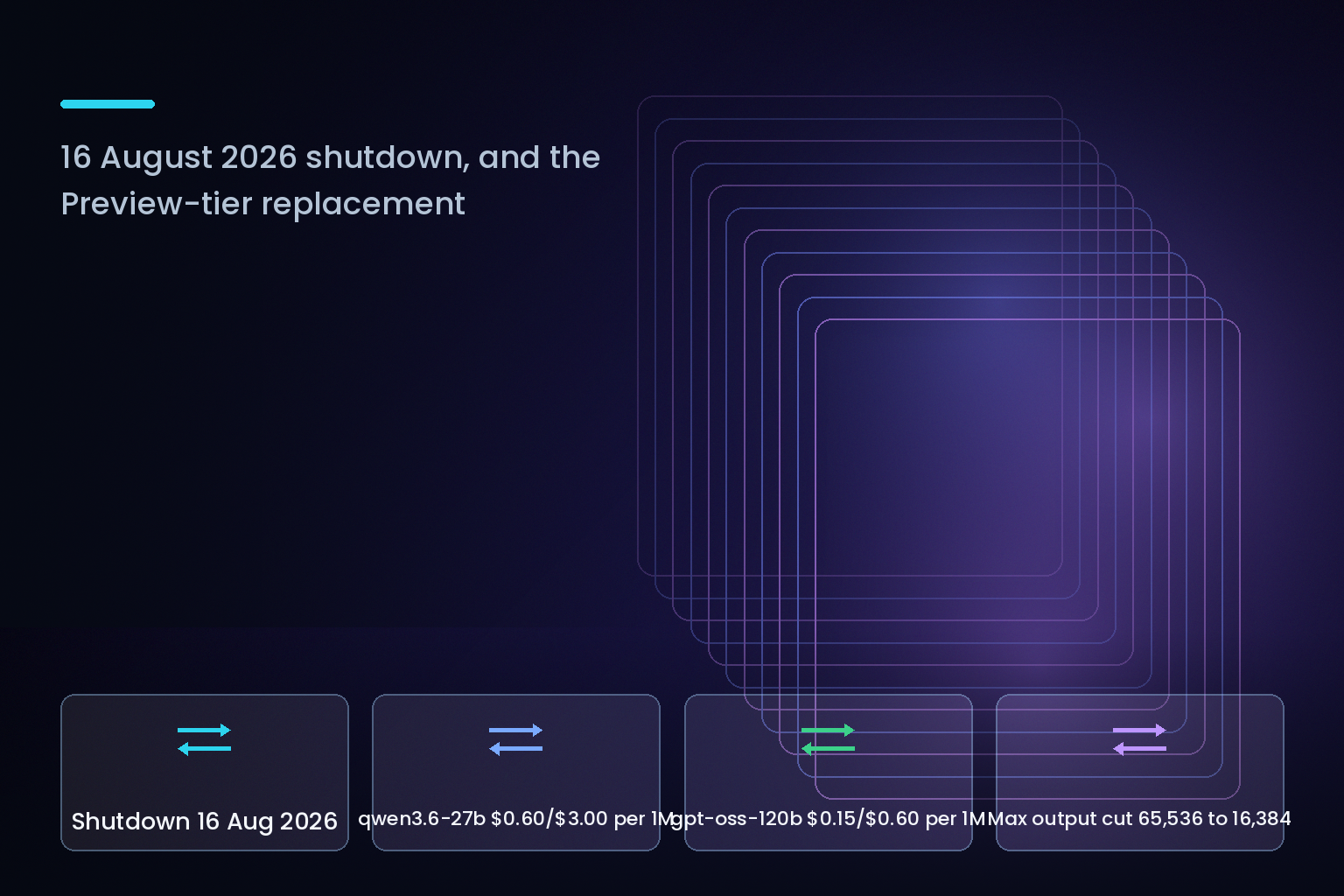
Summary. On 16 August 2026 Groq shut down llama-3.1-8b-instant and llama-3.3-70b-versatile for free and developer-tier accounts, five days before this article was written. Groq's deprecation page offers two replacements for the 70B model: openai/gpt-oss-120b at $0.15 input and $0.60 output per 1M tokens, or qwen/qwen3.6-27b at $0.60 and $3.00. That second option is 4x the input price and 5x the output price of the first. It also sits in the Preview tier on Groq's Supported Models page, under a note reading "Preview models are intended for evaluation purposes only and should not be used in production environments as they may be discontinued at short notice." The same document that defines that rule recommends the model as a production replacement. Enterprise customers on a committed-spend contract keep both retired models.
What changed, and when
Groq emailed affected users on 17 June 2026 and set the shutdown for 16 August 2026, a 60-day window. The deprecation page states the scope plainly: "This deprecation applies to free and developer-tier usage; enterprise customers with a committed-spend contract are not affected."
The recommended replacements, as printed in Groq's own table:
| Deprecated model | Shutdown date | Groq's recommended replacement |
|---|---|---|
llama-3.1-8b-instant |
16 Aug 2026 | openai/gpt-oss-20b |
llama-3.3-70b-versatile |
16 Aug 2026 | openai/gpt-oss-120b or qwen/qwen3.6-27b |
qwen/qwen3-32b |
17 Jul 2026 | openai/gpt-oss-120b |
meta-llama/llama-4-scout-17b-16e-instruct |
17 Jul 2026 | openai/gpt-oss-120b or qwen/qwen3.6-27b |
This is the second wave in two months from the same 17 June 2026 email cycle. Groq removed four model IDs from free and developer tiers between 17 July and 16 August 2026.
Two things make this harder to catch than a normal deprecation. First, the Groq changelog carries no entry for it. The newest dated item on that page is 18 April, covering the MiniMax M2.5 and Qwen3-VL 32B Instruct Enterprise additions and the Python SDK v1.2.0 release. A team watching the changelog for breaking changes saw nothing. Second, the "Deprecated Models" heading on the Supported Models page has no table under it at all, only a link back to the deprecation guidelines. A developer checking the model catalogue on 21 August 2026 sees llama-3.3-70b-versatile absent from every table and no explanation of where it went.
The contradiction inside one document
Groq's deprecation page carries its own lifecycle guidelines. Under "Preview Models" it lists three properties: "Evaluation Purpose: Preview models are often early releases or early access models that are intended for evaluation purposes only and should not be used in production environments." "Limited Support: Preview models may be discontinued at short notice with limited advance warning." "Experimental Usage: Preview models often show new capabilities or architectures and may be refined based on user feedback."
Under "Production Models" the same page promises: "When a production model is deprecated, we will provide a clear migration path and recommended replacement model."
llama-3.3-70b-versatile was a production model. The clear migration path Groq provides includes qwen/qwen3.6-27b, which the Supported Models page files under Preview, three rows below Meta's Prompt Guard classifiers. So the migration path out of a production model runs into a model the vendor says may be discontinued at short notice with limited advance warning.
The other named replacement, openai/gpt-oss-120b, is a genuine production model and appears in the Production Models table. If you take that branch the contradiction never bites you. The problem is that the deprecation page presents the two as equivalent alternatives, separated by "or", with no note that one is Preview and one is Production and no price attached to either.
What the swap actually costs
Prices below are from the Groq model cards as published on 21 August 2026, quoted per 1 million tokens.
| Model | Input | Cached input | Output | Max output tokens |
|---|---|---|---|---|
openai/gpt-oss-120b |
$0.15 | $0.075 | $0.60 | 65,536 |
qwen/qwen3.6-27b |
$0.60 | not published | $3.00 | 16,384 |
openai/gpt-oss-20b |
$0.075 | $0.037 | $0.30 | 65,536 |
Three consequences follow from that table, and none of them appear on the deprecation page.
The price gap is 4x on input and 5x on output. A workload spending $1,000 a month on gpt-oss-120b output tokens spends $5,000 on qwen3.6-27b for the same volume. Groq's own production-ready checklist sets an alerting threshold of "Track cost increases (alert if >20% above baseline)". A team that follows the deprecation page's second suggestion trips its own cost alarm by roughly 400%.
Prompt caching does not close the gap. The gpt-oss-120b and gpt-oss-20b model cards both publish a cached-input rate at exactly half the standard input price. The qwen3.6-27b card publishes no cached-input figure at all. Groq's rate limits page states that "Cached tokens do not count towards your rate limits", so caching still buys headroom, but the per-token discount that makes long system prompts affordable on the GPT-OSS models is not documented for the Qwen model. Treat it as unknown rather than as zero.
Maximum output collapses by a factor of four. Both GPT-OSS models cap completions at 65,536 tokens. qwen/qwen3.6-27b caps at 16,384. Context window is identical at 131,072 across all three, so the break is on generation length only. Long-document generation, bulk translation and any agent that emits large structured payloads in a single completion will start truncating.
What breaks in code, not just in billing
Capability sets differ, and this is the part that fails at runtime rather than at invoice time.
| Capability | openai/gpt-oss-120b |
qwen/qwen3.6-27b |
|---|---|---|
| JSON Schema Mode | Listed | Not listed |
| JSON Object Mode | Listed | Listed |
| Browser Search | Listed | Not listed |
| Code Execution | Listed | Not listed |
| Image input | Text only | Text and images, max 3 |
If your service pinned llama-3.3-70b-versatile and used structured outputs with a JSON Schema, the Qwen card lists JSON Object Mode but not JSON Schema Mode. Object mode guarantees valid JSON; schema mode guarantees the shape you asked for. Downstream parsers built on a guaranteed schema are the thing that breaks, and they break as malformed-payload exceptions in your own code rather than as an error from Groq.
The Qwen model gains vision that neither GPT-OSS model has: text and image input, a 20 MB maximum file size, and a maximum of 3 input images. If you were already routing image work to a separate provider, that is the one honest reason to take the more expensive branch.
Sampling defaults also move. The Qwen card recommends temperature=1.0, top_p=0.95, top_k=20, min_p=0 for thinking mode and temperature=0.7, top_p=0.80, top_k=20, min_p=0, presence_penalty=1.5 for non-thinking mode, with thinking and non-thinking selected through reasoning_effort. Groq's model migration guide does not cover any of this. That guide is about moving prompts from closed models such as GPT, Claude and Gemini onto open ones, and its parameter table only compares closed-source defaults against Llama defaults. There is no in-platform, model-to-model migration guide for the deprecation Groq just executed.
How to tell if this is you
Check three things, in this order.
Are you on a committed-spend enterprise contract? If yes, both retired model IDs still work for you and nothing below applies. The deprecation is scoped to free and developer tiers.
Do any of your services send a hardcoded model string of llama-3.3-70b-versatile or llama-3.1-8b-instant? Grep your repositories, your prompt-template store and your infrastructure-as-code for those two literals. Groq's deprecation page states that "After the deprecation date, the model will no longer be accessible" and "Requests to deprecated model IDs will return errors". It does not say which HTTP status you get. Groq's error codes page documents 400 Bad Request for invalid syntax and 404 Not Found for a missing resource, and lists neither as the deprecation response. Your retry logic matters here: a 404 will not be retried by most SDK defaults, but a 400 will not be either, and a client that treats any non-200 as transient will burn its retry budget on a model that is never coming back.
Does anything in your stack enumerate https://api.groq.com/openai/v1/models and pick the first match by substring? That pattern silently reroutes traffic when the catalogue changes.
What to do
Default to openai/gpt-oss-120b for the 70B replacement and openai/gpt-oss-20b for the 8B replacement. Both are Production-tier, both keep the 65,536-token completion ceiling, both publish a cached-input price, and both retain JSON Schema Mode, Browser Search and Code Execution.
Take qwen/qwen3.6-27b only if you need image input inside the same call, and only with the Preview status written into your risk register. Groq's rule for Preview is discontinuation at short notice with limited advance warning, and you have just watched the company execute a 60-day notice on a Production model.
Re-run your structured-output tests before switching, not after. Schema-mode behaviour is the failure that surfaces in your parser rather than in Groq's response.
Add deprecation monitoring that does not depend on the changelog. The changelog missed this. The Supported Models page has an empty Deprecated Models section. Only the deprecation page carried the date, and the only push notification was a single email on 17 June 2026 to whoever held the account at the time. Polling https://api.groq.com/openai/v1/models on a schedule and diffing the result is the cheap version of this. The real cost of a deprecation is rarely the code change; it is finding out late.
What is still unknown
Three things are not published and should not be guessed at.
The HTTP status code returned for a request to a retired model ID. The deprecation page says errors; the error codes page does not name one.
The cached-input price for qwen/qwen3.6-27b. Absent from the model card while both GPT-OSS cards publish theirs.
Whether the Developer-plan rate limits printed on the Supported Models page for qwen/qwen3.6-27b (250K TPM, 1K RPM) reconcile with the figures on the rate limits page. That page renders Free and Developer limits in a tabbed table, and a plain fetch cannot reliably tell which tab it captured. Read your own numbers at the limits page in account settings rather than trusting either printed table.
FAQ
How eCorpIT can help
Model deprecations of this shape are a portfolio problem before they are a code problem: you need to know every service, prompt template and pipeline that pins a model ID before the shutdown date, not after. eCorpIT's senior engineering teams run application portfolio analysis and LLM migration work for teams on GroqCloud, Bedrock and the OpenAI platform, including structured-output regression testing across model swaps. If you are working out what a provider change costs you, talk to us or read how we staff AI engineering teams.
References
- Model Deprecation - GroqDocs - shutdown dates, replacement table, Preview and Production lifecycle guidelines, enterprise scope.
- Supported Models - GroqDocs - Production, Preview and empty Deprecated Models sections; prices and limits per model.
- Qwen 3.6 27B model card - GroqDocs - $0.60/$3.00 pricing, 16,384 max output, 20 MB file size, 3 input images, sampling defaults.
- OpenAI GPT-OSS 120B model card - GroqDocs - $0.15/$0.075/$0.60 pricing, 65,536 max output, capability list.
- OpenAI GPT-OSS 20B model card - GroqDocs - $0.075/$0.037/$0.30 pricing, 65,536 max output.
- Changelog - GroqDocs - newest dated entry 18 April; no deprecation notice.
- API Error Codes and Responses - GroqDocs - 400, 404 and 429 definitions; no deprecation-specific code.
- Rate Limits - GroqDocs - cached tokens excluded from limits, RPM/TPM definitions, 429 handling.
- Production-Ready Checklist - GroqDocs - the 20% cost-increase alert threshold and model-selection steps.
- Model Migration Guide - GroqDocs - closed-to-open migration scope; no in-platform model-to-model path.
- Structured Outputs - GroqDocs - JSON Object Mode and JSON Schema Mode definitions.
- Prompt Caching - GroqDocs - caching behaviour referenced by the cached-input pricing rows.
Last updated 21 August 2026. All prices, limits and dates read directly from Groq documentation on that date.