On this page · 11 sections
- What the announcement says
- The contradiction, quoted
- The three-console instruction that was never updated
- The free tier cap AWS has not quantified
- Five output formats, and Terraform is not one of them
- Recording costs nothing; the actions cost what they always did
- Who should look at this now
- What is still unknown
- FAQ
- How eCorpIT can help
- References
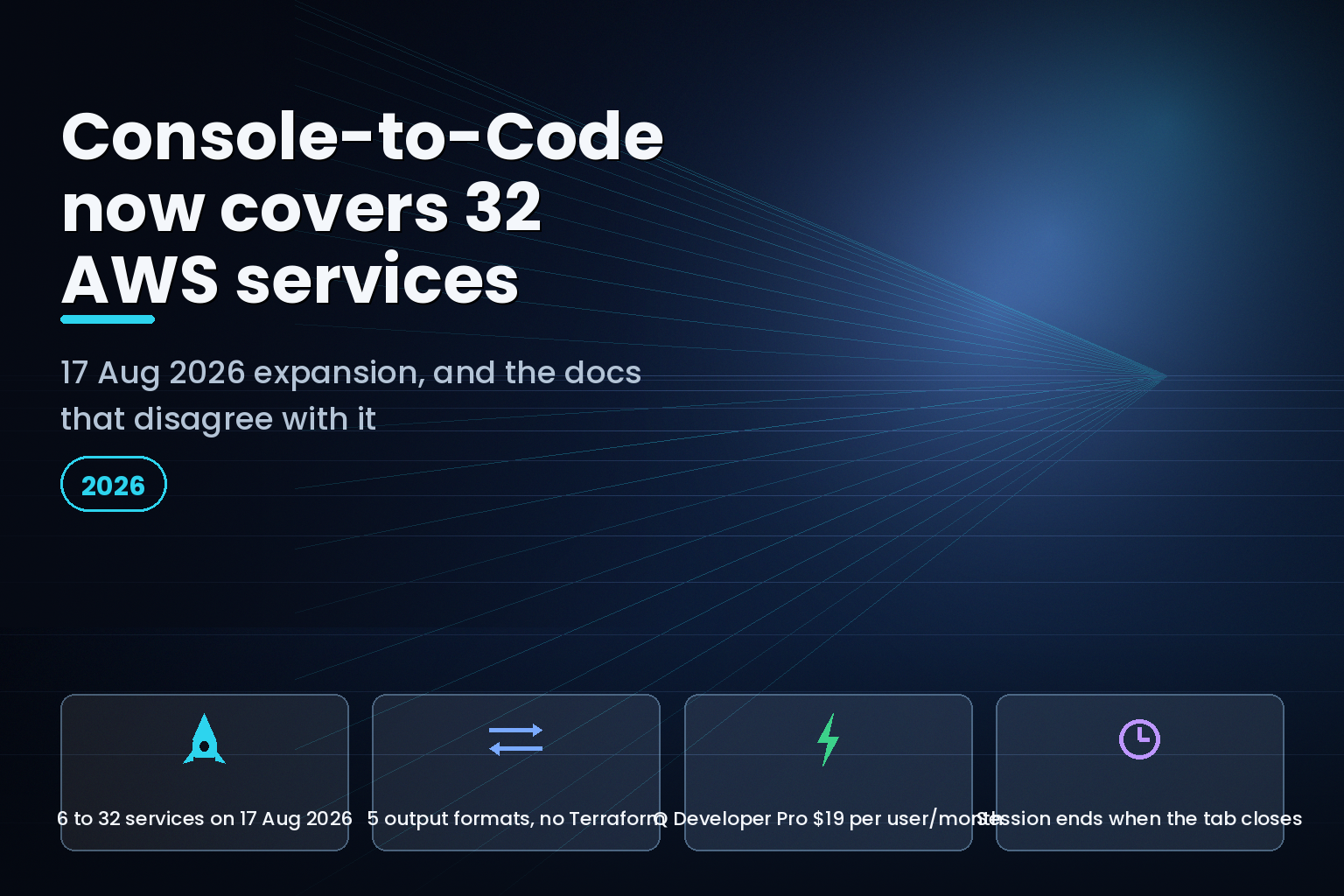
Summary. On 17 August 2026 AWS expanded Console-to-Code from 6 to 32 services and said it had added "cross-region and cross-browser-tab action recording," stating that "previously, switching regions or working across browser tabs would reset or fragment recorded action lists." The Amazon Q Developer User Guide says the opposite in two places: Console-to-Code saves "its own state for as long as your browser tab is open," and "the session will end when you close the browser tab, or when your AWS Management Console session ends, whichever comes first." The same page still tells you to start recording from one of three consoles — VPC, RDS or EC2 — even though the service list beneath it now runs to 32. Output is limited to five formats, none of them Terraform, and the free tier caps CDK and CloudFormation generations at a number AWS has never published. Amazon Q Developer Pro, which lifts that cap, is $19.00 per user per month.
What the announcement says
The 17 August post makes two claims. The first is coverage: total service support grows from 6 to 32, "helping developers, DevOps engineers, and cloud architects more easily convert manual console workflows into repeatable, production-ready infrastructure as code." The second is session behaviour: "Actions are now consolidated into a single unified list, enabling customers to capture and automate complex, multi-region infrastructure deployments without losing context." Availability is all commercial AWS Regions.
The coverage claim checks out. The user guide lists exactly 32 services, and the list is broad enough to be useful: EC2, VPC, DynamoDB, Cognito, IoT, RDS, CloudWatch, Batch, SQS, CloudFormation, EC2 Image Builder, Systems Manager, Athena, EventBridge, ECR, SNS, Secrets Manager, ElastiCache, Step Functions, EKS, Lambda, ECS, API Gateway, S3, CloudFront, WAF, Shield, Firewall Manager, Bedrock, CodeCommit, CodeDeploy and CodeBuild.
The session claim does not.
The contradiction, quoted
| Source | Statement on session lifetime |
|---|---|
| What's New, 17 August 2026 | "Console-to-Code also introduces cross-region and cross-browser-tab action recording. Previously, switching regions or working across browser tabs would reset or fragment recorded action lists." |
| Q Developer User Guide, "Where can you use Console-to-Code?" | "Console-to-Code works across multiple services, saving its own state for as long as your browser tab is open." |
| Q Developer User Guide, "Step 2: Take actions" | "The session will end when you close the browser tab, or when your AWS Management Console session ends, whichever comes first." |
Both documents are live. There is a reading that reconciles them: a recording might now follow you as you open a second tab, while still ending when the tab you started in is closed. AWS does not say that anywhere, and the guide's Step 2 wording sets the end condition as closing "the browser tab" without qualifying which one.
Until AWS updates the guide, plan the recording session as if it dies with the tab. Generate the code before you close anything.
The three-console instruction that was never updated
Step 1 of the procedure reads: "Go to the console of one of the integrated services (Amazon VPC, Amazon RDS, or Amazon EC2)." Those three were part of the original set. The service list on the same page now has 32 entries, and nothing in the announcement suggests you can only start a recording from three of them.
This is the kind of stale instruction that turns into a support ticket. An engineer looking for the Console-to-Code icon in the Step Functions console, and finding the guide's Step 1 naming only VPC, RDS and EC2, has no way to tell whether the icon is missing because the feature does not start there or because the documentation is behind.
The free tier cap AWS has not quantified
Console-to-Code is a feature of Amazon Q Developer and inherits its tiers. The guide is precise about the shape of the limit and silent about its size:
| Tier | Recording and CLI generation | CDK or CloudFormation generation | Requirement |
|---|---|---|---|
| Free | No fixed monthly limit | Limited per month; number not published | Sign in to the AWS Management Console |
| Pro | No fixed monthly limit | No fixed monthly limit | IAM Identity Center identity subscribed to Q Developer Pro |
AWS writes that at the free tier "there is a limit to how many times per month you can generate code to use with the AWS CDK or AWS CloudFormation based on your recorded actions," and that "after you reach the monthly code generations limit, you must authenticate to the Pro tier in order to generate more code." The guide points to the Amazon Q Developer pricing page for the number. That page is client-rendered and returns no Console-to-Code text to a plain fetch, so the practical position is that the cap exists, applies to the output most teams actually want, and is not discoverable before you hit it.
What is knowable is the price of clearing it. The AWS Price List API AmazonQ offer file, version 20260806174549 published 6 August 2026, lists Amazon Q Developer Pro at $19.00 per month per user in US East (N. Virginia). At ₹88 to the dollar that is about ₹1,672 per engineer per month, or roughly ₹2.0 lakh a year for a ten-person platform team.
The same offer file prices the Agent for Code Transformation at $0.003 per line of code submitted, which is worth knowing if a Console-to-Code recording is the front end of a wider modernisation.
Five output formats, and Terraform is not one of them
Console-to-Code generates CDK Java, CDK Python, CDK TypeScript, CloudFormation JSON and CloudFormation YAML. That is the whole list.
For any team standardised on Terraform, the expansion to 32 services changes nothing. The recorded actions still come out as CLI commands or as CDK and CloudFormation, and converting either into HCL by hand removes most of the time the feature was meant to save. The gap is sharper this month, because AWS shipped IAM Policy Autopilot support for Terraform plan files on 18 August 2026 — one day after this launch. One AWS tool reads Terraform; the other still refuses to write it.
CDK C#, CDK Go and Pulumi are also absent.
Recording costs nothing; the actions cost what they always did
The guide carries a note that deserves more attention than its placement suggests: "When you record an action, you will still be charged for the action itself, if applicable. For example, if you record yourself provisioning an Amazon EC2 instance, then you will still be charged for the instance. There is no additional cost for recording the action."
Console-to-Code is not a dry run. Every click you record actually provisions the resource. Anyone treating a recording session as a design exercise across EC2, RDS, EKS and ElastiCache will be paying for a running environment while they decide whether the generated CDK is any good, and will need to tear it down afterwards. The IaC is a by-product of a real deployment, not a substitute for one.
The permission needed to use the feature is q:GenerateCodeFromCommands, plus permissions for whatever actions you intend to record. Generated CLI commands can be pushed straight into AWS CloudShell from the panel, which is convenient and also means a mis-selected command runs against the same account you just recorded in.
Who should look at this now
A team that provisions through the console, works in CDK or CloudFormation, and wants a first draft of the template rather than a finished one. The generated code is a starting point that still needs review, parameterisation and a state strategy.
A team on Terraform, or one that needs an auditable dry run before resources exist, gets nothing new from the 17 August expansion.
What is still unknown
Three things. AWS has not published the free-tier monthly generation cap. It has not reconciled the cross-browser-tab claim with the guide's session-end wording. And it has not said whether the 32-service list is now the ceiling or the next checkpoint. Until the first two are settled, the safe assumptions are that the cap is low enough to matter on a busy day and that the recording ends when the tab does.
FAQ
How eCorpIT can help
Generated templates are a draft, not a deployment. eCorpIT's senior engineering teams review and harden CDK and CloudFormation output, add the parameterisation and state handling that Console-to-Code does not produce, and rebuild in Terraform where that is the house standard. Our note on Terraform 1.16 destroy protection covers the guardrails side, and cloud FinOps for Indian teams covers what the recorded resources cost while you are still deciding. Talk to us at /contact-us/.
References
Last updated: 22 August 2026.