On this page · 12 sections
- What actually shipped on 7 August 2026
- Gap 1: the cap is list cost, and list cost is not your price
- Gap 2: the overshoot is per thread, not per session
- Gap 3: a deployment budget bounds each run, not the schedule
- Gap 4: residency pricing is 1.1x, and the budgets page never says so
- The trap that has no undo
- What to do this week
- India-specific considerations
- What is still unknown
- FAQ
- How eCorpIT can help
- References
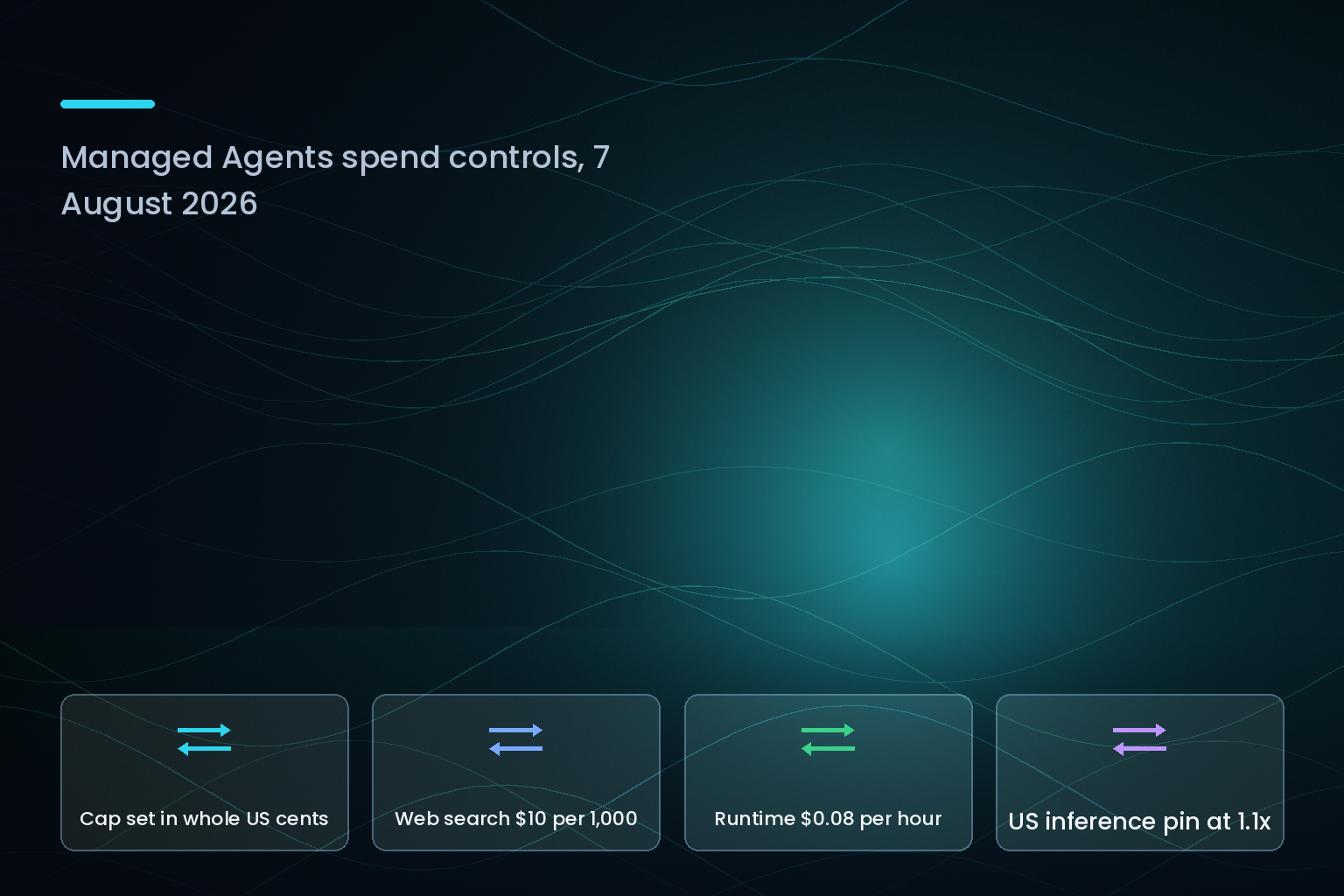
Summary. Anthropic shipped session budgets for Claude Managed Agents on 7 August 2026, alongside an advisor roster entry and an inference_geo pin. The budget is a hard dollar ceiling written in whole US cents, and the platform enforces it against a running total priced at public list rates: model tokens at each served model's list price, web searches at $10 per 1,000 searches, and session running time at $0.08 per hour. Four things the announcement did not say decide whether that ceiling means anything. The cap tracks list cost rather than your contracted price. It overshoots by one model request per thread, and a session can run 25 concurrent threads. On a scheduled deployment the same cap is copied onto every run, so a "2000" amount is roughly $20 per run and not $20 per day. And pinning inference_geo to "us" prices requests at 1.1x the standard rate, a multiplier the budgets documentation never mentions.
The three features landed together in the 7 August 2026 entry of the Claude Platform release notes. Read as a set, they are the first real spend-governance surface Managed Agents has had. Read carefully, they are also four separate ways to write a control that does not do what the person who approved it thinks it does.
What actually shipped on 7 August 2026
Three entries, one date:
A session budget is "an optional hard spend ceiling you set when you create a session". The budget object has exactly two fields. type is always "limit". max_list_cost carries an amount that is "a whole number of US cents written as a string with no leading zeros" (so "125" is $1.25), plus a currency that must be USD. Decimal forms such as "25.00" are rejected with a 400. The amount is a string so that, in Anthropic's words, "no float rounding is ever applied to it".
An advisor is a {"type": "advisor", "model": "<model id>"} entry in an agent's multiagent roster. At most one per roster. It gives the session's primary thread a model it can consult mid-turn, and the multiagent orchestration reference states the constraint plainly: "the agent's own model must not be more capable than its advisor; models of equal capability can pair."
inference_geo pins where model inference runs. It sits inside the model object on the agent definition, with a per-session override at create time.
Gap 1: the cap is list cost, and list cost is not your price
The session budgets page is unusually direct about this. "List cost is not your contracted price: if your organization has negotiated discounts, the session reaches its cap when the list-price total does, and your billed spend might be lower than the cap."
For a discounted enterprise that inverts the control. A $200 cap set by a platform team is a $200 cap on undiscounted list arithmetic. If the negotiated rate is 30% off, the session stops at roughly $140 of real spend and the agent goes idle with work unfinished. Nobody gets billed more than they expected. They get less work than they paid for, and the idle session looks like a failure rather than a budget event.
There is a second precision detail underneath it. Enforcement uses "the exact, unrounded list cost", while the list_cost figures reported on the session and its events are whole cents rounded to the nearest cent. A reported figure can read up to half a cent either side of the number enforcement actually used. That matters when you raise a cap: the new max_list_cost "must be strictly greater than the session's consumed list cost", and the docs tell you to base the new value on usage.list_cost and "set it a cent or more above that figure".
Gap 2: the overshoot is per thread, not per session
The cap is checked between model requests, never mid-request. "The request that carried the total past the cap was admitted while the session was still under it and runs to completion." Anthropic's own worked example: a session capped at "50", or 50 cents, "can pause with a list_cost of "53"". That is 6% over on a single-threaded session.
The documented bound is "one model request per thread". A multiagent session supports a maximum of 25 concurrent threads, a roster of up to 20 unique agents, and advisor consultation threads that are explicitly "exempt from this limit". Each thread's cost is priced at its own served model. So the worst-case overshoot on a wide fan-out is not one request past the cap, it is one request past the cap on every running thread, each priced at whatever model that thread is using. Size the cap with that margin in mind, not with the single-thread example in mind.
| Control | What the cap is measured against | Overshoot bound | Can it be re-added after removal? |
|---|---|---|---|
| Session budget (single thread) | Exact unrounded list cost, all threads shared | One model request | No, removal is one-way |
| Session budget (multiagent, up to 25 threads) | One shared cap, no per-thread caps | One model request per running thread | No, removal is one-way |
| Deployment budget | Copied onto each session the deployment starts | Same per-run bound, per run | Yes, null then set again later |
Gap 3: a deployment budget bounds each run, not the schedule
This is the number most likely to produce a surprise invoice. The scheduled deployments reference says the deployment "copies the cap onto each session it starts, so the budget bounds every run separately rather than acting as a cumulative ceiling across runs: a deployment with a "2000" cap can spend up to about $20 on every run."
An hourly cron with that cap is bounded at roughly $480 a day, not $20. A per-minute schedule, the documented maximum granularity, is bounded by nothing a finance team would recognise as a bound. Anthropic supports up to 1,000 scheduled deployments per organisation, so the exposure compounds across an estate rather than across a single agent.
Two related behaviours are worth writing into your runbook. Changing a deployment's budget "applies to runs started afterward"; a session already running keeps the cap it started with. And unlike a session budget, a deployment's budget can be cleared with "budget": null and set again later.
Gap 4: residency pricing is 1.1x, and the budgets page never says so
The data residency page is explicit. For Claude 4.6 and later models, US-only inference, set with inference_geo: "us", "is priced at 1.1x the standard rate across all token pricing categories (input tokens, output tokens, cache writes, and cache reads)". Global routing is standard pricing. The same multiplier is applied to Managed Agents when an agent's model configuration pins inference_geo to "us". On a Priority Tier commitment, each token consumed with the US pin "draws down 1.1 tokens from your committed TPM".
The budgets page defines list cost as model tokens "at each served model's list price" and says nothing about the residency multiplier in either direction. Two documents published under the same platform, one week apart, and the question a FinOps owner will ask first, which is whether a US-pinned session burns its cap 10% faster, is answered by neither. Treat it as unresolved until Anthropic states it, and instrument usage.list_cost against your own token counts rather than assuming.
The pin also propagates. On a multiagent roster, "the coordinator's pin and every roster member's pin must either all be set to the same value or all be unset. A mismatched roster is rejected with a 400 validation error." One compliance-driven agent therefore forces the US pin, and the 1.1x, onto every agent in the roster. This is the same coupling of residency to unit price we traced through OpenAI's zero-data-retention endpoint limits and India residency, and it is now a Claude problem too.
The trap that has no undo
Two rules interact badly. First: "Removing a session's budget is one-way: a session whose budget has been removed cannot be given a new one." Adding a budget to a session created without one is a 400, and so is re-adding it after removal.
Second: a budget "can only track consumption the platform can price". If a budgeted session's usage comes to include a model with no public list price, "the budget can no longer measure the session's spend: the session can pause with a stop_reason of budget_reached, and changing the budget is rejected. Remove the budget to resume the session."
Removing the budget is the only documented way out, and removal is permanent for that session. A long-running agent that touches an unpriced model once has to choose between staying paused and running uncapped for the rest of its life. The real cost here is not the tokens, it is the governance hole that opens the moment an operator picks the resume path under time pressure.
What to do this week
Audit every deployment cap and multiply it by the schedule's fire count, not by one. Set session caps from usage.list_cost rather than from max_list_cost when you raise them, and add a cent of margin for the rounding. If your organisation is on a negotiated rate, size caps in list-price terms and document the gap so an idle session is read as a budget event and not an outage. Confirm no agent or advisor on a budgeted roster uses a model without a public list price, because that create is rejected with a 400 today and becomes an unrecoverable pause tomorrow.
Handle the pause correctly in code. A session at its cap accepts only user.tool_confirmation, user.tool_result, user.custom_tool_result and user.interrupt; anything that would start new work, such as user.message, is rejected with a 400 naming that list. A user.interrupt sent while every thread is paused at the cap is "accepted and ignored". Watch for the session.usage event, which the platform always emits immediately before the budget_reached idle event.
Teams already tracking the wider August wave should read this next to the Claude computer use toolset migration and the Files API GA response-format fork, both dated 19 August 2026, and against the broader pattern of agent session isolation across AWS, Azure, Google and Anthropic. Budget controls are only as good as the cost-governance process around them, which is the same failure mode behind most cancelled agentic AI projects.
India-specific considerations
Workspace geo, which controls where data is stored at rest and where endpoint processing such as image transcoding and code execution happens, currently offers "us" as the only available value, and it cannot be changed after workspace creation. Inference geo offers only "us" and "global". There is no India geo on either axis as of 21 August 2026.
For an Indian buyer with Digital Personal Data Protection Act 2023 obligations, that means Claude Managed Agents cannot today keep either inference or at-rest storage inside India through these controls. The one lever that moves work onto infrastructure you control is a self-hosted sandbox, where "tool execution and the sandbox filesystem stay on infrastructure you control", though the residency page notes that "the contents of attached memory stores remain stored by Anthropic and are copied to your sandbox for the session". Price the 1.1x US pin into any budget you set for a regulated workload, and treat the DPDP question as an architecture decision rather than a parameter. We work through that trade-off in detail on our data residency and DPDP cloud architecture page.
What is still unknown
Whether the 1.1x US-inference multiplier is included in the list cost the budget enforces against. Whether the per-thread overshoot on a 25-thread session is bounded in any way beyond one request per thread. Whether an India workspace geo or inference geo is planned. None of these are stated on any page published as of 21 August 2026.
FAQ
How eCorpIT can help
eCorpIT builds and governs production AI agent systems for teams running them at scale, with senior engineering teams working across cost instrumentation, residency architecture and platform migration. We are CMMI Level 5, MSME Certified and ISO 27001:2022 certified, and we design applications aligned with DPDP Act 2023 requirements. If you are sizing spend controls for Claude Managed Agents or auditing an agent estate that grew faster than its budgets, contact us and we will review the deployment schedule and cap arithmetic with your platform team.
References
- Claude Platform release notes: 7 August 2026 entries for session budgets, advisor and
inference_geo; 10 August 2026 Sonnet 5 pricing entry.
- Session budgets: budget object shape, list-cost components, overshoot behaviour and error reference.
- Data residency:
inference_geovalues, 1.1x US pricing, workspace geo limitations.
- Multiagent orchestration: advisor roster entry, 25-thread limit, 20-agent roster cap, uniform geo pin rule.
- Scheduled deployments: per-run budget semantics, cron and timezone rules, 1,000-deployment limit.
- Session operations: session statuses and updating the session budget.
- Session event stream:
session.usageandsession.status_idleevent ordering.
- Start a session: session create parameters and per-session geo override.
- Agent setup: pinning
inference_geoon an agent's model configuration.
- Claude Managed Agents overview: platform scope and beta header requirements.
- Self-hosted sandboxes: tool execution on your own infrastructure and memory store copying.
- Task budgets: the advisory, token-denominated budgets that session budgets are distinct from.
- Service tiers: Priority Tier commitments and token burndown.
Last updated: 21 August 2026.