On this page · 9 sections
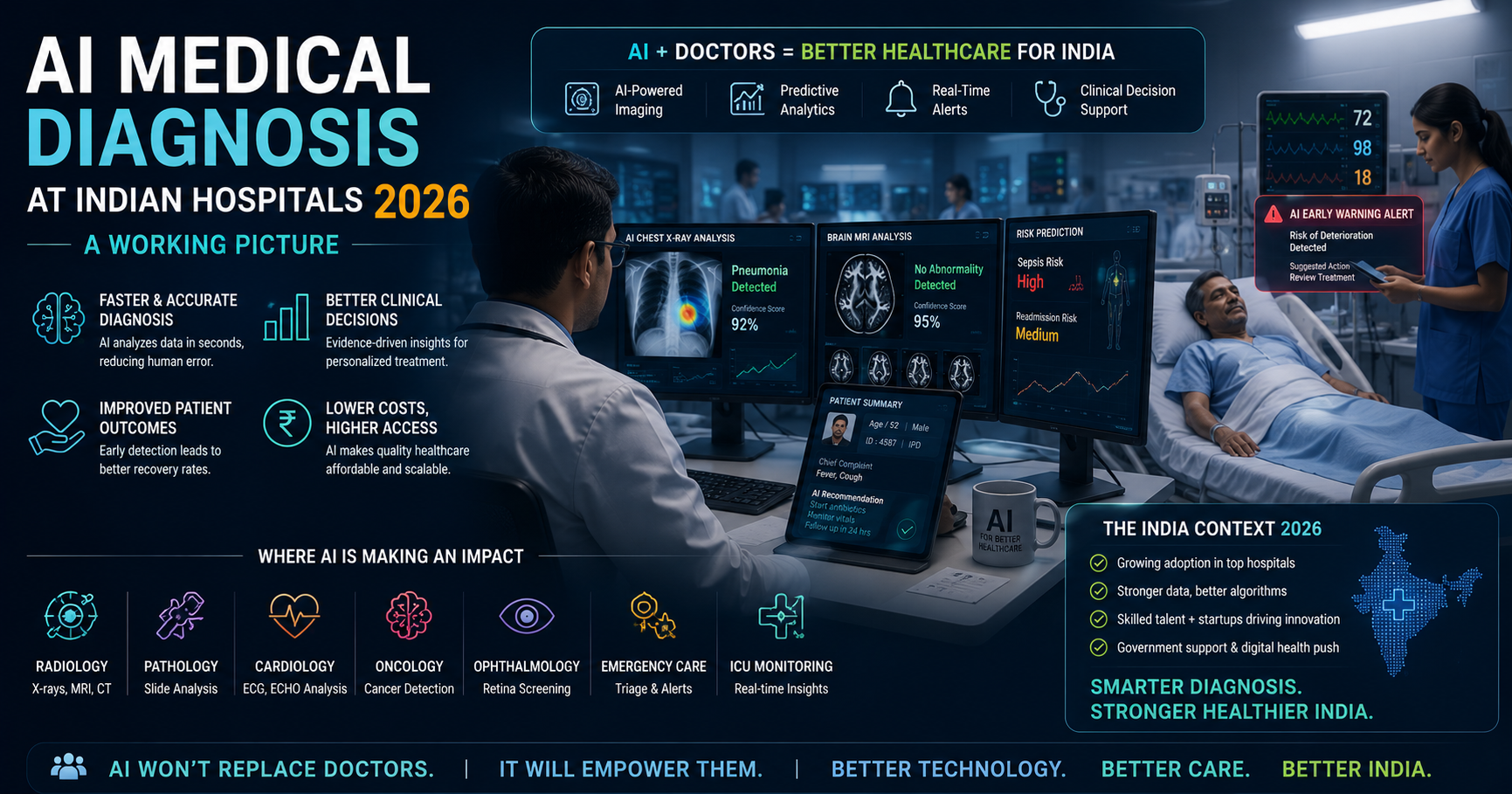
Summary. AI medical diagnosis at Indian hospitals crossed the proof-of-concept threshold in 2024-25. In 2026 it is doing real clinical work — Apollo's AI processes brain scans for stroke severity in roughly 2 minutes (down from 60), Tata Memorial-trained breast cancer models are starting clinical validation, AIIMS has AI research centres across 22 campuses, and AI-augmented radiology workflows are operating across Fortis, Max, Manipal, Aster DM and many private and public diagnostic networks. India's AI in healthcare market is accelerating toward roughly $1.6 billion by end-2026 at a 40%+ CAGR. The regulatory frame moved in October 2025 when CDSCO released draft guidance for Medical Device Software classifying most diagnostic AI as Class C devices. This article surveys what is actually working at Indian hospitals, what the regulatory and data picture looks like in 2026, and what good implementation looks like for healthcare leaders deciding where to invest.
The Indian healthcare system has a structural fit for AI diagnosis that hospitals in higher-income economies do not. Indian radiologists routinely read 100+ scans a day, often at remote locations with limited specialist coverage. The combination of high volume, severe specialist shortage and concentrated diagnostic centres is exactly the operational environment where AI augmentation produces the largest improvements in clinical throughput and quality. The result is that Indian hospitals are deploying AI for diagnosis at a faster operational rate than peer institutions in much wealthier health systems.
This guide is built for hospital chief medical officers, heads of radiology and pathology, clinical IT directors and CIOs of healthcare systems planning AI investment over the next 12-24 months. The research base draws on industry coverage from Medical Buyer, eHealth Magazine, MediaNama, the Ministry of Health and Family Welfare and a cross-section of clinical reports from 2025 and 2026.
The headline numbers
A few numbers anchor the rest of the article.
Market growth. India's AI in healthcare market is on track to reach approximately $1.6 billion by 2026 at a CAGR around 40.6%, per research summarised by Yahoo Finance on the Indian AI in Medical Diagnostics market.
Apollo Hospitals — operational at scale. Apollo has set aside 3.5% of its digital spend for AI over the past two years and announced in March 2025 that AI would be deployed across all major service lines to reduce documentation and routine workload for doctors and nurses. Apollo's AI processes brain scans for stroke severity in real time, cutting diagnosis time from approximately 60 minutes to roughly 2 minutes.
AIIMS — research and clinical workflow. Dedicated AI research centres operate across all 22 AIIMS campuses, deploying machine learning for radiology, pathology and drug discovery — producing India-built models validated on Indian patient populations.
Radiology productivity. AI tools reduce scan reading time by 30-50% while maintaining accuracy at parity or above for narrow tasks (tuberculosis detection on chest X-ray, intracranial haemorrhage detection on head CT). The clinical impact is most pronounced in high-volume settings.
Funding. Three Indian AI healthtech firms account for much of the visible activity: Qure.ai has raised $125 million, Niramai roughly $30 million, SigTuple roughly $30 million. Tata Elxsi, Tricog Health, Practo, CrelioHealth, Cardiotrack and 5C Network sit alongside them in the active diagnostic AI map.
What is operating at Indian hospitals in 2026
A function-by-function picture of where AI diagnosis has moved past pilot.
Radiology
Radiology is the most-deployed clinical AI application in Indian hospitals. AI does three concrete things in radiology workflows today.
Triage and prioritisation. AI scans the inbound queue and surfaces studies that show potential emergencies — intracranial haemorrhage, large-vessel occlusion stroke, tension pneumothorax, aortic dissection — to the top of the radiologist's worklist. Apollo's stroke detection workflow, where AI cuts diagnosis time from 60 minutes to roughly 2 minutes for severity assessment, is the canonical example. The clinical impact is measurable in door-to-needle time for ischaemic stroke and door-to-intervention time for large-vessel occlusion.
Augmented reading. AI reads alongside the radiologist on routine studies (chest X-ray for tuberculosis, mammography for breast lesions, screening CT for lung nodules) and flags findings for the radiologist's attention. The reduction in reading time is 30-50% on appropriate study types without loss of sensitivity.
Centralised interpretation. Platforms such as 5C Network and SigTuple connect imaging in remote hospitals and diagnostic centres to centrally located radiologists augmented by AI, expanding specialist coverage to populations that previously had none. The result is faster reporting, more consistent quality and lower overall cost per study.
Qure.ai's qXR (chest X-ray AI for tuberculosis and other conditions) and qER (head CT AI for intracranial haemorrhage) are the most widely deployed AI diagnostic products in India, used across public and private health systems including state-government tuberculosis screening programs.
Pathology
Pathology is on a slightly slower curve than radiology because the workflow is harder — slide preparation, digital imaging infrastructure and the regulatory pathway all require more investment. But pathology AI is now operational at multiple Indian centres.
SigTuple builds AI-powered smart microscopes and cloud-based analytics to automate blood, urine and slide interpretation. The AI100 product is FDA 510(k) cleared and SigTuple holds multiple patents on its screening tools. Niramai's thermal imaging plus AI for breast cancer screening is operating in community camps, primary care centres and workplace health checks in low-resource settings.
The 2026 frontier in pathology is digital pathology coupled with AI screening — slides are digitised, AI pre-reads, and the human pathologist focuses on cases requiring expert judgement. This is operating at AIIMS, Tata Memorial, CMC Vellore and a growing number of private chains.
Cardiology
Tricog Health and Cardiotrack handle remote ECG interpretation augmented by AI, allowing primary health centres without on-site cardiologists to deliver timely arrhythmia detection and acute coronary syndrome triage. Apollo, Manipal and a number of public health systems use this model in rural and tier-2 / tier-3 city settings where on-site specialist coverage is unavailable.
Oncology
Tata Memorial Hospital trained breast and ovarian cancer AI models on Indian patient data — addressing the long-standing concern that AI models trained on Western populations underperform on Indian patients. The Print covered the work in early 2026, noting the importance of population-specific training data for diagnostic accuracy. AIIMS oncology centres are running parallel work on lung, head-and-neck and gynaecological cancers.
Ophthalmology
AI for retinal screening — particularly for diabetic retinopathy in India's diabetic patient population — is widely deployed in screening camps and primary care settings. Tools like Eyenuk, Aravind Eye Care's internal AI and Forus Health's AI-augmented fundus cameras handle high-volume screening with specialist confirmation only for flagged cases.
The Indian hospital chains leading deployment
A short field guide for hospital leaders watching what their peers are doing.
[Apollo Hospitals](https://www.apollohospitals.com/). Most operationally mature AI deployment in India. AI integrated into radiology (stroke, brain trauma), oncology and clinical documentation. Public commitment to expand AI across all major service lines.
[Fortis Healthcare](https://www.fortishealthcare.com/). AI tools deployed across multiple sites in clinical operations, including radiology and emergency triage. Active partnerships with diagnostic AI startups.
[Max Healthcare](https://www.maxhealthcare.in/). Radiology AI deployment, with emerging work on pathology and clinical workflow automation.
[Manipal Hospitals](https://www.manipalhospitals.com/). Wide deployment across radiology, cardiology (Tricog partnership) and emerging pathology. Integrated AI into emergency department workflows.
[Aster DM Healthcare](https://www.asterdmhealthcare.com/). AI in radiology, with notable Gulf-region cross-deployment given Aster's geographic footprint.
AIIMS network. 22 campuses with dedicated AI research centres. Research-to-clinic translation is institutionalised at AIIMS Delhi, AIIMS Bhubaneswar and AIIMS Bhopal.
Tata Memorial Centre. Population-specific AI training and validation, with emphasis on oncology where Western-trained models historically underperform on Indian patients.
CMC Vellore. Long-standing leader in clinical informatics, now extending into AI-augmented radiology, pathology and laboratory medicine.
The regulatory frame: CDSCO, DPDP, SAHI and BODH
The Indian regulatory environment for AI medical diagnosis changed materially in 2025.
CDSCO Medical Device Software guidance (October 2025). The Central Drugs Standard Control Organization released draft guidance on Medical Device Software, classifying most diagnostic AI tools — including AI for CT and MRI imaging — as Class C devices, signifying moderate-to-high risk. The implication for hospitals is that the AI tools they deploy in clinical workflows must have appropriate licences and clinical validation. Hospitals can no longer treat diagnostic AI as a workflow optimisation; it is now a regulated medical device.
Digital Personal Data Protection Act (DPDP), 2023. Personal health data processed by AI must comply with DPDP — explicit consent, purpose specification, data minimisation and breach notification. Indian hospitals deploying AI need DPDP-aligned data flows from day one, particularly where third-party AI vendors process patient data.
National Health Authority Health Data Management Policy. Establishes consent management, health ID linkage and audit requirements for personal health data under Ayushman Bharat Digital Mission.
ICMR Ethical Guidelines for AI in Biomedical Research and Healthcare. Provides the principles for use of AI in clinical research, including informed consent, transparency about model behaviour and oversight requirements.
SAHI and BODH. The Strategy for AI in Healthcare in India (SAHI) and the Benchmarking Open Data Platform for Health AI (BODH), launched by MoHFW in early 2026, define national strategy and a shared validation platform for diagnostic AI tools. BODH in particular reduces the cost and time for AI startups to validate models against representative Indian patient data.
The practical effect on hospitals is that the procurement and clinical-validation process for AI tools is no longer informal. CDSCO licensing, DPDP-compliant data flows, NHA-aligned consent management and ICMR-aligned clinical validation are baseline expectations in 2026 procurement processes.
What good implementation looks like for hospitals in 2026
Six disciplines distinguish hospitals that get AI diagnosis working from hospitals that get stuck at pilot.
Clinician sponsorship from the start. AI in clinical workflow succeeds when senior clinicians own it — head of radiology, head of pathology, chief of emergency medicine — not when IT pushes it down. Clinician-led deployments translate to higher adoption, more useful feedback and faster iteration.
CDSCO and DPDP compliance treated as the floor, not a project. Procurement processes verify CDSCO licensing for the AI tool, DPDP-compliant data processing agreements with the AI vendor, audit trail availability and clinical validation documentation. Tools that cannot supply these get rejected.
Clinical integration with existing workflows. The AI is embedded in the radiology reading software, the pathology slide viewer, the cardiology ECG system — not a separate dashboard the clinician has to remember to open. Adoption depends entirely on integration quality.
Population-relevant validation. The AI tool must have demonstrated performance on Indian patient data. Tools validated only on Western data are increasingly rejected because of well-documented performance gaps on Indian populations. Tata Memorial's India-trained models and the SAHI/BODH validation platform are the proof points hospitals can rely on.
Performance monitoring in production. AI performance drifts. The hospital tracks sensitivity, specificity and clinical impact metrics monthly, not annually. Drift detection alerts trigger retraining or vendor replacement decisions.
Clear failure-mode planning. When the AI fails — and it will — the clinical workflow continues without it. Hospitals plan explicit fallback procedures and train clinicians on the cases where AI output should be questioned (rare presentations, atypical patient demographics, unusual scan quality).
A 90-day deployment sprint for hospital leaders
For hospital CIOs and chief medical officers ready to move from evaluation to deployment, a 90-day sprint pattern that has produced consistent results.
Weeks 1-4 — Diagnose and choose. Pick one clinical use case (radiology triage, retinal screening, pathology pre-read) where AI can produce measurable impact. Identify the senior clinician who will sponsor it. Verify CDSCO licensing and DPDP-compliant data processing for the chosen AI tool. Set the measurement plan (sensitivity, specificity, throughput, time-to-report, clinical outcome).
Weeks 5-8 — Integrate. Wire the AI into the existing clinical software (PACS, LIS, EHR) so clinicians use it inside their normal workflow. Set up the audit logging and performance monitoring infrastructure. Train the clinical team on the tool's intended use and known failure modes.
Weeks 9-13 — Run and measure. Operate the AI in clinical workflow with explicit measurement. Track the success metrics weekly. Run regular clinical case review where AI errors are surfaced and lessons fed back to the vendor. At week 13, present the financial and clinical results to leadership and decide on expansion.
The output of a successful 90-day sprint is one operational AI deployment with measured clinical impact, a procurement and governance template the hospital can apply to subsequent deployments, and credibility to expand into adjacent clinical areas.
FAQ
How eCorpIT can help
eCorpIT builds clinical AI integration and digital health platforms for Indian hospitals, diagnostic networks and healthtech startups. Our work covers PACS / LIS / EHR integration, DPDP-aligned data architecture, CDSCO-aligned validation workflows, model deployment infrastructure and clinical observability.
If your hospital or diagnostic network is planning AI deployment in 2026, our healthcare engineering team can help. Reach us at ecorpit.com/contact-us/ or contact@ecorpit.com.
References
- Medical Buyer — "AI storms into real healthcare delivery": medicalbuyer.co.in
- eHealth Magazine — "From Diagnostics to Policy: How AI is Transforming Indian Healthcare": ehealth.eletsonline.com
- The Print — "Trained on Indian patients' data, how an AI tool can improve breast & ovarian cancer diagnosis": theprint.in
- Oxmaint — "India's AI in Healthcare Strategy 2026: SAHI Framework & Impact": oxmaint.com
- MediaNama — "How SAHI And BODH Shape AI Use In India's Healthcare": medianama.com
- Cyril Amarchand Blogs — "Medical Device As Software: Has CDSCO Guidance Changed The Rules?": corporate.cyrilamarchandblogs.com
- CDSCO Medical Device Software Regulation 2026: mavenrs.com
- Qure.ai: qure.ai
- Niramai: niramai.com
- SigTuple: sigtuple.com
- 5C Network: 5cnetwork.com
- Healthcare IT News — "Indian states roll out radiology AI": healthcareitnews.com
- Yahoo Finance — "India AI in Medical Diagnostics Market Research Report 2025-2030": uk.finance.yahoo.com
- eCorpIT — "Generative AI Enterprise Strategy 2026": ecorpit.com
Last updated 8 June 2026 by the eCorpIT Editorial team.