On this page · 10 sections
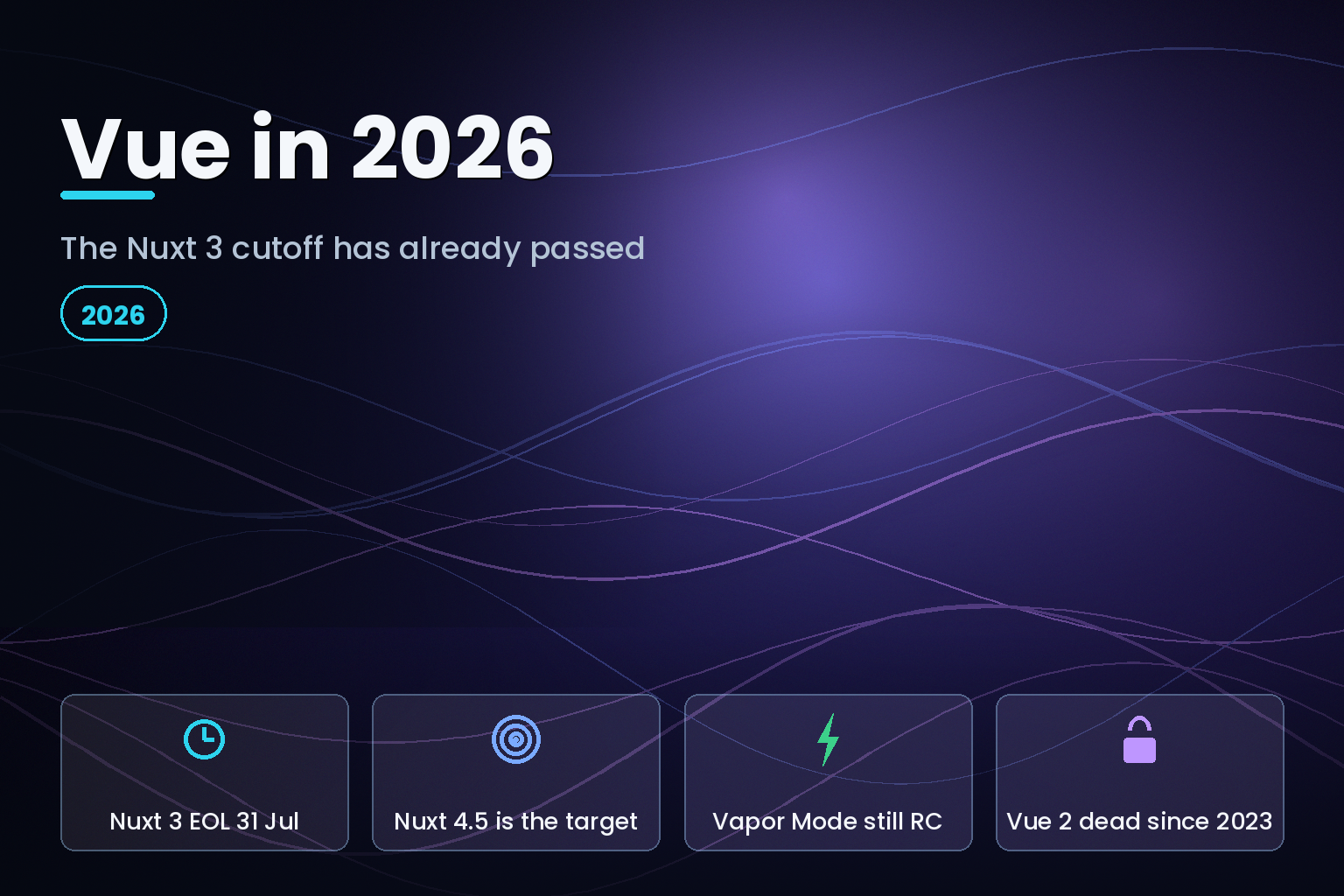
Summary. The Vue decision in August 2026 is not about Vue. Vue 3.5.41 shipped on 5 August 2026 and the framework is healthy. The live deadline sits one layer up: Nuxt 3 reached end of life on 31 July 2026, 18 days ago, while Nuxt 5 is explicitly still being stabilised. Nuxt 4.5 arrived on 18 July 2026 as the supported line. Below that, Vue 2 has been dead since 31 December 2023, its final release was 2.7.16, and the only supported path is a commercial contract with HeroDevs that publishes no price. Vuex is in maintenance mode with Pinia 4.0 the current state library since 14 July 2026. Vapor Mode, the performance story everyone quotes, is feature-complete but still in release candidate as of 18 July 2026. If a vendor is selling you Vapor Mode performance today, they are selling you a pre-release.
The three deadlines that actually price a Vue engagement
Most Vue proposals talk about developer experience. The costs live in the calendar.
| Layer | Current supported version | The dated cliff | Migration cost |
|---|---|---|---|
| Vue core | 3.5.41, released 5 August 2026 | Vue 2 EOL 31 December 2023; final release 2.7.16 | Full rewrite from Vue 2; routine within Vue 3 |
| Meta-framework | Nuxt 4.5, released 18 July 2026 | Nuxt 3 EOL 31 July 2026 | Major version move, Nuxt 5 not yet stable |
| State management | Pinia 4.0, released 14 July 2026 | Vuex in maintenance, no new features | Store rewrite if still on Vuex |
| Routing | Vue Router 5.0, released 29 January 2026 | vue-router 3.x deprecated on npm | Low: v5 shipped with no breaking changes |
| Build tooling | Vite 8, released 12 March 2026 | Requires Node.js 20.19+ or 22.12+ | Couples the bundler upgrade to the runtime |
Vue Router 5 deserves a note because it is the rare upgrade that costs nothing. The maintainers described it as "a boring release" that merges unplugin-vue-router into the core package with no breaking changes, the single exception being that the iife build no longer bundles @vue/devtools-api. Take that upgrade.
Nuxt is the opposite. A team running Nuxt 3 today is running unsupported software, and the recommended destination is Nuxt 4.5 rather than Nuxt 5, because the Nuxt team stated on the 4.5 release that its focus now turns to stabilising v5. Nuxt 5 can be opted into today through future.compatibilityVersion: 5, which is a reasonable way to de-risk the eventual move but not a production recommendation on its own. A maintenance patch, v3.21.9, shipped alongside 4.5 for teams that need a moment to plan.
Vapor Mode is real, and it is not ready
This is where we correct most incoming briefs.
Vapor Mode is a compilation strategy that drops the virtual DOM. It reached feature-completeness in the Vue 3.6 release candidate on 18 July 2026, alongside a rewrite of @vue/reactivity based on alien-signals. Vue's own release notes are precise about the status: it is "100% opt-in and supports a subset of existing Vue APIs."
That subset is the commercial detail. Vapor Mode does not support the Options API at all. app.config.globalProperties is unavailable. getCurrentInstance() returns null. Per-element @vue:xxx lifecycle events and v-memo are unsupported. Component template refs no longer expose $el, $props, $attrs, $slots or $refs. Opting in is per-component, through <script setup vapor>, and a pure-Vapor application uses createVaporApp() while mixed applications need vaporInteropPlugin.
Read that list against a real codebase. Any application with meaningful Options API surface, which means most Vue applications older than about three years, cannot adopt Vapor Mode without rewriting those components first. The honest framing for a 2026 build: architect new components so they can opt in later, and do not put Vapor Mode performance in a business case until 3.6 is stable.
What the adoption numbers do and do not say
Two sources get quoted at buyers, and they tell opposite stories because they measure different things.
W3Techs reports that Vue.js is used by 0.8% of all websites whose JavaScript library is known, which is 0.6% of all websites, measured 17 August 2026. The same page reports that "Version 2 is used by 97.3% of all the websites who use Vue.js". That second figure gets circulated as evidence that Vue 3 migration has failed. It is not evidence of anything, because the W3Techs detector distinguishes only Version 1 and Version 2 and has no Version 3 bucket at all. It is a detection artefact.
State of JS 2025 measures surveyed developers instead and puts Vue at 84% satisfaction, in the A tier of its library tier list. The same survey's most useful finding for a buyer is about churn: the average respondent has used only 2.6 different front-end frameworks across their entire career. Teams do not rotate stacks. The framework you choose is the one you will still be maintaining in 2030, which is the argument for weighting support calendars over benchmarks.
We have also seen aggregator pages quote "1.7% of all websites" and "19.2% of the frontend framework market" attributed to W3Techs. Neither figure appears on the W3Techs Vue page. Check the primary before either number reaches a board pack.
Where Vue is the right call
Vue fits well when the team values a single-file component model and a gentle onramp for engineers who are not full-time front-end specialists, when the application is form-heavy and state-heavy rather than exotic, and when you want first-class TypeScript without adopting a large surrounding ecosystem. Vue is written in TypeScript and ships bundled type declarations across all official packages.
There is a caveat worth putting in the contract. Vue's Vite setup is transpile-only, so type errors do not surface during development; the documentation directs teams to run vue-tsc for command-line type checking. Budget CI time for it. Vue also notes that Vue CLI still provides TypeScript support but is no longer recommended, so a project still on Vue CLI is carrying a second, quieter migration.
Vue is the wrong default when your hiring plan depends on a deep local senior pool, where React remains easier to staff in most Indian metros, or when a client's existing design system and component library are React-native and rebuilding them is not funded. On those briefs we say so and point the work at React Native app development or a Node.js development company engagement instead of forcing the framework.
India-specific considerations
For teams building from India, two factors change the maths.
Nuxt's server-side rendering makes it straightforward to put personal data into server-rendered payloads and cached routes without deciding where that data lives. Under the Digital Personal Data Protection Act 2023, that becomes a problem when you must service an erasure request and prove every cached copy was caught. Decide at design time which routes may render personal data and which caching layers are allowed to hold it. It is a one-day decision at design time and a multi-month remediation afterwards.
On staffing, Vue's senior pool in India is genuinely thinner than React's. That is not an argument against Vue, but it is an argument for writing down architectural decisions rather than relying on the next hire to infer them, and for treating the Nuxt upgrade path as a named owner's responsibility rather than an assumed skill.
What eCorpIT builds with Vue
We take Vue work in four shapes: a greenfield Nuxt 4 application, a Nuxt 3 to 4 migration for teams now past the July 2026 cutoff, a Vue 2 to Vue 3 rebuild, and a Vuex to Pinia state migration.
Our delivery process runs in five steps. First, a version and lifecycle audit that pins your Vue, Nuxt, Pinia, Vue Router and Vite versions against published end-of-life dates and returns a dated upgrade calendar. Second, a component inventory that separates Options API from Composition API code, because that split decides both the Vue 3 migration cost and whether Vapor Mode is available to you later. Third, an architecture and delivery plan with migration items priced separately from feature items. Fourth, build in two-week increments with vue-tsc type-checking in CI rather than transpile-only. Fifth, handover with the upgrade calendar as a maintained document.
The stack we standardise on: Vue 3.5 stable, Nuxt 4.5, Pinia 4, Vue Router 5, Vite 8 and TypeScript throughout. We hold new work off Vue 3.6 until it leaves release candidate, and we say when a client's constraints justify deviating.
Why eCorpIT
eCorp Information Technologies Private Limited has operated from Gurugram since 2021. We are CMMI Level 5 appraised, MSME certified and ISO 27001:2022 certified, and we are partners with AWS, Microsoft and Google. Teams are senior-led and multi-disciplinary.
We design applications aligned with DPDP Act and GDPR requirements, and we flag where a rendering or caching decision creates a compliance obligation rather than leaving your legal team to discover it.
On engagement models, we work either fixed-scope and fixed-price for well-defined builds and migrations, or on a dedicated-team monthly retainer where the roadmap will move. Migrations we scope after the lifecycle audit, because quoting a Nuxt 3 to 4 move before counting the server routes and modules is guesswork. If neither model fits your situation we will tell you.
For teams weighing Vue against the alternatives before committing, the same team runs Angular development and custom software development engagements and will give you a straight comparison.
FAQ
How eCorpIT can help
We start Vue engagements with a lifecycle audit that maps your Vue, Nuxt, Pinia, Vue Router and Vite versions against each project's published end-of-life dates, then prices the migration work separately from the feature work. For the many teams now sitting past the Nuxt 3 cutoff, that audit is the fastest way to turn an open-ended risk into a dated plan with a cost attached. We build new Vue applications the same way, standardising on stable releases rather than release candidates. Send us your package.json and a description of the application at /contact-us/ and we will return a dated upgrade calendar, whether or not you engage us for the work.
References
- Vue 2 End of Life — Vue.js, end-of-life date, final release and extended-support arrangement.
- Vue 2 is Approaching End Of Life — Evan You, 15 December 2023, deprecated packages list.
- Vue core release v3.5.41 — vuejs/core, current stable release, 5 August 2026.
- Vue core release v3.6.0-rc.1 — vuejs/core, 18 July 2026, Vapor Mode status and unsupported API list.
- TypeScript with Vue — Vue.js, first-class TypeScript support and vue-tsc guidance.
- State Management — Vue.js, statement that Vuex is in maintenance mode.
- Vue Router v5.0.0 — vuejs/router, 29 January 2026.
- Pinia v4.0.0 — vuejs/pinia, 14 July 2026.
- Nuxt 4.5 — Nuxt, 18 July 2026, Nuxt 3 end-of-life date and Nuxt 5 status.
- Announcing Vite 8 — Vite, 12 March 2026, Rolldown default and Node.js requirements.
- Vue.js usage statistics — W3Techs, measured 17 August 2026.
- State of JS 2025: Libraries — Devographics, Vue satisfaction score and tier placement.
- HeroDevs pricing — HeroDevs, Never-Ending Support coverage and custom-pricing model.
Last updated 18 August 2026.