On this page · 11 sections
- What the "one language" claim actually buys you
- The four calendars, and where each one bites
- Express 5 is the migration nobody budgets for
- Node.js changes its release model at version 27
- Where MERN is the right call, and where it is not
- India-specific considerations
- What eCorpIT builds on MERN
- Why eCorpIT
- FAQ
- How eCorpIT can help
- References
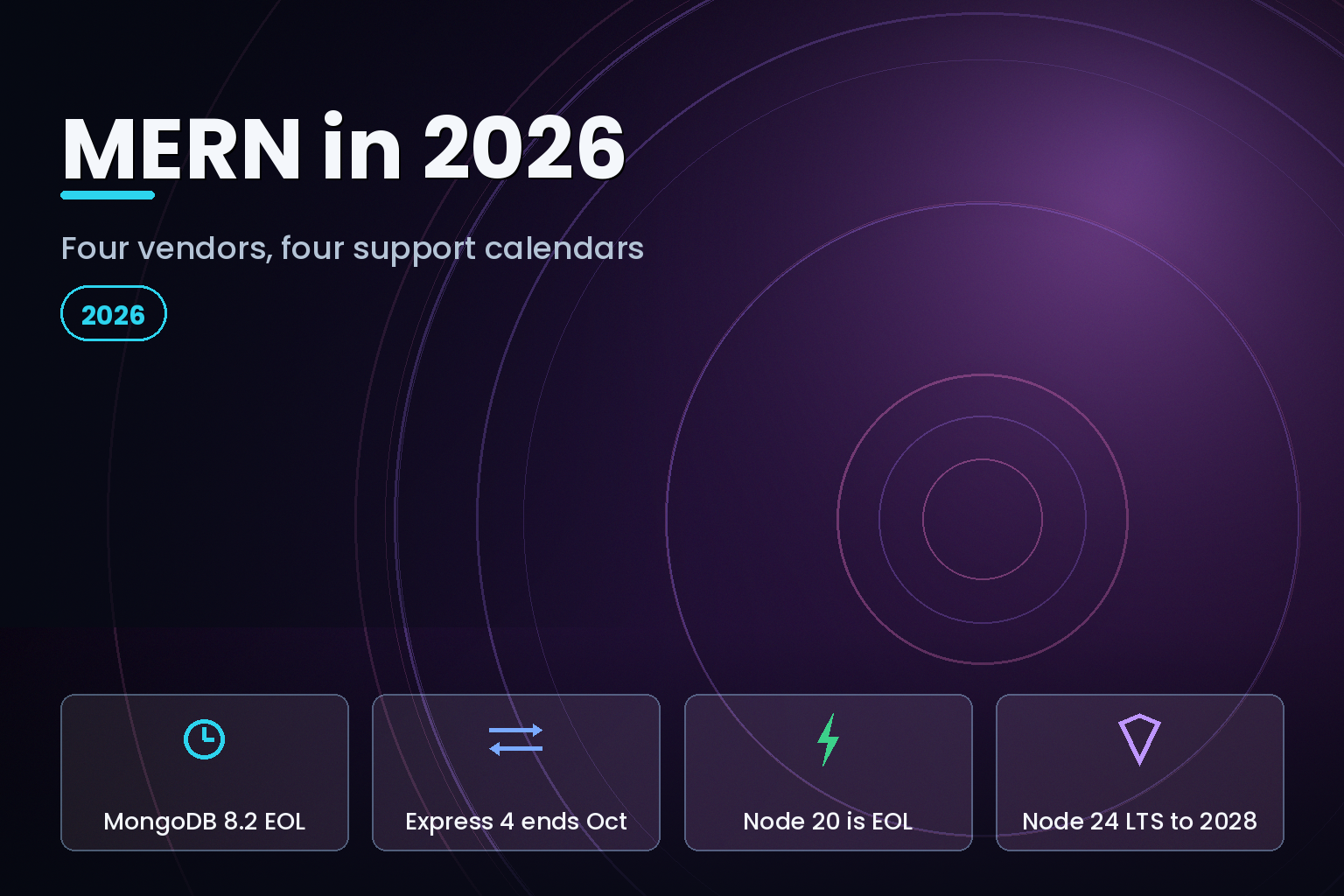
Summary. MERN is sold as one language end to end, and that part is true. What the pitch leaves out is that MongoDB, Express, React and Node.js each run their own release calendar, and three of the four have moved in the last 14 months. MongoDB 8.2 reached end of life on 31 July 2026, four weeks ago. MongoDB 6.0 died on 31 July 2025. Node.js 20 "Iron" reached end of life on 30 April 2026, while Node.js 24 "Krypton" carries LTS status and Node.js 26 has been the Current line since 5 May 2026. Express 4 entered maintenance on 1 April 2025 with an end-of-life target of no sooner than 1 October 2026, and Express 5.1.0 became the npm default on 31 March 2025, moving roughly 17 million weekly downloads onto a new major. React 19.2 is the current line. The single-language argument is real. The single-calendar assumption is not, and it is what turns a cheap MERN build into an expensive one in year three.
What the "one language" claim actually buys you
The genuine saving in MERN is not runtime performance. It is that one engineer can move between the browser component, the HTTP handler and the aggregation pipeline without a context switch, and that validation logic, date handling and type definitions can be shared rather than reimplemented twice.
That saving is largest on teams of three to eight engineers building a product with heavy read/write symmetry: dashboards, marketplaces, internal tools, content platforms, B2B SaaS. It shrinks fast when the workload turns into scheduled batch processing, heavy numerical work, or a domain with a mature library ecosystem elsewhere. A team that reaches for Node.js because "it is all JavaScript" and then rebuilds a reporting engine in it has spent the saving and more.
The State of JS 2025 survey puts a useful number on how little churn there actually is: the average respondent has used only 2.6 different front-end frameworks across their entire career. Teams do not hop stacks. Whatever you pick, you will likely live in it for years, which is exactly why the support calendar matters more than the benchmark.
The four calendars, and where each one bites
This is the table we build every MERN engagement around. Every date is from the vendor's own published lifecycle page, as of August 2026.
| Component | Current supported line | The dated cliff | What it forces |
|---|---|---|---|
| MongoDB | 8.0 (EOL 31 October 2029), 8.3 released May 2026 | 8.2 reached EOL 31 July 2026; 6.0 died 31 July 2025 | Minor-version upgrades on a short clock unless you sit on a major |
| Node.js | 24 "Krypton" LTS; 26 Current since 5 May 2026 | 20 "Iron" reached EOL 30 April 2026 | Runtime upgrade before dependencies drop your version |
| Express | 5.1.0, npm default since 31 March 2025 | 4.x EOL no sooner than 1 October 2026 | Route-syntax rewrite, not a version bump |
| React | 19.2 | 19.0 shipped 5 December 2024; React Compiler 1.0 on 7 October 2025 | Optional adoption, lowest migration pressure |
| Build tooling | Vite 8, released 12 March 2026 | Requires Node.js 20.19+ or 22.12+ | Couples your bundler upgrade to your runtime upgrade |
Read the MongoDB row twice. MongoDB publishes two different schedules, and buyers routinely quote the wrong one. On MongoDB Atlas Auto Upgrade, 8.2 was released September 2025 and hit end of life on 31 July 2026, a working life of about ten months. On Enterprise Advanced the same 8.2 release carries the same 31 July 2026 date, while 8.0 runs to 31 October 2029 and 7.0 to 31 August 2027. A team that standardised on 8.2 last autumn is running unsupported today. A team that stayed on 8.0 has three more years.
The lesson is not "MongoDB moves too fast". It is that the odd-numbered and intermediate MongoDB releases are short-lived by design, and picking one for a production system without reading the lifecycle table is a self-inflicted wound.
Express 5 is the migration nobody budgets for
Express 5 is the part of a MERN modernisation that reliably overruns, because it does not look like a major upgrade from the outside.
Express v5.0.0 landed on npm on 9 September 2024 and was announced on 15 October 2024, ten years after the v5 pull request was first opened. It was deliberately conservative. In the Express Technical Committee's own words, "This release is designed to be boring!" The stated focus was "dropping old Node.js version support, addressing security concerns, and simplifying maintenance."
Boring did not mean free. Express 5 dropped every Node.js version before 18. More consequentially it replaced the path-matching engine, moving from path-to-regexp 0.1.7 to 8.x, and removed sub-expression regular expressions in routes for security reasons. The project was explicit about why: regular-expression denial of service. A route written as /:foo(\d+) no longer works. Optional parameters changed from :name? to {:name}. The wildcard * became *name. The characters (, ), [, ], ?, + and ! are now reserved. Numerical capture-group parameters are gone entirely — every parameter must be named.
None of that is difficult per route. It is difficult across four hundred routes, and it is not fully automatable. The Express team ships an official codemod package to handle the mechanical parts, but says plainly that the new path-matching syntax requires manual modification. A realistic Express 4 to 5 migration on a mature API is a two-to-five week engineering item, not an afternoon.
The clock is public. Express 4 entered MAINTENANCE on 1 April 2025 and the Technical Committee's proposed schedule sets its end of life at no sooner than 1 October 2026, with the caveat that "v4 is a special case, and we may extend MAINTENANCE support." Express 5 itself enters maintenance no sooner than 1 April 2026 and EOL no sooner than 1 April 2027, both dependent on when v6 ships. There is a commercial extended-support route through the project's HeroDevs partnership for teams that genuinely cannot move.
Node.js changes its release model at version 27
The runtime calendar is about to get simpler, and anyone planning a multi-year MERN roadmap should price it in now.
Historically, and through Node.js 26, odd-numbered releases became unsupported after six months while even-numbered releases moved to Active LTS. Starting with Node.js 27, Node.js is moving to an annual cycle in which every major version moves to LTS status after its six-month Current phase, preceded by six additional months of an Alpha phase. LTS status typically guarantees critical bug fixes for a total of 30 months.
The practical guidance from the project has not changed: production applications should only run Active LTS or Maintenance LTS releases. Today that means Node.js 24 or Node.js 22. Node.js 26 has been Current since 5 May 2026 and is not where a production MERN API should be sitting.
There is a second-order trap here. Vite 8, released 12 March 2026, requires Node.js 20.19+ or 22.12+ and ships Rolldown as its bundler. Your build tooling and your server runtime are now coupled. Teams that defer the Node upgrade discover they have also frozen their front-end build.
Where MERN is the right call, and where it is not
We turn down MERN briefs regularly, and the reasons are consistent.
MERN fits when the product is read/write symmetric and document-shaped, when the team is small enough that shared types across the boundary is a real saving, when the schema genuinely evolves month to month, and when the delivery pressure is on iteration speed rather than on analytical query complexity.
MERN is the wrong default when the data is relational in fact rather than in fashion — invoices with line items, ledgers, anything where you will end up writing joins in application code. It is wrong when reporting is a first-class feature rather than an afterthought. And it is wrong when the compliance surface pushes you toward a stack your auditors already understand. On those briefs we usually recommend a Python development company engagement or a Java development company route instead, and say so before the contract rather than after.
The honest version of the pitch: MERN buys you velocity and one hiring pool. It does not buy you a database that is good at everything.
India-specific considerations
Two things change the calculus for teams building from or for India.
The first is the Digital Personal Data Protection Act 2023. A document database makes it structurally easy to scatter personal data across nested subdocuments and denormalised copies, which is convenient until you have to service an erasure request and prove you caught every copy. If you are handling personal data under DPDP, the data model needs a deliberate decision about where personal fields live and how deletion propagates. That decision costs days if made at design time and months if made after launch.
The second is the talent market. JavaScript and TypeScript is the deepest hiring pool in the Indian market at mid-level, which is a real argument for MERN on a team you intend to grow. The same pool thins noticeably at the senior end for MongoDB schema design and aggregation-pipeline performance work, which is precisely the skill that decides whether a MERN application is still fast at year three. Budget for that seniority explicitly rather than assuming the pool covers it.
What eCorpIT builds on MERN
We take MERN work in four shapes: a greenfield product build, an Express 4 to 5 migration, a MongoDB version and schema remediation, and a rescue engagement on an existing codebase that has stopped being safe to deploy.
Our delivery process runs in five steps. First, a stack and lifecycle audit that pins your current MongoDB, Node.js, Express and React versions against the vendors' published EOL dates and produces a dated upgrade calendar. Second, a data-model review, because most MERN performance problems are schema problems wearing an index costume. Third, an architecture and delivery plan with the migration items priced separately from the feature items, so nobody discovers the Express rewrite in month four. Fourth, build in two-week increments with automated tests against the target runtime, not the current one. Fifth, handover with the upgrade calendar as a maintained document rather than a one-off slide.
The stack we standardise on: MongoDB 8.0 for anything that needs a long support runway, Node.js 24 LTS, Express 5.1, React 19.2, Vite 8 for the front-end build, and TypeScript across all four layers. We deviate from that when a client's constraints require it, and we write down why.
Why eCorpIT
eCorp Information Technologies Private Limited has operated from Gurugram since 2021. We are CMMI Level 5 appraised, MSME certified and ISO 27001:2022 certified, and we are partners with AWS, Microsoft and Google. Teams are senior-led and multi-disciplinary, which for a MERN engagement means the person designing your MongoDB schema has done it before at production scale.
We design applications aligned with DPDP Act and GDPR requirements, and we will tell you where a data-model decision creates a compliance obligation rather than leaving it for your legal team to find.
On engagement models: we work either on a fixed-scope, fixed-price basis for well-defined builds and migrations, or on a dedicated-team monthly retainer for product work where the roadmap will change. Migrations we scope after the lifecycle audit, because quoting an Express 5 migration before counting the routes is guesswork and we would rather not. Talk to us about which model fits and we will say if neither does.
If your build is mobile-first rather than web-first, the same team runs React Native app development and Flutter app development engagements, and the backend patterns carry over.
FAQ
How eCorpIT can help
We start MERN engagements with a lifecycle audit that maps your current MongoDB, Node.js, Express and React versions against each vendor's published end-of-life dates, then prices the migration work separately from the feature work. That way the Express 5 route rewrite and the MongoDB version move are visible line items rather than surprises in month four. We build new MERN products the same way, standardising on long-support versions so the first upgrade is years out rather than months. Tell us what you are building at /contact-us/ and we will send back a dated upgrade calendar for your stack, whether or not you engage us for the build.
References
- Node.js Release Working Group: release schedule — Node.js Release WG, per-line Active LTS, Maintenance and end-of-life dates, retrieved 18 August 2026.
- Introducing Express v5: A New Era for the Node.js Framework — Wes Todd, Express Technical Committee, 15 October 2024.
- Express@5.1.0: Now the Default on npm with LTS Timeline — Express Technical Committee, 31 March 2025, support-phase table and EOL targets.
- MongoDB Software Lifecycle Schedules — MongoDB, Atlas and Enterprise Advanced end-of-life dates, retrieved 18 August 2026.
- React Versions — React, current version and changelog index, retrieved 18 August 2026.
- React v19 — React, 5 December 2024.
- React 19.2 — React, 1 October 2025.
- React Compiler v1.0 — React, 7 October 2025.
- Announcing Vite 8 — Vite, 12 March 2026, Rolldown default and Node.js version requirements.
- Migrating to Express 5 — Express, path-matching and deprecated-signature changes.
- State of JS 2025: Front-end Frameworks — Devographics, framework-count-per-respondent figure.
Last updated 18 August 2026.