On this page · 9 sections
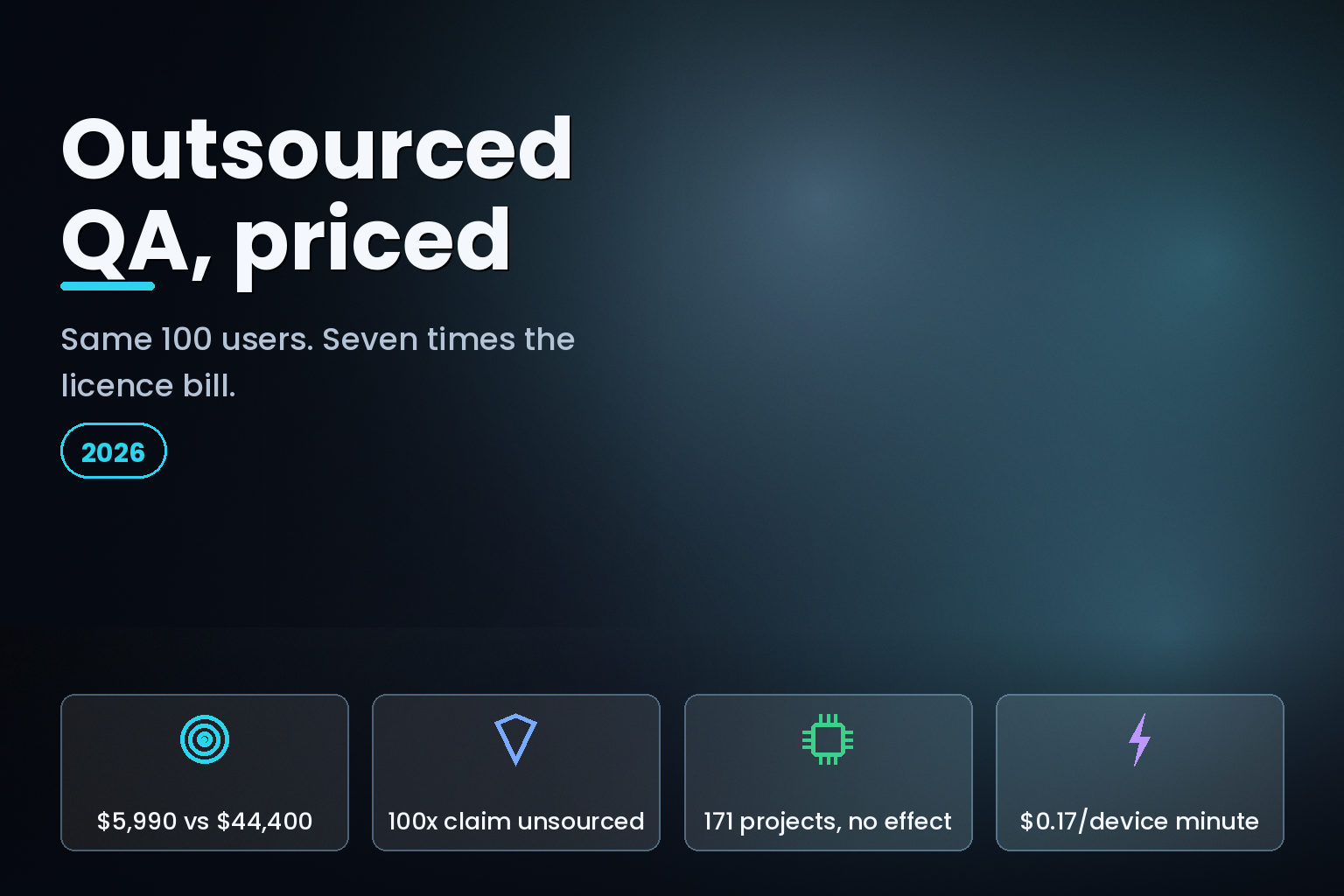
Summary. Test management licensing for 100 users ranges from $5,990 a year for Zephyr Essential to $44,400 a year for TestRail Professional at its published $37 per seat per month. The functionality gap between them does not explain a 7x spread; the licensing model does. Two of the largest vendors in the category, Tricentis and Applitools, publish no price at all. On the evidence side, the industry's most quoted number, that a defect costs 100 times more to fix in production, traces to 1981 internal course notes with no surviving dataset, and the largest study of the effect, covering 171 projects, found none. This page sets out what we charge for, what the tools cost, and which claims we will not make to win the work.
What outsourced QA actually costs
Three cost layers stack, and buyers usually model only one.
The first is people. PayScale's India dataset for Test / Quality Assurance Engineer, based on 1,077 self-reported profiles and last updated on 10 July 2026, puts average base pay at ₹505,129 a year, with the 10th to 90th percentile band running ₹247,000 to ₹1,000,000. Entry-level total compensation averages ₹293,714 across 170 profiles. These are self-reported figures, so treat them as an order of magnitude rather than a benchmark.
The second is tooling, and this is where the spread is widest.
| Tool, 51-100 user annual band | Published price | Model |
|---|---|---|
| Zephyr Essential | $5,990/year | Per-user volume band |
| Zephyr Standard | $6,810/year | Per-user volume band |
| Xray Standard | $7,280/year | Per-user volume band |
| Zephyr Advanced | $8,730/year | Per-user volume band |
| Xray Advanced | $8,740/year | Per-user volume band |
| Xray Enterprise add-on | $13,200/year | Separate paid app |
| TestRail Professional | $44,400/year at 100 seats | $37/seat/month |
TestRail is the outlier by an order of magnitude, and the reason is structural rather than functional: the Jira marketplace apps price in volume bands that flatten as headcount rises, while TestRail prices per seat with no flattening. TestRail's own newer monthly card, effective on invoices from 1 August 2026, charges $2,715 a month flat for up to 100 users, which is $32,580 a year and a different answer again.
That conflict is live and worth naming. TestRail's marketing pricing page still shows $37 per seat per month while its support article, updated 29 June 2026, gives $41 per user under the new monthly card. Both are first-party. A procurement exercise that quotes one and budgets the other will be wrong by a wide margin.
The third layer is execution infrastructure.
| Service | Published rate |
|---|---|
| AWS Device Farm, real device | $0.17 per device minute |
| AWS Device Farm, unmetered slot | From $250 per device slot per month |
| AWS Device Farm, desktop browser | $0.005 per instance minute |
| Firebase Test Lab, physical device | $5 per hour per device |
| Firebase Test Lab, virtual device | $1 per hour per device |
| BrowserStack Automate, desktop and mobile | $99 to $225 per month |
| Sauce Labs Real Device Cloud | $199 per month annual, $249 monthly |
| Katalon True Platform | $59 per seat per month annual, $70 monthly |
Two details in that table are routinely misreported. AWS Device Farm's standard free trial is 250 device minutes, not 1,000; the pricing page footnote says the larger figure is a limited-time promotion. Firebase Test Lab bills per minute rounded up, so a 22-second test costs a full minute and a 75-second test costs two, which changes the economics of large suites of short tests considerably.
Tricentis publishes no price for Tosca, qTest or Testim, and Applitools publishes none for any tier. Their pages render fine; the absence is editorial. For a buyer, an unpriced tool is an unbudgetable tool until a quote arrives, and that timing usually sits on the critical path.
The evidence problem, stated plainly
Most QA sales material rests on two numbers. Both deserve scrutiny.
The first is that a defect found in production costs roughly 100 times what it costs to fix in design. This is usually attributed to the IBM Systems Sciences Institute. Laurent Bossavit traced the citation chain to Roger Pressman's textbook, which cites 1981 IBM course notes. His finding: "the Institute was a corporate training program, not a research body; as such it is inappropriate to cite the source of the ratios as 'an IBM study' or 'a study by the IBM Systems Science Institute', in the total absence of any claim that the Institute was the primary source." No dataset has ever surfaced, and the underlying project data, if it exists, may date to 1967.
The claim has since been tested. Menzies, Nichols, Shull and Layman examined 171 software projects spanning 2006 to 2014 in Empirical Software Engineering 22(4), pages 1903 to 1935. Their conclusion: "We found no evidence for the delayed issue effect."
We will not sell testing on that curve, because it does not survive contact with the data.
The second number is the Consortium for Information and Software Quality estimate that poor software quality cost the United States $2.41 trillion in 2022, of which accumulated technical debt is $1.52 trillion. That figure is real and citable, but three disclosures belong with it. Its own Appendix B describes the method: "Assuming that our cost estimates in 2020 were close, we can project those forward based on the changes in economic conditions. Due to just inflation at 15% cumulative, our $1.56 trillion estimated in 2020, jumps to $1.8 trillion in 2022." For most other components the report states it "simply assumed that there was no growth." It was sponsored by tooling vendors, and its published components sum to more than the headline because they overlap.
The older NIST figure has the same problem in a different form. The $22.2 to $59.5 billion range comes from a May 2002 planning report prepared by RTI, not by NIST staff, it is denominated in 2002 dollars, and it measures the cost of inadequate testing infrastructure rather than the cost of defects.
What holds up is incident-level evidence. Parametrix, a Lloyd's coverholder, put the direct financial loss to the 500 largest US companies by revenue, excluding Microsoft, from the CrowdStrike update failure of 19 July 2024 at $5.4 billion, based on monitoring of 6,000 technology businesses. One defective update, one named publisher, one stated method. That is a stronger argument for release testing than any escalation curve.
Where automated testing actually stands in 2026
| Framework | Current stable | Released |
|---|---|---|
| Cypress | 15.20.1 | 10 August 2026 |
| Selenium | 4.47 | 10 August 2026 |
| Playwright | 1.62.1 | 30 July 2026 |
| Appium | 3.5.0 | 31 May 2026 |
Selenium 5 does not exist. The 4.47 release post records that the team "Published a Selenium 5 release charter" and an architecture decision record on BiDi boundaries. A charter is not a release, and any migration plan built around a Selenium 5 date is built on nothing.
Recent releases also argue for pinning versions rather than tracking latest. Cypress 15.18.0 shipped TypeScript 7 support that was broken on arrival and only fixed in 15.20.0; 15.20.1 is a hotfix for a regression in 15.20.0 that sent every Cypress Cloud request to http://localhost:3000. A team on automatic minor upgrades absorbed both.
On adoption, the World Quality Report 2025-26, based on 2,000 interviews conducted by Coleman Parkes Research across 23 countries in June and July 2025, found that 89% of organisations are piloting or deploying generative-AI-augmented workflows, split 37% in production and 52% in pilot, while "only 15% have achieved enterprise-scale deployment." Reported average productivity gain is 19%, and one third saw minimal gains. Non-adopters rose to 11% from 4% in 2024.
Mark Buenen, Global Leader, Quality Engineering and Testing at Capgemini, put the gap this way on 13 November 2025: "While technical progress is clear, many organizations still struggle to align Gen AI enabled quality engineering with business goals. In 2025, we're seeing more focus on governance, ROI, and cross-functional impact. The challenge ahead is closing the Gen AI divide to turn investment into measurable value."
What we build, and how the engagement runs
We run outsourced QA as a function, not a body-shop headcount line. Typical scope: test strategy and risk-based coverage design, automated regression suites in Playwright or Selenium, mobile device coverage, API contract testing, performance testing, accessibility conformance testing, and release gating inside the client's existing pipeline.
Our five-step process:
- Coverage and risk assessment. What breaks, what it costs when it breaks, and what is currently untested. Output is a ranked risk register, not a coverage percentage, because coverage percentage is the metric that most reliably produces useless tests.
- Test architecture. Framework selection with pinned versions, environment and test-data strategy, and the split between unit, integration and end-to-end. We size the end-to-end layer deliberately small.
- Automation build. Suites written against the risk register, running in the client's CI from day one rather than in a parallel system that later needs integrating.
- Release gating. Defined pass criteria, quarantine handling for flaky tests, and a triage rota so that a red build has an owner.
- Steady-state run. Maintenance, coverage extension, and quarterly review of which tests earned their runtime. Suites that only ever pass are candidates for deletion.
Engagement model: a fixed-price assessment and test-architecture phase, then either a dedicated squad on a monthly retainer or per-release testing priced by scope. We publish no per-hour rate card. An hour spent on exploratory testing of a payments flow and an hour spent maintaining a selector are not the same unit of value, and pricing them identically rewards the wrong work.
This practice sits alongside our DevOps services and custom software development teams, which matters because release gating without a pipeline to gate is theatre. Teams testing serverless workloads should also read our guidance on AWS serverless integration testing with LocalStack.
India-specific considerations
India's delivery model has shifted in a way that favours outsourced QA. The Reserve Bank of India's Survey on Computer Software and ITES Exports for 2024-25, published 4 November 2025, puts software services exports at US$204.7 billion, up 7.3%, with 90.7% delivered off-site rather than on-site. The survey covered 2,206 respondents out of 6,766 companies contacted, representing about 90% of total software services exports. Europe grew 14.3% to a 32.8% share while the United States share fell to 52.9%. NASSCOM's most recent published Strategic Review, for FY2025, puts sector revenue at $283 billion with headcount at 5.80 million.
Accessibility testing is becoming a compliance requirement rather than a nice-to-have. Section 40 of the Rights of Persons with Disabilities Act 2016 empowers the Central Government to set accessibility standards, and section 46 requires that "service providers whether Government or private shall provide services in accordance with the rules on accessibility formulated by the Central Government under section 40 within a period of two years from the date of notification of such rules." Section 2(n) defines information and communication technology to include web-based services, which pulls websites and apps into scope.
For government-facing work, Guidelines for Indian Government Websites 3.0, maintained by the National Informatics Centre and last updated 13 August 2026, states that "the current version ensures conformity with Level AA of WCAG 2.1. In all 17 new success criteria have been added to the new version." GIGW binds government websites and apps, not private companies.
The Securities and Exchange Board of India made digital accessibility mandatory for all Regulated Entities through circular SEBI/HO/ITD-1/ITD_VIAP/P/CIR/2025/111 dated 31 July 2025, and has extended the timelines at least twice since, most recently by a circular dated 31 July 2026. We are not quoting a compliance date here because the current one is not readable on sebi.gov.in without opening the circular PDF, and a wrong date in a compliance plan is worse than no date.
One technical point worth stating because vendors get it backwards: WCAG 2.2, published 5 October 2023, did not replace WCAG 2.1. The W3C is explicit that "WCAG 2.2 does not deprecate or supersede WCAG 2.1, and WCAG 2.1 does not deprecate or supersede WCAG 2.0." All three remain W3C Recommendations, and GIGW 3.0 normatively requires 2.1 Level AA.
We design test programmes aligned with WCAG 2.1 Level AA requirements and with RPwD Act 2016 obligations where they apply. eCorpIT is certified for CMMI Level 5 and ISO 27001:2022, and is MSME registered.
Why eCorpIT
We are a Gurugram-based technology consulting organisation founded in 2021, with senior-led, multi-disciplinary engineering teams and partnerships with AWS, Microsoft and Google. Our QA practice is built around a position that costs us some sales: we will not quote the 100x defect curve, we will not present vendor-sponsored trillion-dollar estimates without their methodology, and we will tell you when a test suite should be deleted rather than extended.
Klaudia Dussa-Zieger, President of ISTQB, described the shift on 29 July 2025: "Generative AI is transforming how we design, execute, and manage tests." The tooling is changing quickly. The discipline of deciding what is worth testing has not changed at all, and it is still where the value sits.
FAQ
How eCorpIT can help
We scope QA against a ranked risk register rather than a coverage target, build automation into your existing pipeline instead of alongside it, and review quarterly which tests have earned their runtime. Engagements start with a fixed-price assessment and test-architecture phase, after which you can take a dedicated squad on retainer or buy testing per release. If your tooling renewal is approaching or an accessibility obligation is now in scope, contact us and we will begin with the assessment.
References
- Xray Test Management pricing, Atlassian Marketplace - Cloud annual and monthly user bands.
- Zephyr test management pricing, Atlassian Marketplace - Standard and Advanced edition bands.
- TestRail pricing - Professional at $37 per seat per month, Enterprise at $74.
- Upcoming changes to TestRail's monthly subscription pricing - new monthly card effective 1 August 2026.
- BrowserStack pricing - Automate, Live, App Automate and Percy tiers.
- Sauce Labs pricing - Live Testing, Virtual Device Cloud and Real Device Cloud.
- Katalon pricing - per-seat monthly and annual rates.
- Tricentis Tosca pricing - no published price.
- Applitools platform pricing - all tiers listed as custom.
- AWS Device Farm pricing - $0.17 per device minute, 250-minute standard trial, $250 per unmetered slot.
- Firebase Test Lab usage, quotas and pricing - $5 and $1 per hour, per-minute rounding.
- Cypress changelog - 15.20.1 released 10 August 2026.
- Selenium 4.47 released - release date and Selenium 5 charter.
- Playwright v1.62.1 release - released 30 July 2026.
- Appium releases - 3.5.0 released 31 May 2026.
- CISQ, The Cost of Poor Software Quality in the US, 2022 report - $2.41 trillion headline and Appendix B methodology.
- Bossavit, The Leprechauns of Software Engineering, on the IBM Systems Sciences Institute ratios - citation chain analysis.
- Menzies, Nichols, Shull and Layman, Are delayed issues harder to resolve? - 171 projects, no evidence for the delayed issue effect.
- RTI for NIST, The Economic Impacts of Inadequate Infrastructure for Software Testing - May 2002, $22.2 to $59.5 billion range.
- Parametrix report on the CrowdStrike outage impact on large US companies - $5.4 billion direct loss estimate.
- World Quality Report 2025-26 press release - adoption figures and Mark Buenen quote.
- ISTQB CT-GenAI certification press release - Klaudia Dussa-Zieger quote, 29 July 2025.
- PayScale, Test / Quality Assurance Engineer salary, India_Engineer_(Computer_Software)/Salary) - ₹505,129 average, n=1,077, updated 10 July 2026.
- RBI Survey on Computer Software and ITES Exports 2024-25 - US$204.7 billion, 90.7% off-site.
- NASSCOM Technology Sector in India Strategic Review 2025 - FY25 revenue and headcount.
- The Rights of Persons with Disabilities Act 2016 - sections 2(n), 40 and 46.
- New features of GIGW 3.0 - WCAG 2.1 Level AA conformance.
- W3C Web Content Accessibility Guidelines overview - WCAG 2.2 does not supersede 2.1.
Last updated: 17 August 2026.