On this page · 14 sections
- What changed in 2026
- LlamaParse (LlamaIndex)
- Unstructured
- Docling (IBM Research, LF AI & Data)
- Azure AI Document Intelligence
- Other options worth pricing
- Quality: what the benchmarks tell you
- Head-to-head comparison
- Decision table
- Worked cost example: 100,000 pages a month
- India, DPDP and data residency
- Implementation checklist
- How eCorpIT can help
- References
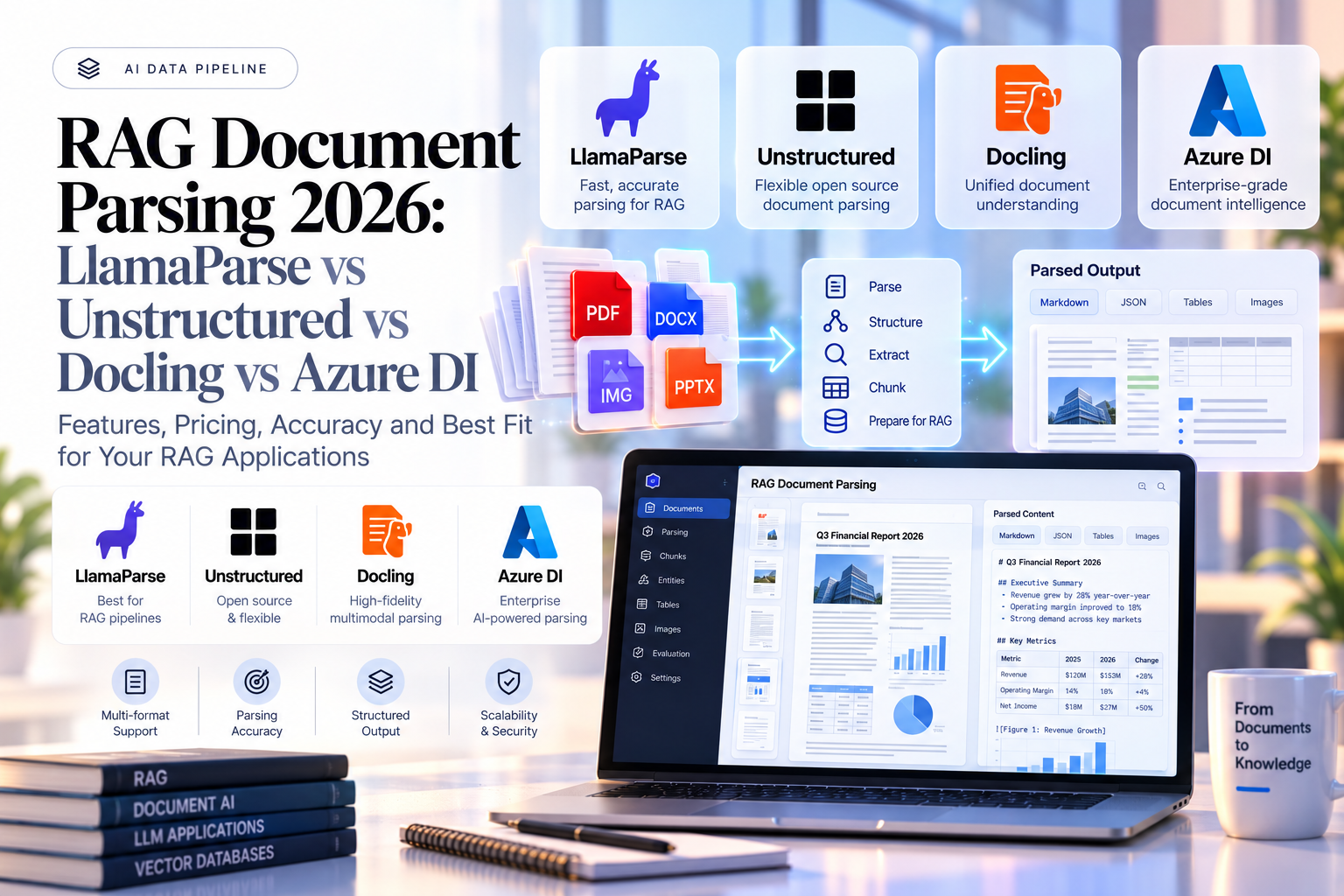
Summary. Four options dominate RAG parsing in October 2026, with very different cost curves. LlamaParse bills credits at $1.25 per 1,000, and its v2 tiers cost 1, 3, 10 or 45 credits a page, so a page runs from $0.00125 (Fast) to about $0.056 (Agentic Plus); Pro is $500 a month for 400,000 credits. Unstructured's hosted Transform API charges a flat $0.015 a page after a one-time 10,000 free pages; its open-source library is Apache-2.0. Docling is MIT-licensed, runs fully offline, reached v2.141.0 on 20 October 2026 and graduated in the LF AI & Data Foundation on 27 August 2026; IBM also sells it managed at $4 per 1,000 pages. Azure Document Intelligence charges $1.50 per 1,000 pages for Read and $10 for Layout, is metered in Central India and ships on-premises containers. For 100,000 pages a month, routed LlamaParse costs $637.50, Azure Layout $1,000, Unstructured $1,500, and self-hosted Docling about $33 to $65 of GPU time plus the engineers to run it. Pick Docling or Azure containers when documents cannot leave your network, Azure for managed processing in India, LlamaParse when hard tables justify per-page routing, and Unstructured when connectors matter more than unit price.
About this article. Prices, licences, regions and benchmark figures were checked against vendor pages, documentation and benchmark sources on 22 October 2026. Vendors change pricing often, so re-check before you commit. No vendor paid for inclusion or placement. Researched with AI assistance and reviewed by our editorial team.
What changed in 2026
Older comparisons now get these wrong:
- LlamaParse moved to tiers. The v2 API prices parsing at 1, 3, 10 or 45 credits a page (Fast, Cost-effective, Agentic, Agentic Plus). On 19 March 2026 LlamaIndex open-sourced LiteParse (Apache-2.0), a local parser that uses no LLM, layout model or GPU.
- Unstructured flattened its price. Transform bills $0.015 a page across document and extraction types after a 10,000-page credit that applies once per account.
- Docling went managed. IBM launched Docling for IBM watsonx on 15 June 2026 at $4 per 1,000 pages, and 2026 releases moved Docling to a threaded, memory-bounded docling-parse v7 backend.
- Azure set retirement dates. Microsoft now lists the service as Azure Document Intelligence in Foundry Tools. API v4.0 (2024-11-30) is current; v3.0 retires on 30 March 2029 and v2.1 on 15 September 2027.
- Mistral OCR 4.1 went GA on 16 July 2026 at $4 per 1,000 pages, double OCR 3's $2.
- Vendor benchmarks multiplied. LlamaIndex published ParseBench in April 2026, and each vendor tops its own table.
Parsing errors are baked into the index: a flattened table cannot be fixed later by a better embedding model, and switching parser means re-embedding everything.
LlamaParse (LlamaIndex)
LlamaParse is LlamaIndex's proprietary parsing service; its pricing FAQ says plainly that it is not open source. LiteParse, the open-source sibling, runs without any machine-learning model, so it has no layout detection or chart understanding; its May 2026 v2 added Markdown and JSON output.
| v2 parse tier | Credits per page | Cost per 1,000 pages |
|---|---|---|
| Fast | 1 | $1.25 |
| Cost-effective | 3 | $3.75 |
| Agentic | 10 | $12.50 |
| Agentic Plus | 45 | $56.25 |
| Layout extraction add-on (any tier) | +3 | +$3.75 |
Plans. Free ($0, 10,000 credits a month); Starter ($50 a month, 40,000 credits); Pro ($500 a month, 400,000 credits, pay-as-you-go up to $5,000 a month at the same $1.25 per 1,000 credits); Enterprise (volume discounts, SSO, SaaS or hybrid deployment). Concurrent parse jobs: 5 on Free and Starter, 20 on Pro, 100 on Enterprise.
Deployment. SaaS runs in North America (us-east-1) and the EU (eu-central-1); Enterprise can deploy into a private VPC. Files are cached for 48 hours, and caching can be switched off. The pricing page lists SOC 2 Type II, GDPR and HIPAA, with BAAs on Enterprise, plus 80+ languages and 130+ file formats.
Trade-off. Per-page tier choice is the lever. The pricing page advertises tier routing per page that saves up to 80% (a vendor claim); in the v2 API this is the Cost Optimizer, which sends simple pages from the Agentic tiers down to Cost-effective. There is no India tenant, and Agentic Plus gets expensive fast. Best for mixed corpora where a minority of pages carry dense tables, charts or forms.
Unstructured
Unstructured sells two things. The open-source unstructured library is Apache-2.0 and uses Tesseract and Poppler locally, with extra language packs for more languages. Transform, the hosted API, charges $0.015 a page after the one-time credit. PDF, PPTX and TIFF count per page; most other files, including images, count as file size divided by 100 KB. The Business plan adds dedicated instances on AWS or Azure, in-VPC deployment on AWS, Azure or Google Cloud, bare metal and custom pricing.
The pricing page lists 40+ connectors (SharePoint, Confluence and S3 in; Pinecone, Qdrant and PostgreSQL out), five chunking strategies, enrichment options, and SOC 2 Type 2, ISO 27001, HIPAA and GDPR. The multi-tenant SaaS region is not published, but Business dedicated instances are offered in nine AWS regions, including Mumbai.
Trade-off. One vendor pulls, partitions, chunks, embeds and loads into your vector database. The flat rate makes hard scans relatively cheap, but a clean digital page also costs $0.015. The open-source build is not the hosted product: Unstructured's own benchmark scores its open-source library at 0.715 on adjusted CCT, its main text-accuracy measure, against 0.880 for its hosted VLM pipeline (vendor-run). Best for managed ingestion from many enterprise sources.
Docling (IBM Research, LF AI & Data)
Docling is an MIT-licensed Python SDK and CLI started at IBM Research Zurich; models carry their own licences. It converts PDF, Office files, HTML, images and email into a DoclingDocument and exports Markdown, HTML, DocTags or lossless JSON; it integrates with LangChain, LlamaIndex, CrewAI and Haystack and ships an MCP server. Docling graduated in the LF AI & Data Foundation on 27 August 2026. OCR is pluggable: RapidOCR, Nemotron-OCR, EasyOCR, Tesseract (CLI or tesserocr) and ocrmac. The VLM pipeline uses Granite-Docling-258M (Apache-2.0, released 17 September 2025, English with experimental Japanese, Arabic and Chinese), whose model card reports a structure-only TEDS of 0.97 on FinTabNet tables.
Throughput from Docling's documentation, vendor-reported:
| Hardware | Standard, no OCR | Standard, with OCR (image test set) | VLM (Granite-Docling) |
|---|---|---|---|
| AWS g6e.2xlarge (L40S) | 3.1 pages/s | not published | 2.4 pages/s |
| RTX 5090 workstation | 7.9 pages/s (1.5 CPU-only) | 1.6 pages/s | 3.8 pages/s |
| RTX 5070 workstation | 4.2 pages/s (1.2 CPU-only) | 1.1 pages/s | 2.0 pages/s |
The OCR figures come from a separate set of page images, not the PDF used for the other columns.
Docling for IBM watsonx costs $4 per 1,000 pages pay-as-you-go, without support, or from $3,999.60 per million pages a year with support and higher throughput, as a SaaS on AWS; IBM does not name the region. IBM claims about 14 times faster processing than open-source Docling (vendor claim).
Trade-off. Nothing leaves your network and there is no per-page fee, but you own GPUs, queues and upgrades, and competitor-run benchmarks place the default pipeline below hosted VLM pipelines on table cells. Best for air-gapped or regulated workloads with a platform team.
Azure AI Document Intelligence
Azure's service is deterministic OCR and layout analysis; Microsoft describes it as part of Azure Content Understanding, which also offers LLM-powered analysis. East US and Central India list identical USD rates in Microsoft's Retail Prices API:
| Model or meter | Price |
|---|---|
| Read (text) | $1.50 per 1,000 pages to 1M; $0.60 above |
| Layout and prebuilt models | $10 per 1,000 pages |
| Custom extraction | $30 per 1,000 pages |
| Add-ons (high resolution, formulas, fonts) | $6 per 1,000 pages |
| Free tier (F0) | 500 pages a month, first two pages per request |
| Commitment, prebuilt 100,000 pages | $900 a month, then $9 per 1,000 |
| Connected container, prebuilt 100,000 pages | $720 a month |
| Disconnected container, prebuilt | $8,640 a year for up to 1.2M pages |
The free tier analyses only the first two pages of each request. Layout returns text, tables, titles, paragraphs and selection marks; printed-text support includes Hindi, Marathi, Tamil and many Devanagari-script languages, though handwriting covers only 12 languages, none of them Indian. The v4.0 containers run Read and Layout, recommended at 8 cores and 24 GB of memory; connected containers report usage every 10 to 15 minutes, and Microsoft says they do not send document content. Best for Azure shops, managed processing in India and printed Hindi or Marathi.
Other options worth pricing
| Option | Price per 1,000 pages | Hosting | Watch for |
|---|---|---|---|
| AWS Textract | $1.50 Detect Text; $15 Tables, Layout free alongside | AWS, including Mumbai | English plus five European languages only |
| Google Document AI Layout Parser | $10, initial chunking included | Global, us, eu, europe-west4, us-central1 | Not in asia-south1 |
| Mistral OCR 4.1 | $4; $5 annotated | Global API | Regional endpoints cost 1.1x and lack batch; OCR 4.1 not confirmed there |
| Reducto r-1 Parse | $10; batch 20% off | SaaS; VPC, on-prem on Enterprise | $150 free usage |
| Gemini 3.5 Flash-Lite, direct | about $2.23 (assumptions below) | API | Output tokens dominate |
Sources: AWS Textract pricing, Google Document AI pricing and regions, Mistral's OCR 4.1 page and regional inference docs, and Reducto pricing.
A vision LLM is cheaper than it looks. Gemini 3 and later models bill 560 tokens per PDF page by default; at $0.30 per million input and $2.50 per million output tokens for Gemini 3.5 Flash-Lite, a page with a 200-token prompt and 800 output tokens costs about $0.0022. The risk is invented text: Unstructured's vendor-run benchmark scores off-the-shelf frontier models at 0.044 to 0.257 on tokens added, its measure of words that never appeared in the source.
Quality: what the benchmarks tell you
No independent benchmark covers all four headline tools:
- OmniDocBench v1.6 (OpenDataLab, academic). Small open models lead: TeleOCR at 96.91 overall, OvisOCR2 at 96.47, PaddleOCR-VL-1.6 at 96.34 and MinerU2.5-Pro at 95.75. Mistral OCR (2503 model) scores 85.66, with table TEDS of 76.78. LlamaParse and Azure are absent, Docling and Unstructured's open-source library are not on the v1.6 leaderboard, and text evaluation covers only Chinese and English.
- ParseBench (LlamaIndex, vendor-run). The April paper covered about 2,000 enterprise pages and 14 methods, with LlamaParse Agentic leading at 84.9%; on the live leaderboard Agentic Plus now leads at 90.2%.
- Unstructured SCORE (vendor-run). On table cell content accuracy: Unstructured VLM 0.820, Reducto Agentic 0.708, Docling 0.606 (0.657 with Granite VLM), LlamaParse VLM 0.522.
- OpenBenchmarks (a Y Combinator-backed benchmarking firm whose partners include Reducto, LlamaIndex and Extend). On 94 redlined contracts: Extend 93.1%, Reducto 84.8%, LlamaParse Agentic Plus 84.7%, Mistral OCR 4.1 36.9%, Unstructured 27.0%, against a 25.2% markup-blind baseline. Docling was not tested, and Azure was run but ruled out because it marked none of the deletions.
Rankings flip with the document set, so score a gold set of your own files end to end.
| Failure mode | Symptom in answers | What to test |
|---|---|---|
| Multi-column layouts | Sentences spliced across columns | Two-column reports |
| Borderless or merged-cell tables | Numbers under the wrong header | Cell accuracy on your tables |
| Scanned, low-DPI pages | Misread digits and names | Textract advises at least 150 DPI |
| Handwriting | Lost annotations | Textract and Azure handwriting skip Indian languages |
| Hindi and Devanagari | Garbled or dropped text | Azure Read; Docling with Tesseract hin or RapidOCR |
| Tracked changes | Deleted clauses quoted as live | Redlined contracts |
Head-to-head comparison
| Measure | LlamaParse | Unstructured | Docling | Azure Document Intelligence |
|---|---|---|---|---|
| Licence | Proprietary (LiteParse Apache-2.0) | OSS Apache-2.0; Transform proprietary | MIT; Granite-Docling Apache-2.0 | Proprietary |
| Text-only, per 1,000 pages | $1.25 (Fast) | $15 | $0 plus compute | $1.50 Read |
| Structured, per 1,000 pages | $3.75 to $56.25 | $15 | $0 plus compute; $4 IBM managed | $10 Layout |
| Free allowance | 10,000 credits a month (Free plan) | 10,000 pages once | Unlimited | 500 pages a month |
| Self-hosting | Enterprise VPC or hybrid | OSS anywhere; Business in-VPC | Fully offline | Read and Layout containers |
| Hosted regions | North America, EU | Not published; dedicated in AWS regions incl. Mumbai | Wherever you run it | Azure regions incl. Central India |
| Output | Markdown, JSON, HTML tables, XLSX | JSON elements, HTML tables | Markdown, HTML, DocTags, JSON | JSON with tables and paragraphs |
| Compliance the vendor publishes | SOC 2 Type II, GDPR, HIPAA (BAA on Enterprise) | SOC 2 Type 2, ISO 27001, HIPAA, GDPR | Your controls | Microsoft compliance documentation |
Decision table
| Pick this | If |
|---|---|
| Docling, self-hosted | Documents cannot leave your network and you can run GPU workers |
| Azure Document Intelligence | You need managed processing in Central India, printed Hindi or on-prem containers |
| LlamaParse | Hard tables and charts are a minority of pages, you will route by tier, and US or EU hosting is fine |
| Unstructured Transform | You want connectors, chunking and embedding in one managed pipeline |
| Docling for IBM watsonx or Mistral OCR 4.1 | You want one flat managed rate, $4 per 1,000 pages, without tier routing |
| Reducto | Documents are hard and you need a commercial VPC or air-gapped deployment |
| AWS Textract | You are AWS-native with English or Western European documents |
| A vision LLM directly | Volume is low and occasional invented text is tolerable |
Worked cost example: 100,000 pages a month
Scenario: 70,000 born-digital PDF pages and 30,000 scanned pages with tables, at list prices.
| Option | Arithmetic | Monthly cost |
|---|---|---|
| LlamaParse, routed (Cost-effective digital, Agentic scanned) | (70,000 × 3 + 30,000 × 10) = 510,000 credits × $1.25/1,000 | $637.50 |
| LlamaParse, all Agentic | 1,000,000 credits × $1.25/1,000 | $1,250 |
| LlamaParse, scanned on Agentic Plus | 1,560,000 credits × $1.25/1,000 | $1,950 |
| Unstructured Transform | 100,000 × $0.015 | $1,500 |
| Azure, Layout on every page | 100 × $10 | $1,000 |
| Azure, prebuilt commitment tier | Flat for 100,000 pages | $900 |
| Azure, Read digital + Layout scanned | 70 × $1.50 + 30 × $10 | $405 |
| Docling, batch on g6e.2xlarge | (6.3 h + 8.3 h) × $2.242 | about $33 ($65 with 2x headroom) |
| Docling, GPU always on | 730 h × $2.242 | about $1,637 |
| Docling for IBM watsonx or Mistral OCR 4.1 | 100 × $4 | $400 |
| Reducto r-1 Parse | 100 × $10 | $1,000 ($800 batch) |
| Textract, Detect Text digital + Tables scanned | 70 × $1.50 + 30 × $15 | $555 |
| Gemini 3.5 Flash-Lite | 76M input × $0.30/M + 80M output × $2.50/M | about $223 |
Assumptions:
- LlamaParse on Pro: the $500 fee covers the first 400,000 credits at the same rate, so the routed bill is $500 plus $137.50.
- Unstructured is at steady state; the 10,000 free pages apply once.
- Azure routed uses Read for digital pages, which returns text without table structure.
- Docling: vendor-reported 3.1 pages a second for digital pages; for scanned pages with OCR we assume 1.0 page a second, as Docling publishes no OCR figure for this instance. The GPU price is AWS's US East on-demand rate; in Mumbai the same instance costs $2.69 an hour, or about $39 for the batch run. Engineering time, often the largest cost, is excluded.
- Gemini: 560 page tokens, a 200-token prompt and an assumed 800 output tokens.
Unit price misleads. Batch Docling is nearly free per page, but an always-on GPU costs more than routed LlamaParse. Routing is the biggest lever, as with LLM hybrid routing: cheap tiers for clean pages, expensive tiers only where needed.
India, DPDP and data residency
| Option | Processing in India | On-prem or air-gapped | Check |
|---|---|---|---|
| Azure Document Intelligence | Yes, Central India | Connected and disconnected containers | Connected containers still meter to Azure |
| Docling (OSS) | Wherever you deploy | Yes | You own security and patching |
| Docling for IBM watsonx | Region not stated (AWS) | No | Ask IBM |
| Unstructured | Business dedicated instance in AWS Mumbai | Bare metal (Business) | SaaS region not published |
| LlamaParse | No; North America or EU | Enterprise VPC or hybrid | Disable the 48-hour cache |
| AWS Textract | Yes, Mumbai | No | Opt out of content use, or content may be stored in another region |
| Google Document AI | Form Parser in asia-south1; OCR there only in preview | No | Layout Parser not in asia-south1 |
| Mistral OCR | No India endpoint | Enterprise self-hosting | Regional endpoints cost 1.1x |
| Reducto | No India endpoint listed | Enterprise VPC, on-prem | EU and AU endpoints on Growth |
Section 16 of the DPDP Act, 2023 lets the government restrict transfers of personal data to countries it notifies and preserves stricter sector laws, and penalties for security-safeguard failures reach ₹250 crore. The DPDP Rules, dated 13 November 2025 and announced on 14 November, phase in over 18 months; Rule 13 lets the government bar Significant Data Fiduciaries from moving specified personal data out of India. For KYC files, claims or patient records, keep parsing inside your perimeter or in an Indian region. EU teams can use LlamaParse's EU tenant, Google's eu multi-region or a European dedicated instance.
Implementation checklist
- Build a 200 to 500 page gold set covering scans, tables and Hindi documents.
- Score parse fidelity and end-to-end retrieval separately.
- Classify pages (born-digital or scanned, table density) and route them.
- Store rich output with bounding boxes so you can re-chunk and cite without re-parsing.
- Pin versions: Azure api-version 2024-11-30, LlamaParse saved configurations, explicit Mistral model IDs.
- Check page-counting rules and retention settings for each vendor.
- Normalise output to Markdown plus JSON coordinates so switching parsers is a re-run, not a rewrite.
Docling for scanned Hindi and English pages (install the Hindi traineddata first, because Docling checks languages when the options are created):
            from docling.datamodel.base_models import InputFormat
from docling.datamodel.pipeline_options import PdfPipelineOptions, TesseractCliOcrOptions
from docling.document_converter import DocumentConverter, PdfFormatOption

opts = PdfPipelineOptions(
    do_ocr=True,
    do_table_structure=True,
    ocr_options=TesseractCliOcrOptions(lang=["hin", "eng"]),
)
converter = DocumentConverter(
    format_options={InputFormat.PDF: PdfFormatOption(pipeline_options=opts)}
)
print(converter.convert("scanned-circular.pdf").document.export_to_markdown())
For the retrieval layer, see our guides to Bedrock Managed Knowledge Base vs self-managed RAG, agentic vs classic RAG and Postgres vector search.
How eCorpIT can help
eCorpIT is a Gurugram-based technology organisation, founded in 2021, assessed at CMMI Level 5 and MSME certified, with senior-led engineering teams working across AWS, Microsoft and Google platforms. Our RAG knowledge assistant service builds ingestion pipelines on the options above, from self-hosted Docling inside client networks to Azure Document Intelligence in Central India, and starts with a gold set from your own documents so the parser choice rests on measured retrieval quality and a real bill. Talk to us at /contact-us/.
Last updated: 22 October 2026.