On this page · 9 sections
- What Apple actually published
- Where the extra numbers come from
- The staleness problem is bigger than the accuracy problem
- Three internal contradictions worth knowing
- Apple's own release is not perfectly consistent either
- Marketing language that reads like a specification
- A rule for the next launch
- How eCorpIT can help
- References
Summary. Apple announced iPhone Duo on 9 September 2026, priced from $1,999 and shipping 23 October 2026. Within hours, full specification tables were live across the web listing resolution, pixel density, refresh rate, RAM and battery capacity. Apple published none of those five numbers. This piece compares Apple's own release against two of the most-read third-party pages, line by line, and separates the figures that trace to a source from the figures that do not. If you are writing a procurement document, a comparison table or a client brief this month, the distinction matters more than the numbers.
This is not an accusation of bad faith. It is a description of how a spec sheet works: it has rows to fill, and a manufacturer that leaves rows blank does not stop the rows existing.
What Apple actually published
From the iPhone Duo announcement, these are stated outright:
- A 7.6-inch inner display and a 5.4-inch outer display, with a footnote clarifying that "when measured as a standard rectangular shape, the inner display screen is 7.58 inches diagonally, and the outer display screen is 5.36 inches diagonally. The actual viewable area is smaller."
- "ProMotion, Always On, and 3000 nits of peak outdoor brightness."
- A20 Pro, "the same chip in iPhone 18 Pro models", on "the latest 2-nanometer process technology", with a 6-core CPU, 7-core GPU and Dual 16-core Neural Engine.
- Storage in "256GB, 512GB, 1TB, and 2TB storage capacities", starting at $1,999.
- Battery in playback hours: "up to 31 hours of video playback when using the inner display, up to 44 hours of video playback when using the outer display, and up to 24 hours of usage per charge when both displays are used equally."
- Grade 5 titanium, IP68, a hinge "engineered from more than 100 components", Touch ID in the side button.
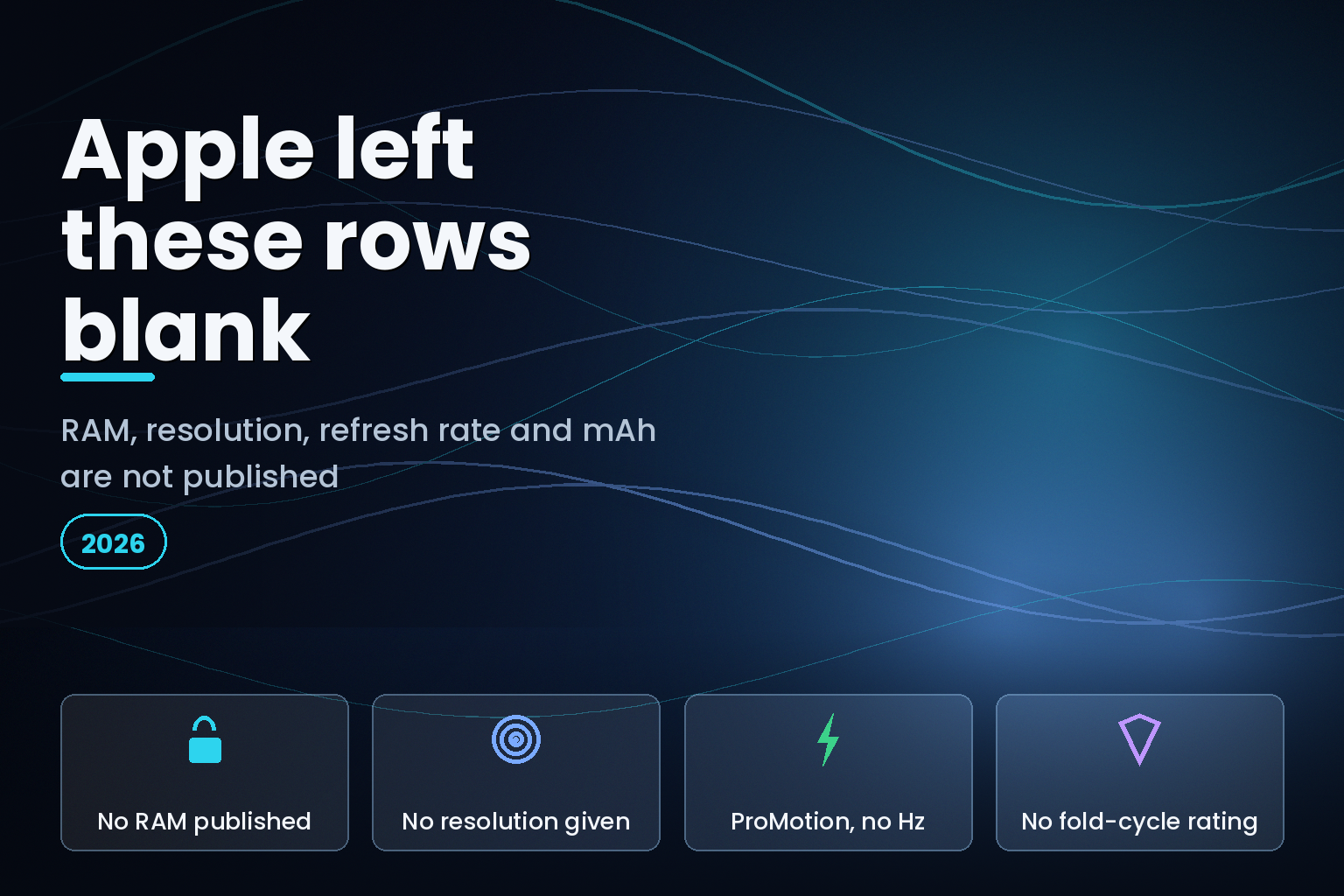
And these are the notable absences. Apple does not publish a pixel resolution for either display, a pixel density, a refresh rate in hertz, a RAM capacity, a battery capacity in mAh, a thickness or weight, a numeric aspect ratio, or a fold-cycle durability rating.
Some of those omissions are routine for Apple. Others, particularly the fold-cycle rating, are exactly the figure a fleet buyer wants.
Where the extra numbers come from
We checked two of the pages that rank for iPhone Duo specifications.
| Specification | Apple | GSMArena | MacRumors foldable guide |
|---|---|---|---|
| Inner display size | 7.6in, 7.58in measured | 7.6in | 7.8in, 7.76in and 7.6in |
| Inner resolution | Not published | 1878 x 2670 | 2,713 x 1,920 |
| Pixel density | Not published | ~430 ppi | Not stated |
| Refresh rate | ProMotion, no figure | 120Hz | Not stated |
| Peak brightness | 3000 nits peak outdoor | 3000 nits peak | Not stated |
| RAM | Not published | 12GB | 12GB expected |
| Storage | 256GB to 2TB | Three inconsistent lists | 256GB, 512GB, 1TB |
| Chip | A20 Pro | A20 Pro | A20 |
| Battery | Hours only | No capacity published | 5,400 to 5,800mAh |
Two things stand out immediately. GSMArena agrees with Apple on the headline items it can check, including the 7.6-inch size, the 3000 nits peak figure and the A20 Pro designation. And the MacRumors guide disagrees with Apple on almost everything, for a reason that has nothing to do with accuracy.
The staleness problem is bigger than the accuracy problem
The MacRumors page in that column is its "2026 iPhone Fold Rumors" guide, bylined 21 August 2026. That is nineteen days before Apple announced the device, and the guide body has not been updated since. It still says "Multiple rumors suggest the first foldable iPhone will debut in September 2026", in the future tense, and it never uses the name iPhone Duo anywhere in its own text.
The guide is not wrong so much as superseded, and it is honest about what it is: the headline says "Rumors", and every figure is attributed to a named analyst or an unnamed leaker, with qualifiers throughout. "Current rumors suggest", "according to one leaker", "expected to feature 12GB RAM", "could have a battery in the 5,400 to 5,800 mAh range", "will allegedly have a display with a 4:3 aspect ratio".
The failure mode is not the page. It is a reader arriving from search, seeing a comprehensive table on a reputable site, and not registering the byline date or the hedging. A pre-announcement rumour guide and a post-announcement spec sheet look identical in a search result.
Three internal contradictions worth knowing
Each of these sits inside a single source, which makes them easy to miss.
MacRumors' outer display does not compute. The guide states the outer display "will measure in at 5.49 inches with a 2,088 x 1,422 resolution and a 4:3 aspect ratio". A 2,088 by 1,422 panel has a ratio of roughly 1.47, not the 1.33 that 4:3 describes. One of the two figures in that sentence must be wrong.
GSMArena lists storage three different ways on one page. The memory table gives 256GB, 512GB, 1TB and 2TB. The header summary gives "256GB/512GB/2TB", dropping the 1TB tier. The page description says "2048 GB storage, 12 GB RAM". Apple's own list is 256GB, 512GB, 1TB and 2TB, so the memory table is right and the header is incomplete.
The same page ships unfilled placeholders. Under the selfie camera it reads "XX MP under display camera", and the CPU line reads "Hexa-core (2x GHz high performance + 4x GHz)" with the clock speeds literally absent. These are on a page titled "Full phone specifications", and they are a useful tell: where Apple published nothing, a template leaves its scaffolding visible.
To GSMArena's credit the page carries a plain disclaimer, "We can not guarantee that the information on this page is 100% correct", and notes the device was "Previously rumored as Apple iPhone Fold, Apple iPhone Ultra".
Apple's own release is not perfectly consistent either
It would be unfair to hold third parties to a standard the primary source does not meet.
Ceramic Shield 2. The body text says "Ceramic Shield 2 on the front has 3x better scratch resistance than the previous generation". An image caption on the same release says "Ceramic Shield 2 on the outer display reduces glare and provides 3x better scratch resistance". Only the caption claims a glare benefit, and only the caption locates the material on the outer display specifically.
iOS 27 against iOS 27.1. The release discusses iOS 27 features throughout, and states Apple Intelligence arrives "with iOS 27 on Monday, September 14". But the pricing and availability section says "iPhone Duo will be available with iOS 27.1". The release never explains what differs. For developers this is not cosmetic, because the layout APIs are new in 27.1, as covered in our adaptive layout guide.
Device Hub. The release says developers can adapt apps using "the new and updated APIs in the latest SDKs, and upcoming support for iPhone Duo in Device Hub in Xcode". Apple's own Tech Talk Prepare your app for iPhone Duo instead instructs developers to "Download Xcode 27.1 and run your app in the iPhone Duo simulator using DeviceHub". One says upcoming, the other says do it now.
Dual Capture appears only in a video caption, never in the body text. If you cite it, cite it as caption-only.
Marketing language that reads like a specification
Four phrases in the release will end up in comparison tables as though they were measurements. None is one.
- "the thinnest iPhone ever", with no thickness given anywhere.
- "the largest display ever on iPhone", a relative claim.
- "delivering the fastest CPU in a smartphone", with no benchmark and no competitor named.
- "up to 40 percent higher stiffness than other materials used in the industry", with the comparison materials unnamed.
The performance figures also move their baseline mid-paragraph. Sustained performance is "up to 35 percent better" than iPhone 17 Pro. The CPU and GPU figures are against A19 Pro. The "50 percent more unified memory bandwidth" and "2x the compute power" claims name no baseline at all. These are not comparable to one another and should not be merged into a single generational claim.
A rule for the next launch
Three habits cover most of this, and none takes long.
- Check the byline date before the table. A guide written before an announcement can outrank the announcement.
- Ask what the manufacturer left blank. RAM, resolution, refresh rate and mAh are the rows Apple habitually omits, and therefore the rows most likely to be filled from elsewhere.
- Treat "up to" as a ceiling under stated conditions. Apple's own battery footnote specifies that fast-charge testing was "conducted with drained iPhone Duo units in open configuration", which is not how anyone uses the device.
For teams planning around the device rather than writing about it, our enterprise planning guide covers the fleet decision and our cost scoping guide covers what app support involves. If you need a figure checked against a primary source before it goes into a client document, ask us at our contact page.
How eCorpIT can help
eCorpIT is a Gurugram-based engineering organisation, founded in 2021, holding CMMI Level 5, MSME and ISO 27001:2022 certifications. We verify hardware and platform claims against primary sources before they enter client documents, briefs or procurement decisions, and we build device and platform plans on figures that have an attributable origin. If a number in a specification table has to survive scrutiny, we will tell you where it came from. Start at our contact page.
References
Last updated: 12 September 2026.