On this page · 9 sections
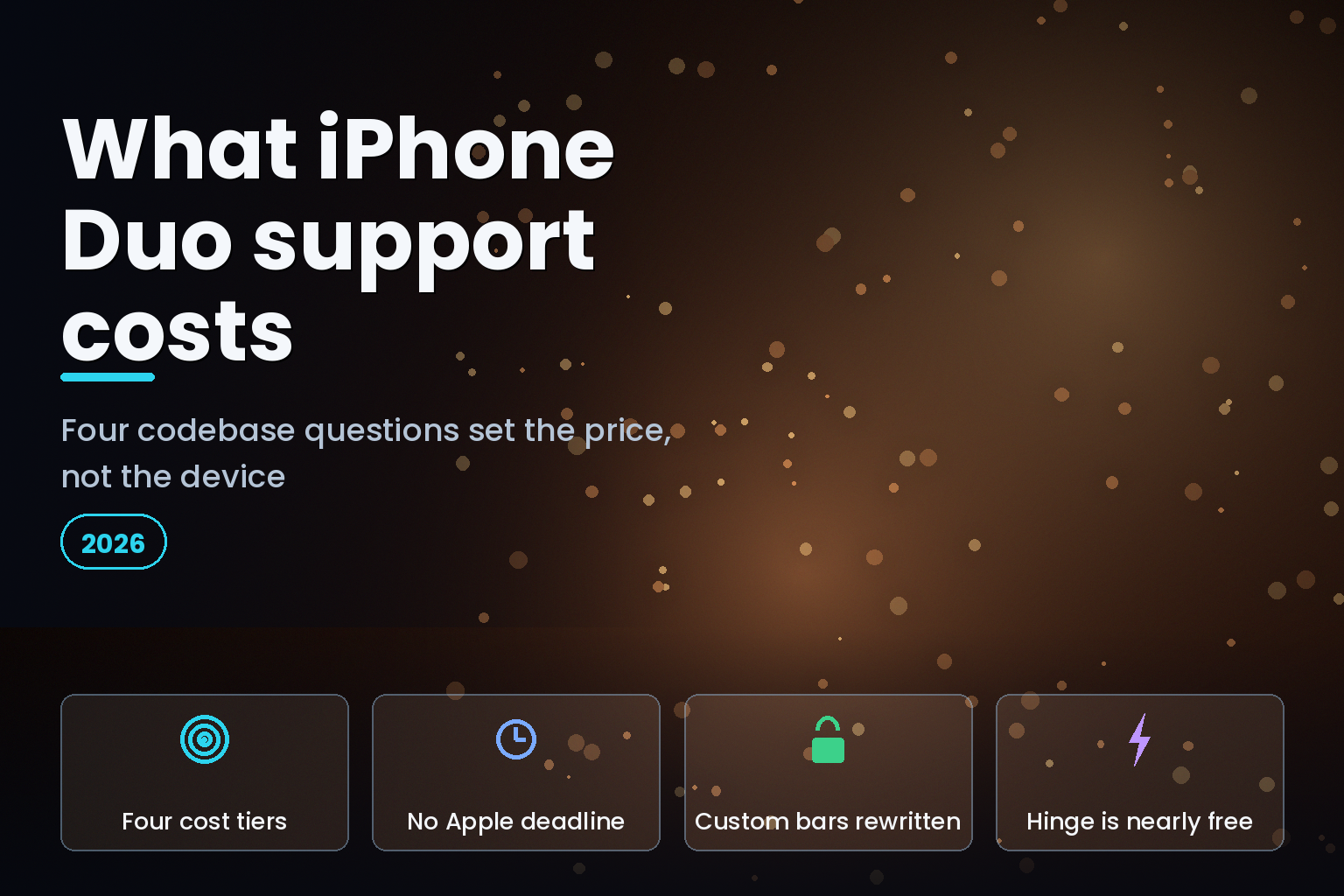
Summary. iPhone Duo was announced on 9 September 2026, starts at $1,999 in the US, and ships on 23 October 2026 running iOS 27.1. If you own an iOS app, someone has probably already asked what supporting it costs. The honest answer is that the device tells you almost nothing about the price. Four properties of your existing codebase do, and you can establish all four in an afternoon without commissioning anything. This guide sets out those four, the four cost tiers they produce, and the questions that separate a real estimate from a guess.
The most useful thing to know up front: there is no deadline. Apple's announcement contains no App Store policy, no submission requirement and no adoption date. Nothing forces this work, which means it competes for budget on merit rather than arriving as compliance. That is the opposite of the Android position, where the Google Play API 36 floor gates submission outright.
The four things that set the price
Ask your engineering lead these four questions. The answers place you in a tier more reliably than any scoping call.
1. Does the app use standard navigation containers? Apple states that NavigationSplitView, UISplitViewController, TabView and UITabBarController are fully adaptive across every pose, with columns collapsing when closed and tiling or overlaying when open. Sheets, popovers, menus and alerts adapt too. An app built on these inherits most foldable behaviour by rebuilding. An app with hand-rolled navigation inherits none of it.
2. Does layout code branch on device orientation? On the inner display it cannot. Apple states the inner display "doesn't honor supported interface orientations", directing developers to size classes instead. Every orientation branch is a site that needs rewriting, and in older codebases there are usually many.
3. How many controls are laid out manually? Manual layout is where the hinge costs money. Apple's own guidance is to adopt the reserved regions API only for "your highest-priority manually laid out controls", which is a tacit admission that doing it everywhere is expensive.
4. Has the app ever been resized? All apps participate in Split View multitasking on iPhone Duo, with no opt-in and no opt-out. An app that already resizes on iPad or under iPhone Mirroring has been tested against variable geometry. One that has only run full screen at fixed sizes has not, and that is where latent bugs live.
The four cost tiers
| Tier | Codebase profile | Scope of work | Typical shape |
|---|---|---|---|
| Rebuild | Standard containers, size-class driven, resizes already | Recompile against iOS 27.1, regression test | Days |
| Audit and patch | Standard containers, some orientation branches | Rebuild, replace orientation logic, fix asymmetric safe areas | One to two weeks |
| Layout refactor | Custom bars or manual layout, never resized | The above plus arrangement adoption and bar rework | Several weeks |
| Rearchitect | Hand-rolled navigation, fixed-geometry assumptions throughout | Navigation layer replaced before foldable work begins | A project, not a task |
Most commercial apps land in the middle two tiers. The top tier is genuinely cheap and is worth doing immediately regardless of whether you care about foldables, because it also improves iPad and iPhone Mirroring behaviour. The bottom tier is not really an iPhone Duo project at all: it is a modernisation project that iPhone Duo has made visible, and it should be budgeted as one.
A related trigger worth surfacing to whoever owns the roadmap: the WWDC26 UIKit session states that UIScene lifecycle "is now required when building with the latest SDKs". For older UIKit apps that never adopted it, that migration sits in front of all of this and should be priced separately.
What does not cost what people assume
Three items are commonly over-scoped in early conversations.
The hinge. Reading the hinge angle sounds like the expensive part and is nearly free, because Apple provides onHingeChange in SwiftUI and UIHingeInteraction in UIKit. It is also usually unnecessary, since Apple explicitly directs teams to use arrangement and region APIs for layout and reserves hinge data for interactions and effects. A team budgeting for hinge work is often budgeting for something it should not build.
Two-pane layouts. These feel like new engineering and are mostly configuration. Apple's ArrangementView and UIArrangementViewController provide split and overlay behaviour with a style modifier, and the system chooses the axis from the view's aspect ratio. The cost is in deciding the product behaviour, not in implementing it. Our adaptive layout guide covers what that code actually looks like.
Supporting both displays. The outer display behaves like other iPhone models. Only the inner display is regular in both dimensions. Teams often plan for two separate designs when what they need is one adaptive design plus testing.
What costs more than people assume
Testing. The device has poses rather than an orientation, and Apple's tooling reflects that: the simulator offers controls to open, close, rotate and fold. Every layout-sensitive screen now has a larger matrix, and that is a QA line item rather than a development one.
Live Activities and widgets. The Dynamic Island has been "redesigned to fit vertically on the side of the outer and inner displays", and the Home Screen now shows Today View as a vertically scrolling list of widgets. Neither demands code, but both demand design review, and design review is slower to schedule than a rebuild.
Custom toolbar views. Apple states that content from custom UIToolbar, UINavigationBar or UITabBar instances "isn't considered" for the new vertical bar layout. Every custom bar is a rewrite if you want the new behaviour, and there is no partial credit.
Choosing an engagement shape
The shape should follow the tier, not the other way round.
A fixed-scope pass suits the rebuild and audit tiers, because the work is bounded by a checklist rather than by discovery. You know what done looks like before you start.
A retained capability suits teams that keep meeting this situation. Apple ships a major iOS version annually and point releases through the year, and iPhone Duo is the second adaptivity forcing function in two years after iPhone Mirroring. Teams without standing capacity are late to each one, and lateness compounds.
An embedded engineer suits the refactor and rearchitect tiers, where the constraint is knowledge of your codebase rather than knowledge of the APIs. The work is archaeology before it is engineering.
We do not publish a rate card for this, because the honest answer depends on which tier you are in, and anyone quoting before seeing your navigation layer is guessing at the only variable that matters.
The three questions to ask any vendor
If you are briefing this out, these separate people who have read Apple's material from people who have read the press coverage.
- Which tier is my app in, and what did you look at to decide? A credible answer names the navigation layer and the orientation branches, not the industry.
- What are you not doing? Reserved regions everywhere, hinge-driven layout, and separate designs per display are all signs of over-scoping.
- What is the deadline? There isn't one. A vendor manufacturing urgency around an App Store requirement is describing something Apple has not published.
A sensible sequence
- Rebuild against the iOS 27.1 SDK and see what breaks. This is cheap and it is diagnostic.
- Grep for
UIScreen.mainand for orientation branches. The counts give you your tier.
- Test in Split View and in each pose in the simulator.
- Only then decide whether arrangements, reserved regions or bar rework are worth commissioning.
Teams that run steps one to three before asking for a quote get a materially better quote, because they have removed the uncertainty the estimate would otherwise have to price in. Our readiness checklist is the ordered version of those steps, and the iOS 27.1 interface changes piece covers what the rebuild alone gives you.
If you want the audit run for you, send us your navigation layer and the two grep counts at our contact page, and we will tell you which tier you are in before any commercial conversation. For staffing rather than delivery, see hiring iOS developers.
How eCorpIT can help
eCorpIT is a Gurugram-based engineering organisation, founded in 2021, holding CMMI Level 5, MSME and ISO 27001:2022 certifications, with senior-led iOS teams. We run the four-question audit and tell you which tier you are in before any commercial discussion, take bounded readiness passes for the rebuild and audit tiers, and embed engineers for refactor work where the constraint is knowledge of your codebase. We scope from your navigation layer rather than from a feature list. Start at our contact page.
References
Last updated: 12 September 2026.