On this page · 13 sections
- Why this beta matters more than most
- Action 1: migrate your SiriKit intents to App Intents
- Action 2: register your core actions through the Actions API
- Action 3: add on-screen awareness with the View Annotations API
- Action 4: support multi-turn follow-ups and streaming responses
- Action 5: add AppIntentsTesting and ship a TestFlight build
- Bonus: consider the Foundation Models framework
- Common migration mistakes to avoid
- A realistic prep timeline
- India-specific considerations
- FAQ
- How eCorpIT can help
- References
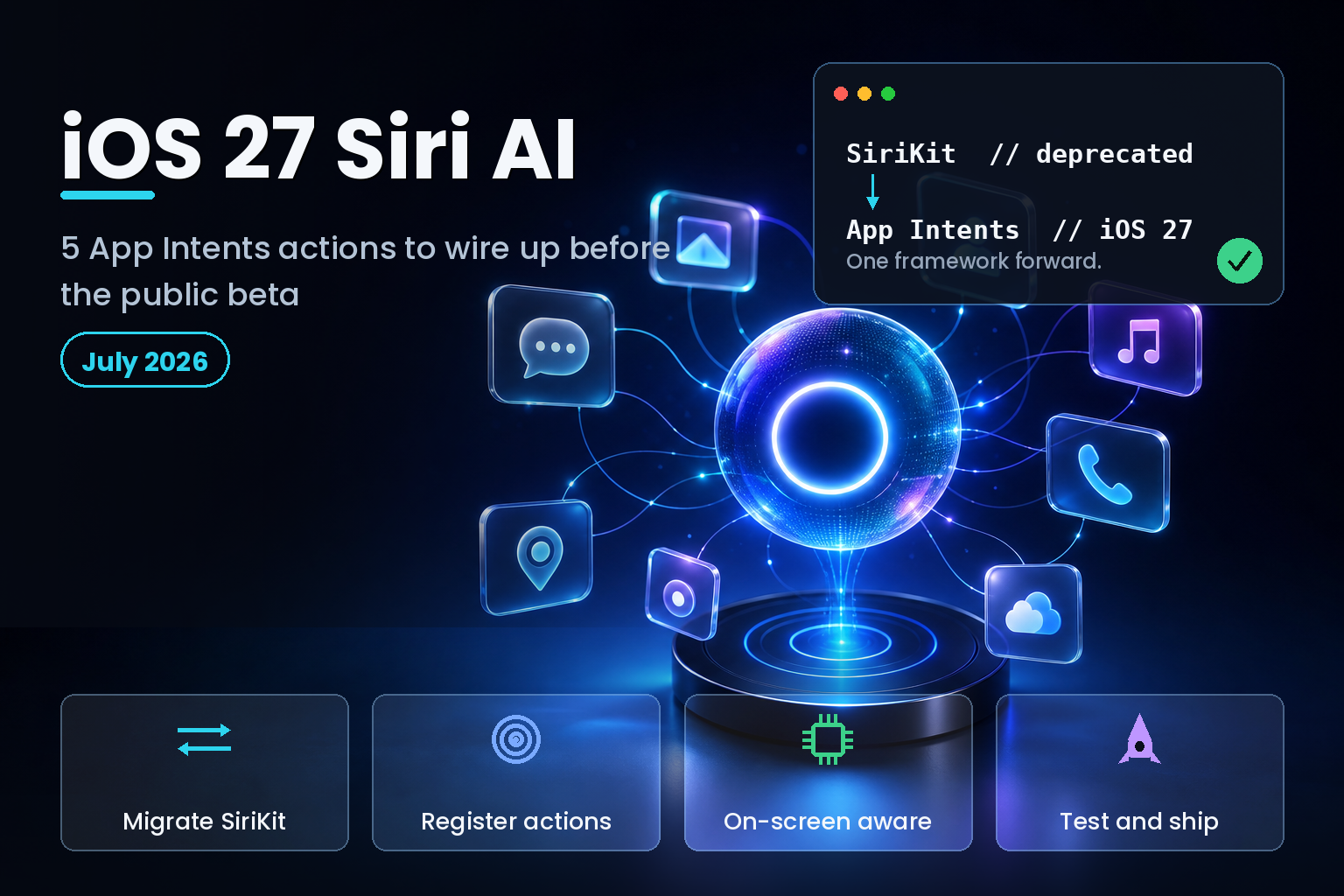
Summary. Apple deprecated SiriKit at WWDC 2026 on June 9, and the expanded App Intents framework is now the only way Siri can call into a third-party app. The rebuilt Siri AI, running on a custom Google Gemini model that Apple reportedly licensed for about $1 billion per year, entered developer testing on June 8, 2026, and the public beta is expected around July 14. That gives iOS and Swift teams roughly five weeks to make their apps visible to the new assistant before millions of testers arrive. This guide covers five concrete App Intents actions to implement and test now: migrating SiriKit intents, registering core app actions, adding on-screen awareness, supporting multi-turn and streaming responses, and shipping a TestFlight build with AppIntentsTesting coverage. Every action needs an iPhone 15 Pro or later to exercise the Apple Intelligence features end to end.
If your app still relies on SiriKit, Siri AI cannot see it. As one WWDC 2026 developer summary put it, your iOS app is invisible to Siri without App Intents. Susan Prescott, Apple's vice president of Worldwide Developer Relations, framed the release this way: "With new intelligence frameworks and agentic coding in Xcode 27, developers have the tools they need to focus on what they do best: bringing their incredible ideas to life." The window to act is the beta period, not launch week.
Why this beta matters more than most
Most iOS releases ask developers to recompile and check for regressions. iOS 27 asks for something larger: a migration. Apple gave SiriKit a formal deprecation notice and signalled a support window of roughly two to three years before removal, per reporting on the WWDC 2026 announcements. App Intents is the documented foundation for connecting an app to Siri and Apple Intelligence, and Apple's own developer materials describe it as the way apps expose their content and actions to the system.
The assistant behind it changed too. Craig Federighi detailed Apple's collaboration with Google to power Siri AI, and Apple's newsroom describes Siri AI as combining conversation, personal context, on-screen awareness, web knowledge, and app actions. For a developer, the practical takeaway is simple: the five actions below are how your app plugs into that stack.
| Action | What it delivers | Where to learn it |
|---|---|---|
| Migrate SiriKit intents | Restores Siri visibility your old code loses | App Intents documentation |
| Register core app actions | Lets Siri run tasks like "create" or "assign" | WWDC26 session 240, App Schemas |
| Add on-screen awareness | Resolves "this" and "that" to app entities | View Annotations API |
| Multi-turn and streaming | Conversational follow-ups and progress UI | WWDC26 session 343 |
| Test and ship to TestFlight | Repeatable validation before the public beta | AppIntentsTesting framework |
Action 1: migrate your SiriKit intents to App Intents
Start with an inventory. List every SiriKit intent your app ships today, because each one stops being the supported path under iOS 27. Then catalogue the 10 to 15 user actions in your app that deserve to become App Intents, and prioritise by how often people use them. This inventory is the single most useful artefact you will produce this month; it tells you what "done" means.
Rebuild the highest-value actions as App Intents rather than SiriKit intents. Update to Xcode 27, confirm the project compiles against the iOS 27 SDK, then implement your top three actions first and verify they surface across Siri AI, Spotlight, Shortcuts, and Widgets. App Intents gives you that reach from one definition, which is a real reason to migrate beyond the deprecation clock. Keep the SiriKit code compiling during the transition so existing users are not stranded, but treat it as legacy from day one.
Action 2: register your core actions through the Actions API
Siri AI can only run what your app formally offers. The expanded Actions API lets a third-party app register specific actions the assistant can execute. If you build a productivity app, you register actions like "create a task," "assign to a team member," or "set a deadline," and Siri can call them in response to natural-language requests, as the App Intents guidance for Siri AI describes.
The design work matters more than the code here. Name actions the way a user would speak them, keep parameters minimal, and make each action do one clear thing. Apple's App Schemas session walks through modelling your domain so Siri understands it. Well-modelled actions are also what let your app show up in enterprise workflows, where Siri AI becomes an app layer rather than a chatbot.
Action 3: add on-screen awareness with the View Annotations API
The headline capability for many apps is on-screen awareness. The new View Annotations API lets developers map interface elements to entities, so when a user says "save this" or "share that row," Siri AI knows what "this" and "that" point to. Apple documents making on-screen content available to Siri and Apple Intelligence as a first-class task.
Wire your primary content views to expose their entities, then test the reference cases directly: open a record, say a command that uses "this," and confirm the correct entity resolves. On-screen awareness is where a beta bug is easiest to miss and most jarring for users, because a wrong reference does the wrong thing confidently. Give it real test time on an iPhone 15 Pro or later, which is the tier that runs the full Apple Intelligence stack.
Action 4: support multi-turn follow-ups and streaming responses
App Intents in iOS 27 adds richer entity types, multi-turn conversational follow-ups, and streaming responses for long-running actions. Add multi-turn parameter resolution so Siri AI can ask a clarifying question when a request is ambiguous, rather than failing. For any action that takes more than a moment, implement streaming responses so the assistant can show progress instead of a frozen prompt, as covered in the advanced App Intents session.
These two features separate an app that technically works from one that feels native to Siri AI. A user who asks to "book the 3 pm slot" should get a follow-up when the app needs the room, and a user who triggers a long export should see it running. Both behaviours are new surface area, so both need explicit beta test cases.
Action 5: add AppIntentsTesting and ship a TestFlight build
Apple added AppIntentsTesting, a framework that validates App Intents through the same infrastructure used by Siri, Shortcuts, and Spotlight, without requiring UI automation. For an enterprise or product team, this is the difference between hoping voice actions work and proving they do in CI. Write tests that confirm each intent registers, that Siri can discover and invoke it, that parameters resolve, and that any generative routing behaves as expected.
Then ship it where testers can reach it. Build against the iOS 27 SDK, submit a TestFlight build with your Apple Intelligence integration, and recruit a small beta cohort on iPhone 15 Pro or newer running the iOS 27 public beta. Recruiting that cohort before July 14 means your testers are ready the day the public build lands, not a fortnight later. Log every failed voice action against the exact beta seed so your fixes track the moving target.
Bonus: consider the Foundation Models framework
Two of the five actions get stronger if your app also adopts the on-device Foundation Models framework. At WWDC 2026 Apple opened the framework beyond its own model: a public protocol layer now lets any language model, including Apple's on-device model, cloud models such as Claude and Gemini, or a model you host, conform to a common Language Model protocol, per Apple's developer coverage. The on-device model also gained Vision, so your app can reason about images on-device.
There is a cost angle worth knowing. Developers in the App Store Small Business Program with fewer than 2 million first-time downloads can run the next generation of Apple Foundation Models on Private Cloud Compute at no cloud API cost, as Apple's newsroom describes. For a small team, on-device summarisation or classification behind an App Intent can be effectively free to run.
| Aspect | SiriKit (legacy) | App Intents (iOS 27) |
|---|---|---|
| Status | Deprecated at WWDC 2026 | Supported, required for Siri AI |
| Siri AI visibility | None | Full |
| Reach from one definition | Siri only | Siri, Spotlight, Shortcuts, Widgets |
| On-screen awareness | No | Yes, via View Annotations API |
| Testing | UI automation | AppIntentsTesting framework |
Common migration mistakes to avoid
Three errors show up repeatedly in the first weeks of an App Intents migration. The first is treating it as a straight port: teams copy SiriKit intent names one-for-one, then wonder why Siri AI resolves them awkwardly. App Intents rewards actions modelled the way a person speaks, so rename and reshape rather than transliterate.
The second is over-registering. An app that exposes forty intents, half of them rarely used, gives the assistant more ways to guess wrong. Ship the handful of actions people actually perform, prove they resolve reliably, then widen. A short list that works beats a long list that misfires during the beta.
The third is skipping the device tier. Because the Siri AI features need an iPhone 15 Pro or later, a team testing only on older supported phones will see intents register but never exercise the generative routing, on-screen awareness, or multi-turn behaviour. Keep at least one AI-capable device in the lab and run the voice paths there, not just in the simulator.
A quieter fourth mistake is leaving no telemetry. Log which intents fire, which parameters fail to resolve, and which fall back to a generic response, each tagged to the beta build. When Apple ships the next seed, that log tells you what regressed instead of leaving you to guess, which matters because the beta is a moving target through early September.
A realistic prep timeline
You do not need all five actions live on day one, but you do need a sequence. The plan below compresses the common developer guidance into the weeks that remain before and during the beta.
| Phase | Focus | Outcome |
|---|---|---|
| Now, before July 14 | Inventory SiriKit; update to Xcode 27; pick top actions | A prioritised migration list |
| Public beta week | Implement top three App Intents; verify in Siri, Spotlight, Shortcuts | Core actions visible to Siri AI |
| Weeks after | Add on-screen awareness, multi-turn, streaming | Native-feeling voice behaviour |
| Before September | AppIntentsTesting in CI; TestFlight cohort on iOS 27 | Proven, repeatable voice actions |
India-specific considerations
For iOS and Swift teams in India building for global users, two points apply. First, language and region gating: Apple says Siri AI arrives first for devices set to English, with more languages to follow, and Siri AI is not launching in the European Union at release, so plan test matrices for the regions your users actually run. Second, data handling under the Digital Personal Data Protection Act, 2023 (DPDP): on-screen awareness and personal-context features let Siri AI read app content, so treat any App Intent that exposes user data as in-scope for your DPDP controls and keep test data separate from production records. If you are standardising an approach across an app portfolio, our iOS 27 App Intents developer guide goes deeper on the migration itself.
FAQ
How eCorpIT can help
eCorpIT is a Gurugram-based technology organisation with senior-led iOS and Swift engineering teams. We help product teams migrate from SiriKit to App Intents, model their app actions for Siri AI, and stand up AppIntentsTesting in continuous integration so voice features are provable before launch. If you want your app visible to Siri AI before the September release, contact us and we will scope the migration against your action inventory. You can also read our deeper iOS 27 App Intents developer guide or browse the eCorpIT blog for more.
References
_Last updated: July 5, 2026._