On this page · 9 sections
- Lesson 1: adopt the UIScene lifecycle now, or the app will not launch
- Lesson 2: Liquid Glass is automatic now, so test it on hardware
- Lesson 3: treat beta 1 as signal, not a ship target
- Lesson 4: work backward from the April 2027 SDK deadline
- How to run the beta regression without chaos
- India-specific considerations
- FAQ
- How eCorpIT can help
- References
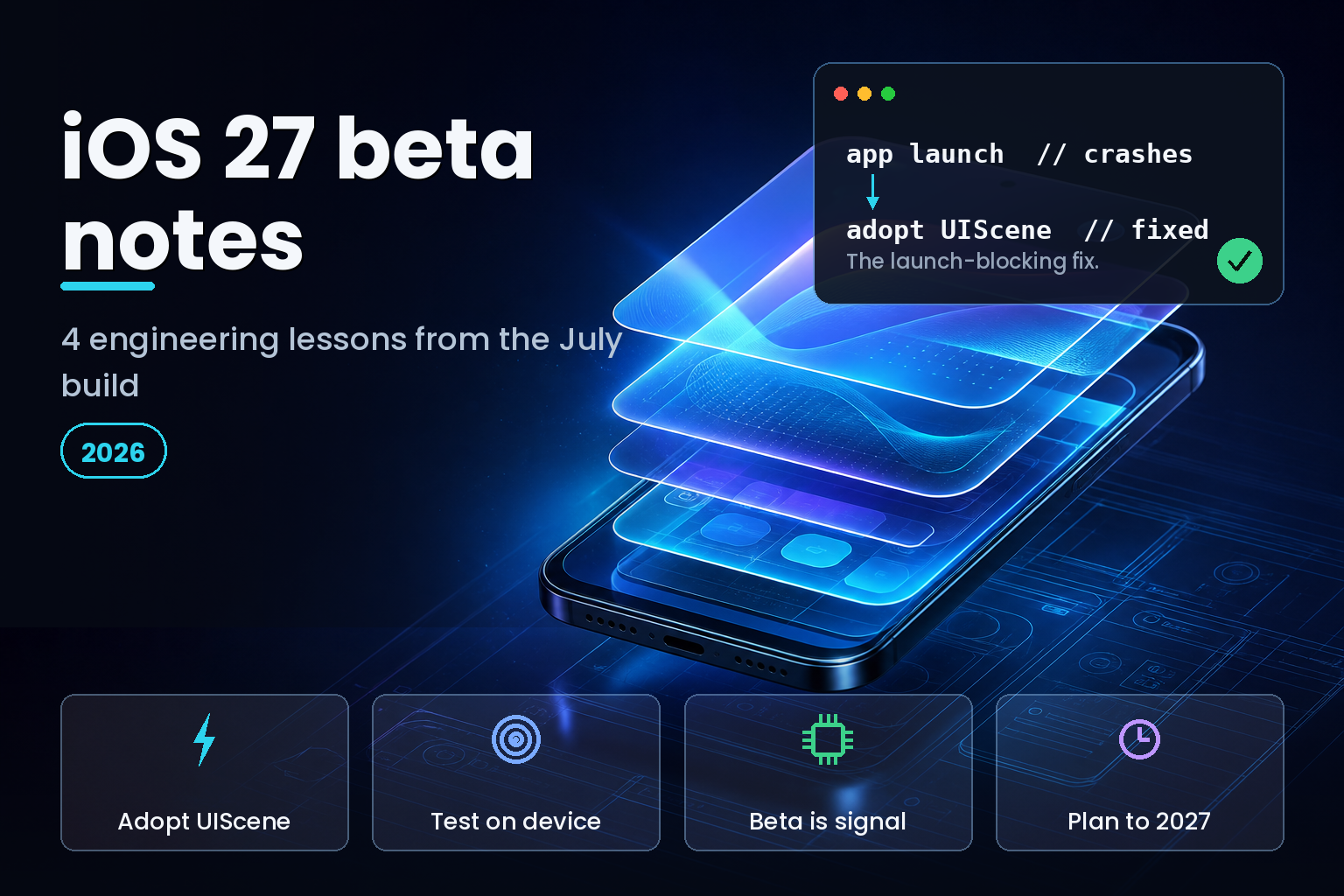
Summary. The iOS 27 developer beta shipped on June 8, 2026, beta 2 followed on June 22, 2026, and the public beta is expected around July 14, 2026 ahead of a September 2026 release. This is not a routine recompile. Built against the iOS 27 SDK, an app must adopt the UIScene lifecycle or it crashes at launch before AppDelegate runs, and the UIDesignRequiresCompatibility flag is now ignored, so Liquid Glass is applied to every app whether the team opted in or not. Xcode 27 also drops Intel Mac support, so an Apple silicon Mac and a $99-per-year Apple Developer account are now table stakes, and the App Store SDK deadline is expected around April 2027. Beta 1 shipped with dozens of known issues, from devices running warm to Siri not responding. These four engineering lessons, drawn from Apple's own release notes and the documented breaking changes, are what a team shipping on Apple platforms should act on now, not in September.
The through-line is simple: iOS 27 changes the rules of launch and rendering, so the cost of waiting is a crash on day one or a broken layout in front of every user. Two of the four lessons are hard gates that can stop your app from launching at all. Treat the beta as the window to find these on your schedule.
Lesson 1: adopt the UIScene lifecycle now, or the app will not launch
This is the one that stops the app cold. Beginning with iOS 27, iPadOS 27, and the other 27 platforms, an app built with the latest SDK must adopt the scene-based lifecycle. If it does not, an assertion fires at launch and the app crashes before AppDelegate even runs, per the community analysis of UIKit's scene mandate. There is no graceful fallback and no partial credit.
The fix is defined. Your Info.plist needs a UIApplicationSceneManifest entry, and you need a SceneDelegate implementing scene(_:willConnectTo:options:), following Apple's migration guidance in Tech Note TN3187 and the Xcode 27 release notes. This is not only a native-UIKit problem: cross-platform toolchains are affected too, and Expo tracked prebuild templates that fail to launch on the iOS 27 SDK until the scene lifecycle is present. If you ship a React Native or hybrid app, verify your generated Info.plist, not just your Swift.
The engineering lesson is to do this first and separately. Adopt UIScene as its own change on your current SDK, ship it, and confirm launch on real devices before you take on anything else in iOS 27. It is the highest-priority item because everything else is irrelevant if the app cannot start.
Lesson 2: Liquid Glass is automatic now, so test it on hardware
For a year, UIDesignRequiresCompatibility let teams opt out of Liquid Glass. That door is closed. In iOS 27 and Xcode 27 the flag is completely ignored, and Liquid Glass is applied to your app automatically whether you want it or not, as the migration preparation guides document. WWDC 2026 refined the design, reducing default transparency, changing sidebar corner radii on iPad and Mac, and revamping app icons, per TechTimes. Your app inherits all of it on the next build.
The trap is the simulator. Liquid Glass is a GPU rendering system, and its specular highlights, real-time content sampling, and motion response do not render with full fidelity in the simulator. A layout that looks fine on your Mac can be unreadable or misaligned on a device. Custom glass implementations and any views still using older UIVisualEffectView blur will need manual work regardless of what later betas change, per Apple's Adopting Liquid Glass guide.
The lesson is to move device testing to the front of the plan. Put a real handset from each supported tier in the loop from day one, and give your design system owners time to decide how custom components express the new language. This is a design decision, not only an engineering one, and it does not resolve itself in code review.
Lesson 3: treat beta 1 as signal, not a ship target
Early betas are noisy. Apple's iOS 27 release notes acknowledged dozens of known issues in the first build, and reported problems included devices running warm, faster battery drain, Siri not responding, the Safari tab bar vanishing, and alarms not stopping from the Lock Screen, per Technobezz's roundup. Beta 2, released on June 22, already improved iPhone Mirroring reliability and added AirPods Max 2 firmware support, per 9to5Mac.
The engineering lesson is to separate OS bugs from your bugs. A crash or a battery spike on beta 1 may be Apple's, not yours, so read the release notes before you open a ticket against your own code. Reproduce suspected app bugs on at least two beta builds before you commit engineering time, because the platform underneath you is moving. Judge your app's real health on a later, calmer seed, and use beta 1 to find only the structural breaks, the launch failures and layout regressions, that will not fix themselves.
Lesson 4: work backward from the April 2027 SDK deadline
The beta is urgent, but the true deadline is the App Store SDK requirement, expected around April 2027, after which new submissions must build against the iOS 27 SDK, per byteiota's timeline. That date sets the real schedule, and it is closer than it looks once you account for the work in between.
Plan backward from it. Account for the UIScene migration, a full Liquid Glass regression pass, accessibility validation on the new design, design reviews for custom components, App Store review time, and any phased rollout. Add one hardware line item that teams miss: Xcode 27 does not run on Intel Macs, per the Xcode 27 release notes, so any Intel machines in your build fleet or CI need replacing before the work can even start. For a broader planning view, see our note on engineering delivery in 2026.
| Lesson | What breaks if ignored | Source of truth |
|---|---|---|
| Adopt UIScene lifecycle | App crashes at launch | Apple TN3187, Xcode 27 notes |
| Test Liquid Glass on device | Broken or unreadable layouts | Adopting Liquid Glass guide |
| Treat beta 1 as signal | Wasted time chasing OS bugs | iOS 27 release notes |
| Plan to the SDK deadline | A rushed, risky submission | App Store SDK requirement |
How to run the beta regression without chaos
A structured pass beats poking at the app on a beta build. Start on your stable SDK: in your current Xcode 26 project, run a full regression with Liquid Glass compatibility off so you expose every masked layout issue on a known-good platform, at a pace you control. Fix those first, because they are your bugs, not the beta's.
Then move to the iOS 27 SDK in a branch. Adopt UIScene, build, and confirm launch on hardware across your device tiers before testing features. Walk your top user flows on a physical device, screenshotting anything the new rendering changes, and log each finding against the exact beta build so your reports track the moving target. Keep the simulator for logic and unit tests, and reserve visual judgement for real devices, where Liquid Glass actually renders.
| Build | Date (2026) | What your team should do |
|---|---|---|
| Developer beta 1 | June 8 | Read release notes; find structural breaks only |
| Developer beta 2 | June 22 | Re-test; confirm which beta-1 bugs were Apple's |
| Public beta | Around July 14 | Widen device testing; adopt UIScene on a branch |
| General release | Around September | Ship migrated app; begin phased rollout |
India-specific considerations
For engineering teams and founders in India shipping on Apple platforms, two practical factors apply. First is hardware planning: because Xcode 27 drops Intel Mac support, any studio still running Intel Macs, common in cost-conscious setups, must budget for Apple silicon machines before iOS 27 work begins, and that lead time matters when import and procurement can add weeks. Second is device-lab discipline: since Liquid Glass only renders truthfully on hardware and iOS 27 keeps the iPhone 11 supported, a lab of a few real handsets across tiers is both necessary and affordable, and second-hand supported devices hold value as test units. Teams building for a global user base should also treat the April 2027 SDK deadline as a fixed planning date, not a distant one, and align sprint capacity accordingly. Our blog covers related delivery planning.
FAQ
How eCorpIT can help
eCorpIT is a Gurugram-based technology organisation with senior-led engineering teams shipping on Apple platforms. We can run your iOS 27 migration end to end: adopt the UIScene lifecycle, execute a structured Liquid Glass regression on real hardware, refresh Intel-based build machines, and plan the work backward from the April 2027 SDK deadline. If you want the launch-blocking changes handled before the September release, contact us. You can also browse the eCorpIT blog or read about our team.
References
_Last updated: July 5, 2026._