On this page · 14 sections
- The story most coverage is missing
- What actually happened at Google I/O 2026
- A2UI and generative UI, explained simply
- Firebase AI Logic — the production path from prototype to app store
- Antigravity 2.0 — vibe-coding a Flutter app in hours, not weeks
- Why this matters equally for Android and iOS teams
- The technical stack, piece by piece
- What teams are already shipping with this stack
- Where the real risk sits
- What CTOs and product owners should do now
- What this means for Indian and global product teams
- Frequently asked questions
- A short closing note
- References
Google didn't just announce AI features at I/O 2026. It built the conference experience itself on Flutter and Gemini — a real-time generative-UI ordering app, a code-generated 3D game level, on-stage AI films — and then handed developers the same stack (Flutter, Firebase AI Logic, Antigravity 2.0) to build production apps with. That is the real story buried under the keynote headlines: Google is now dogfooding Flutter as its own AI-app reference architecture. Here's what actually shipped, how it works, and what it means for anyone deciding how to build an AI-native mobile app in 2026.
The story most coverage is missing
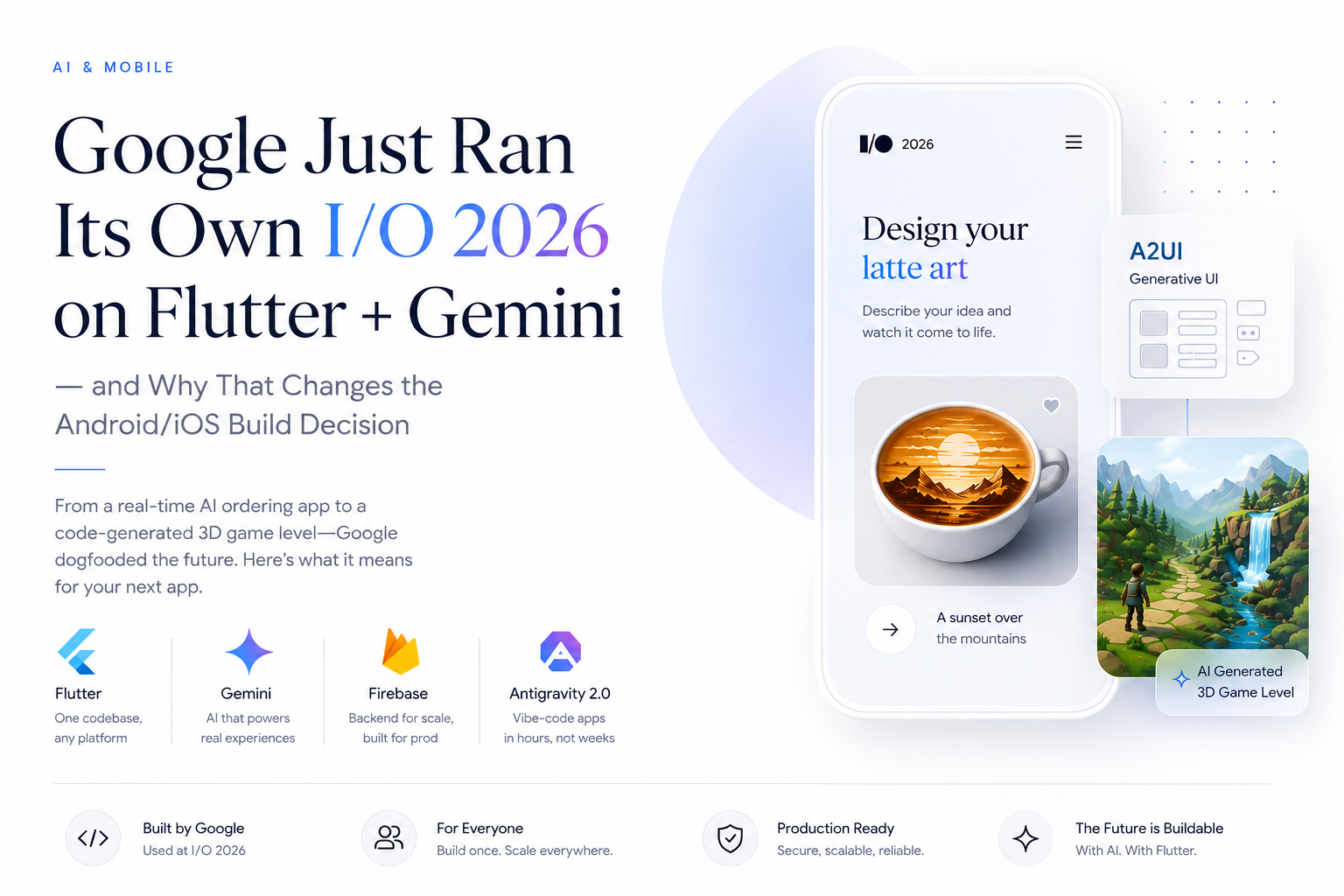
Most write-ups of Google I/O 2026 treated it as a model-release event: Gemini 3.5 Flash, the Omni video model, Antigravity 2.0, intelligent eyewear. That's accurate but incomplete. Buried in Google's own recap of how it built the event is a much more useful signal for anyone shipping mobile apps: Google used Flutter, the Gemini Enterprise Agent Platform, Google Antigravity, and Nano Banana to build the actual attendee-facing app at the conference — a latte-ordering experience where users designed custom art and watched the interface change in real time.
That app wasn't a demo built by a marketing team with unlimited resources for show. It was built using generative UI and the A2UI protocol with Flutter to create adaptive interfaces that changed in real time, backed by Firebase, Cloud Functions, and Firestore — the exact stack any Flutter team can pick up today. When Google wants to prove its own AI tooling works under real conditions, it reaches for Flutter first. That's the headline most coverage skipped.
What actually happened at Google I/O 2026
Google's own engineering recap breaks the build into distinct pieces, and each one maps directly to a decision Android/iOS teams are already wrestling with in 2026.
The ordering app replaced static forms with dynamic, model-generated interfaces. Firebase bridged the frontend to models like Nano Banana, handling the complex reasoning and content generation, while a single Flutter codebase delivered a zero-latency experience across different hardware. That last clause is the part worth underlining: one codebase, multiple device classes, no separate native builds for the AI-heavy screens.
Attendees weren't limited to using the app Google built for them, either — many used Google Antigravity's agentic coding tools to build their own versions of the ordering app on the spot. That's a live demonstration of a claim vendors make constantly and rarely prove in public: that a non-trivial, AI-integrated Flutter app can be assembled by a single developer inside a few hours, not a sprint.
Separately, Google's broader I/O 2026 announcements confirmed Gemini 3.5 Flash now runs roughly four times faster than comparable frontier models at a fraction of Gemini 3.1 Pro's cost, and that Antigravity 2.0 — Google's direct answer to Claude Code, GitHub Copilot, and OpenAI Codex — ships with a CLI, sandboxed sub-agents, and hardened Git policies built for exactly this kind of rapid app assembly.
A2UI and generative UI, explained simply
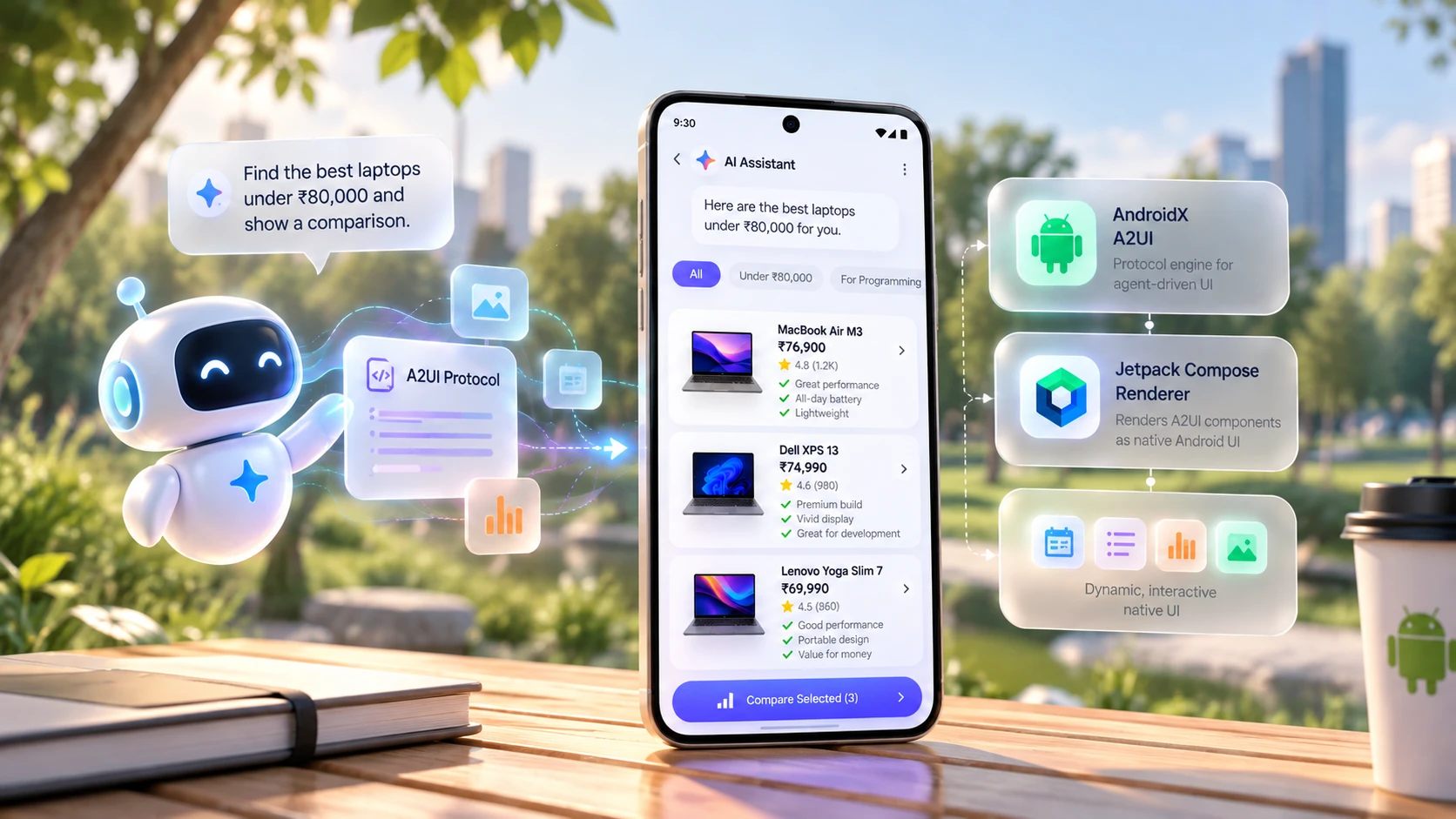
A2UI is the protocol that let Google's model reshape the ordering app's screen live, instead of the app calling an API and rendering a fixed layout. In practice, this is the shift from "the model returns text I put in a chat bubble" to "the model returns a UI description and Flutter renders it as an actual interface" — buttons, forms, and layouts that change based on what the user just said or did.
For product teams, the practical translation is simpler than the protocol name suggests. Instead of hand-building ten screen variants for ten user segments, a generative-UI layer lets one Flutter shell adapt its own layout per user, per session, per intent — a pattern that's shown up under different names (adaptive UI, dynamic UI) throughout 2026's Flutter roadmap discussions, but rarely with a public, working reference implementation until now.
Firebase AI Logic — the production path from prototype to app store
The prototype-to-production gap is where most "AI demo apps" die. Google's answer for Flutter teams is Firebase AI Logic, and its design choices are worth knowing before you architect around it.
The client SDKs are available in Swift for Apple platforms, Kotlin and Java for Android, JavaScript for web, Dart for Flutter, and Unity — meaning a Flutter app and a native iOS or Android app can call the same backend contract without divergent implementations. Critically, the proxy service keeps the Gemini API key on the server, out of the client codebase entirely, which closes the single most common security mistake teams make when they wire a generative model directly into a shipped app.
Firebase AI Logic also supports hybrid and on-device inference, letting an app use an on-device model when available and fall back to the cloud model when it isn't — a meaningful cost and latency lever for anything running on patchy connectivity, which describes a large share of the Android install base outside major metros.
Antigravity 2.0 — vibe-coding a Flutter app in hours, not weeks
The build-speed claim is easy to dismiss as marketing until you look at the numbers Google put on stage. An internal Antigravity 2.0 demo built a functioning operating system in twelve hours using ninety-three parallel sub-agents, more than fifteen thousand model requests, 2.6 billion tokens, and under a thousand dollars in API credits. An OS is a deliberately extreme example, but the underlying capability — many sub-agents working a large codebase in parallel under one orchestrating session — is the same capability available to a team scaffolding a Flutter app.
Separately, developers already running Gemini CLI against real Flutter codebases report it holds full project awareness, reading the pubspec file and library structure directly, with native support for Riverpod and the Impeller rendering engine — meaning it isn't generating generic Dart, it's generating code aware of your actual project conventions. Google AI Studio's I/O 2026 update went further, adding native Kotlin support so the same "describe it, don't hand-code it" workflow now spans Flutter and native Android scaffolding in one tool.
Why this matters equally for Android and iOS teams
The Flutter-specific news is only half the story. The other half is what Google shipped for Android as a platform, because it changes what users expect any app — Flutter or native — to be capable of.
Android's Gemini Intelligence layer is built to handle multi-step tasks, interpret user intent, and automate actions across apps, Chrome, and system services without requiring constant manual input, functioning as a proactive layer rather than a passive assistant. For app builders this raises the baseline: an app that only responds when tapped increasingly looks dated next to a system that anticipates the next action.
On iOS, Apple's own late-2026 roadmap is converging on the same idea from a different angle — on-device call and context intelligence rather than a cloud-first generative layer — which means teams targeting both platforms will need an architecture flexible enough to lean on cloud inference where Android's ecosystem rewards it and on-device inference where iOS's privacy-first posture rewards it. Flutter's single-codebase model, paired with Firebase AI Logic's hybrid on-device/cloud fallback, is one of the few current stacks built to straddle that split without maintaining two AI integration layers.
The technical stack, piece by piece
Stripped of marketing language, the 2026 Flutter-AI stack that Google is now dogfooding breaks into four layers.
The model layer. Gemini 3.5 Flash as the default fast, cheap model for most in-app tasks, with Gemini 3.5 Pro reserved for heavier reasoning — plus Nano Banana Pro for image generation and Gemini 3.1 Flash TTS for voice output, all reachable through one API surface.
The interface layer. Flutter rendering the actual screens, optionally driven by the A2UI protocol when the interface itself needs to be model-generated rather than hand-built.
The integration layer. Firebase AI Logic's client SDKs, handling authentication, key security, and the on-device/cloud routing decision so the app code doesn't have to.
The build layer. Antigravity 2.0 or Gemini CLI doing the scaffolding and iteration work that used to consume the first two weeks of any new feature.
None of these four layers is new in isolation. What's new in 2026 is that Google has now publicly run its highest-visibility internal project through all four at once, which is the closest thing to a reference architecture the ecosystem has had.
What teams are already shipping with this stack
Beyond Google's own I/O build, the pattern is showing up in production teams' public write-ups through 2026. Developer guides now walk through two concrete integration paths for shipping Gemini inside a Flutter app: direct integration through the Google Generative AI Flutter package for fast prototyping, and Firebase AI Logic for the secure, scalable production path — with the explicit recommendation to move off the direct-integration approach before shipping, precisely because it exposes the API key client-side.
Teams building conversational features are also skipping a chunk of custom UI work entirely: Google's Flutter AI Toolkit ships pre-built chat components already wired to Gemini, cutting a feature that used to take a sprint down to an afternoon of configuration.
Where the real risk sits
None of this removes the two problems every AI-integrated app still has to solve.
Cost predictability. A generative-UI screen that re-renders on every user action calls the model far more often than a chatbot screen does. Teams that treat A2UI-style adaptive interfaces as "free" because Flash is cheap per call will still find the aggregate bill surprising at scale — the same lesson enterprise teams are learning the hard way with agentic coding tools in 2026.
Key and quota management across platforms. A Flutter app calling Firebase AI Logic from Android and iOS simultaneously needs quota and rate-limit planning per platform, not just per app, or one platform's traffic spike degrades the other silently.
Vendor concentration. Building an entire interface and build pipeline around one vendor's model, protocol, and IDE tooling is a productivity win today and a migration cost later if pricing or availability shifts — a risk worth pricing in at the architecture stage, not after launch.
What CTOs and product owners should do now
A few concrete moves, in the order we'd recommend to a team starting this quarter.
Pilot on Firebase AI Logic, not the direct SDK, from day one. The migration cost of moving off a client-exposed key later is higher than the setup cost of doing it right the first time.
Scope generative UI to screens that genuinely benefit from it. Not every screen needs a model-generated layout. Reserve A2UI-style adaptive interfaces for genuinely open-ended flows — search, discovery, personalization — and keep transactional flows (checkout, forms, settings) on fixed, predictable Flutter widgets.
Use Antigravity or Gemini CLI for scaffolding, not for the whole build. The parallel-agent demos are real, but production code still needs a human review pass; treat the agent output as a fast first draft, not a merge-ready PR.
Budget the on-device fallback explicitly. If Firebase AI Logic's hybrid inference is on your roadmap, decide up front which features must degrade gracefully offline and test that path before launch, not after a support ticket.
Cap and monitor token spend per feature, not just per app. The same lesson enterprise engineering teams learned about agentic coding budgets in 2026 applies to generative-UI screens: measure cost per feature against the value that feature delivers, and kill the ones that don't pay for themselves.
Want a senior read on where AI-native Flutter fits your Android/iOS roadmap? eCorpIT builds AI-powered mobile apps, generative-UI features, and Firebase-backed Flutter platforms for global clients. We do the architecture call, the cost model, and the build. Talk to our team about a free estimate.
What this means for Indian and global product teams
For an Indian product team building for a mixed Android-heavy, patchy-connectivity market, the hybrid on-device/cloud fallback in Firebase AI Logic is arguably the single most relevant piece of this whole stack — it's the difference between a generative feature that degrades gracefully on a 2G fallback and one that simply breaks.
For a services company building for US or UK clients, the build-speed story is the sharper argument: if Antigravity-style scaffolding genuinely compresses a two-week feature into a two-day one, that changes what's realistic to promise in a fixed-price engagement, provided the team still budgets real hours for the review and hardening pass the agent output needs.
For an SME weighing Flutter against a native-only build for a single platform, the calculus hasn't changed in principle, but the gap has widened: cross-platform used to mean "faster to ship the same features," and now increasingly means "faster to ship the AI features too," because the tooling described above targets Flutter first, with native platforms catching up.
Frequently asked questions
A short closing note
Google didn't run I/O 2026 on Flutter and Gemini to make a point about Flutter. It ran it that way because, for a high-stakes, real-time, AI-generated interface built under a hard deadline, that was the stack its own engineers trusted. That's a more honest endorsement than any keynote slide, and it's the clearest signal yet of where AI-native mobile development is heading for both Android and iOS teams in 2026.
If you want a senior read on where this fits your own roadmap, that's what we do.