On this page · 10 sections
- What shipped, and what it costs
- The 384-token ceiling changes the arithmetic
- The peak window lands on the Indian working morning
- The 15-image cliff, and three other limits that bite
- The detail parameter does not do what OpenAI users expect
- Where this fits against the rest of the market
- What is still unknown
- FAQ
- How eCorpIT can help
- References
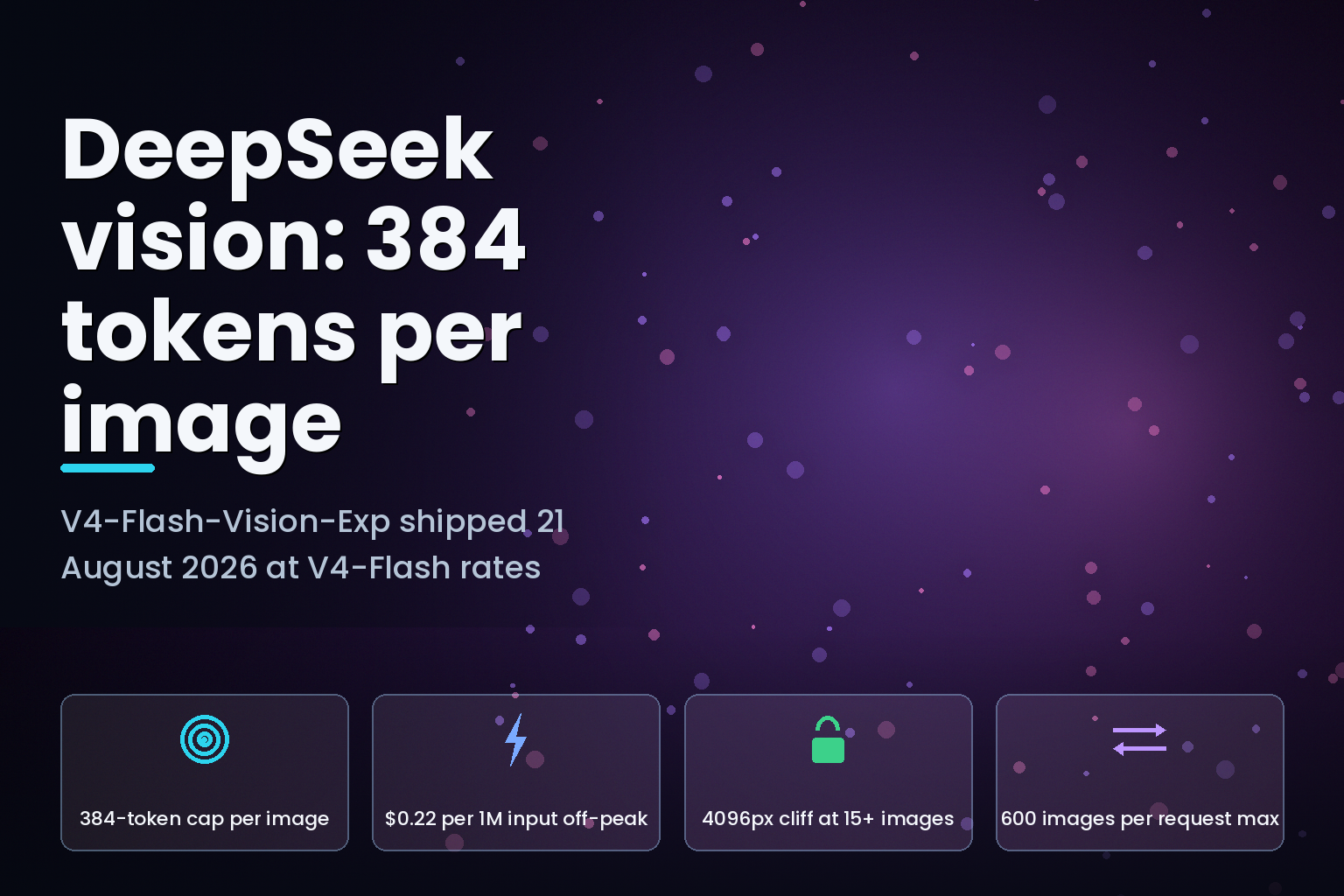
Summary. DeepSeek released deepseek-v4-flash-vision-exp on 21 August 2026, its first multimodal model on the public API. It carries exactly the same price card as DeepSeek-V4-Flash: $0.22 per million cache-miss input tokens off-peak, $0.44 peak, with output at $0.66 and $1.32. Images are converted to tokens by dimension and billed as input tokens, with a documented ceiling of 384 tokens per image. That ceiling is the number worth planning around. A 2000x2000 screenshot and a 5000x5000 scan cost the same, because both are resized to roughly 800x800 before inference. Two other limits are easier to miss and will break batch pipelines: the maximum image dimension drops from 8192px to 4096px per side once a request carries 15 or more images, and detail: high is documented as equivalent to original, not to any higher-fidelity path.
What shipped, and what it costs
DeepSeek added the model to its change log dated 21 August 2026 as an experimental model reachable by setting model='deepseek-v4-flash-vision-exp'. DeepSeek Harness 0.1.1 shipped the same day with support for it.
The Models and Pricing page puts the vision model in the same column as V4-Flash on every line.
| Rate per 1M tokens | deepseek-v4-flash | deepseek-v4-flash-vision-exp | deepseek-v4-pro |
|---|---|---|---|
| Input, cache hit (off-peak) | $0.007 | $0.007 | $0.022 |
| Input, cache hit (peak) | $0.014 | $0.014 | $0.044 |
| Input, cache miss (off-peak) | $0.22 | $0.22 | $0.66 |
| Input, cache miss (peak) | $0.44 | $0.44 | $1.32 |
| Output (off-peak) | $0.66 | $0.66 | $1.98 |
| Output (peak) | $1.32 | $1.32 | $3.96 |
| Concurrency limit | 2500 | 2500 | 500 |
Context length is 1M tokens and maximum output is 384K, identical across the three models. The vision model supports JSON output, tool calls, the Responses API, the Anthropic-compatible API and chat prefix completion. It does not support FIM completion, which V4-Flash does in non-thinking mode.
DeepSeek's pricing footnote is explicit about billing: "Images sent to deepseek-v4-flash-vision-exp are converted into tokens based on their dimensions and billed as input tokens together with your text tokens."
The 384-token ceiling changes the arithmetic
The Vision guide documents the resize rule. Images below roughly 384x384 total pixels are scaled up preserving aspect ratio. Larger images are scaled down preserving aspect ratio so the total pixel count lands near that of an 800x800 image. The consequence, stated in the same section: "there is an upper bound of 384 tokens per image".
Every image in a multi-image request is counted independently under the same rule. There is no discount or separate calculation for batches.
Put the ceiling against the price card. At the worst case of 384 tokens per image and the off-peak cache-miss rate of $0.22 per million tokens, one image costs $0.0000845. Ten thousand images cost $0.85. At peak rate it is $1.69 for the same ten thousand. A 600-image request, the documented maximum per call, tops out at 230,400 image tokens, which is $0.05 off-peak.
| Volume | Image tokens (worst case) | Off-peak cost | Peak cost |
|---|---|---|---|
| 1 image | 384 | $0.000084 | $0.000169 |
| 600 images (one max request) | 230,400 | $0.05 | $0.10 |
| 10,000 images | 3,840,000 | $0.84 | $1.69 |
| 1,000,000 images | 384,000,000 | $84.48 | $168.96 |
Those numbers are for image tokens alone. The prompt text, the tool definitions and the output are billed on top at the same rates, and in a document-extraction workload the output usually dominates: structured JSON at $0.66 per million off-peak will outweigh $0.000084 of image input long before the volume matters.
The engineering read is straightforward. On DeepSeek, image input is not the cost centre. Stop optimising image size and start optimising output schema length.
The peak window lands on the Indian working morning
DeepSeek's pricing footnote sets peak hours at 01:00 to 04:00 and 06:00 to 10:00 UTC, with off-peak rates at half the peak rates for all other hours.
Convert that to IST, which is UTC+5:30. Peak runs 06:30 to 09:30 and 11:30 to 15:30 IST. For a team in Gurugram or Bengaluru starting at 09:30 and breaking for lunch around 13:30, the entire productive morning through mid-afternoon sits inside a peak window that costs exactly double.
| Window (UTC) | Window (IST) | Rate | Input cache-miss |
|---|---|---|---|
| 01:00-04:00 | 06:30-09:30 | Peak | $0.44 / 1M |
| 04:00-06:00 | 09:30-11:30 | Off-peak | $0.22 / 1M |
| 06:00-10:00 | 11:30-15:30 | Peak | $0.44 / 1M |
| 10:00-01:00 | 15:30-06:30 | Off-peak | $0.22 / 1M |
Interactive traffic has to be served when users are awake, so the peak rate is a cost of doing business. Batch traffic does not. Any document-ingestion or screenshot-classification job that runs on a schedule should be scheduled after 15:30 IST, and a job that starts at 11:00 IST and runs four hours is paying double for most of its life. The same reasoning applies to our earlier note on DeepSeek V4 peak and off-peak pricing windows; the vision model inherits the mechanism unchanged.
The 15-image cliff, and three other limits that bite
The vision guide's limits table carries one entry that will silently break batch pipelines built against the documented maximum.
Maximum image dimension is 8192px per side, and it "drops to 4096 px per side when a request contains 15 or more images". A pipeline validated on batches of ten, with page scans at 6000px on the long edge, will start failing the moment a document runs past fourteen pages in a single request. Nothing in the model name or the announcement suggests this.
The rest of the limits are worth pinning to a config file rather than discovering in production. External image URLs are capped at 8192 characters and must download within 60 seconds. A single image supplied inline or by URL may be at most 32 MiB, but the same image referenced by a Files API file_id may be 64 MiB and is exempt from the 32 MiB check. The whole request body is capped at 48 MiB when images are inline. Total image payload per request is 64 MiB without file_id images and up to 200 MiB when file_id references are used. Maximum images per request is 600. Supported formats are JPEG, PNG, GIF and WebP, detected from file content rather than the filename or declared MIME type.
Two restrictions are absolute. Images in system or assistant messages return a 400 error, so a few-shot prompt that puts a reference image in an assistant turn will not run. Sending an image to any model other than deepseek-v4-flash-vision-exp returns a 400 with "This model does not support image".
The Files API is free to use, per DeepSeek's 21 August release note, which makes file_id the obvious default for any image referenced more than once.
The detail parameter does not do what OpenAI users expect
DeepSeek's API is OpenAI-compatible, and the vision guide accepts the familiar detail field on image_url inputs. The semantics differ.
low downscales the image to 512x512 before inference. original keeps the original. auto is documented as "currently equivalent to original". And high is documented as "Provided for compatibility; equivalent to original" — it does not buy extra fidelity. A team porting an OpenAI vision pipeline and expecting detail: high to raise accuracy is setting a no-op.
low is the one value that changes behaviour, and even there the saving is bounded by the 384-token ceiling that already applies. detail is also ignored entirely when the image arrives via file_id, and image_url and file_id are mutually exclusive.
Where this fits against the rest of the market
The model is labelled experimental. DeepSeek's own change log describes text capability as "on par with the official DeepSeek-V4-Flash" and multimodal agent capability as "close to Opus-4.8", and publishes benchmark figures including Chartography 64.3, ZeroBench (Pass@5) 35.0 and DSBench-Hard 63.6. Treat an experimental model as a model that can change or disappear; pin the exact model string and keep a fallback route.
Vercel added the model to AI Gateway on 21 August 2026, the same day, describing a 1M token context window. That matches DeepSeek's own pricing table, which is a useful sanity check: the gateway listing is not overstating the model. Teams already routing through a gateway can add it without a second contract, though gateway fees and any provider markup sit on top of the DeepSeek rates above. Our note on AI gateway routing and model selection covers the cost-attribution problem that creates.
What is still unknown
DeepSeek has not published how image tokens interact with context caching. The pricing table distinguishes cache-hit input at $0.007 from cache-miss input at $0.22, a 31x gap, and the vision documentation does not say whether a repeated image in a multi-turn conversation is eligible for the cache-hit rate. For a workflow that references one image across many turns, that gap is the difference between a rounding error and a line item. Until DeepSeek documents it, measure it against the usage object the API returns, which the token documentation names as the source of truth.
FAQ
How eCorpIT can help
eCorpIT is an ISO 27001:2022 certified, CMMI Level 5 engineering organisation in Gurugram building document and vision pipelines on multiple model providers. Our senior engineering teams cost a workload against the published rate card and the batch window before committing to a provider, because on DeepSeek the scheduling decision moves the bill more than the model choice does. If you are sizing a multimodal extraction pipeline, contact us and we will run the arithmetic against your actual volumes.
References
Last updated: 22 August 2026.