On this page · 10 sections
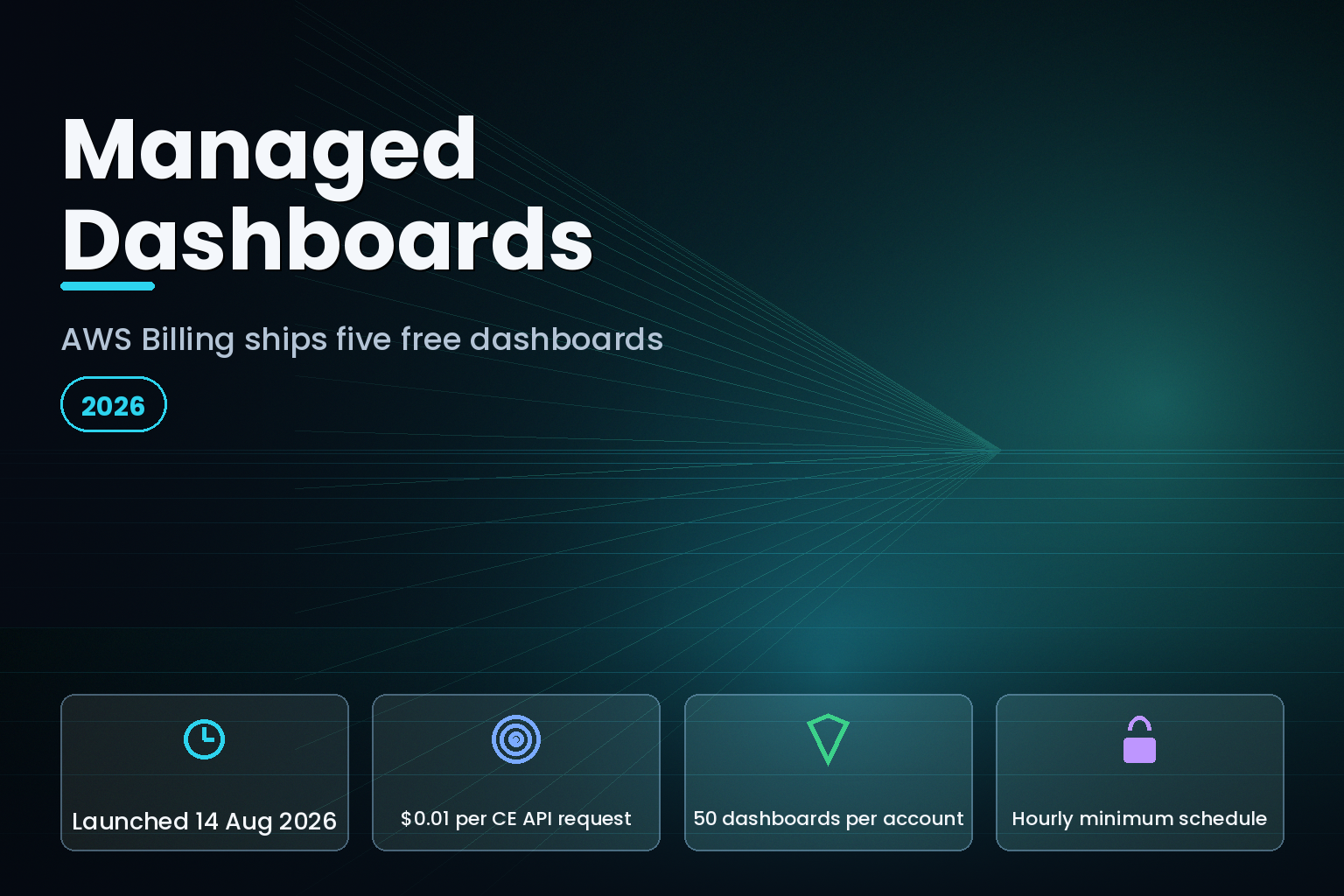
Summary. AWS announced Managed Dashboards for Billing and Cost Management at 02:00 UTC on 14 August 2026: 5 preconfigured, read-only dashboards that appear in every account with no setup, "available in all commercial AWS Regions at no additional cost". That sentence is accurate and it is also the whole trap. The one thing a finance team actually wants - a cost report that lands in an inbox every Monday - is the single action the docs forbid on a Managed Dashboard. The AWS user guide's limitations page states plainly that you cannot schedule email delivery directly on one. To get delivery you duplicate the dashboard, which produces a custom dashboard you own, and a scheduled report on that copy runs an execution role holding 12 ce:* permissions. The Cost Explorer API is billed at $0.01 per request, a figure AWS publishes in its own Price List API under usage type USE1-APIRequest. The minimum schedule frequency is hourly. Nothing in the announcement mentions any of this.
What actually shipped
Five dashboards, organised by the AWS guide into three layers. Cost Overview and Trends covers 12 months of spend across services, accounts, Regions, charge types and billing entities, with forecasts. Compute and Database each break one service category down and pair it with commitment coverage. Reservations and Savings Plans report on commitment performance.
| Managed dashboard | What it breaks down | Commitment metric it pairs |
|---|---|---|
| Cost Overview and Trends | 12 months by service, account, Region, charge type, billing entity | Forecast only, no coverage widgets |
| Compute | EC2, ECS, EKS, Lambda by instance type, platform, availability zone | Savings Plans and Reserved Instance utilisation and coverage |
| Database | RDS, ElastiCache, OpenSearch, DynamoDB, Redshift by engine, instance type, purchase option | Per-service RI coverage and Savings Plans coverage |
| Reservations | EC2, ElastiCache, RDS, OpenSearch, Redshift, MemoryDB by instance type | Coverage and utilisation detail per service |
| Savings Plans | Compute, EC2 Instance and SageMaker plan types | Utilisation, coverage, on-demand spend, purchase mix |
They are identified in the console by a lock icon. Write operations against one return AccessDeniedException, per the getting-started page. Layout and time-range changes you make while viewing are discarded on refresh, which the guide describes as ensuring "a consistent baseline that is always available in its intended form".
The gap between the announcement and the limitations page
The What's New post lists what you can do: duplicate a dashboard, add individual widgets to your own dashboards, export to PDF or CSV. It does not list what you cannot do. The user guide has a dedicated page for that.
| Claim in the 14 Aug announcement | Where the docs agree | What the docs add |
|---|---|---|
| "No additional cost" | Managed Dashboards themselves carry no charge | Scheduled reports call the Cost Explorer API, billed per paginated request |
| "Available in all commercial AWS Regions" | Console access is global | The Cost Explorer API has one endpoint, ce.us-east-1.amazonaws.com |
| "Duplicate any dashboard to create a fully editable custom copy" | Confirmed on the building-custom page | The copy counts against a 50-dashboard-per-account ceiling |
| "Export via PDF or CSV" | Confirmed on the exporting page | CSV export is per widget only, not whole-dashboard |
| Read-only, maintained by AWS | Confirmed | Also blocks tagging, sharing, deleting and scheduled email delivery |
| Nothing stated about automation | - | "Creating dashboards using AWS CloudFormation is not currently supported" |
That last line matters more than it looks. A platform team that manages every other guardrail as code cannot manage these. The dashboards arrive by fiat, and the custom copies you build from them have to be clicked into existence.
Where the money is
The scheduled-report path is the only route from a Managed Dashboard to a recurring report, and it is the only route that costs anything. The execution role AWS publishes for scheduled reports grants exactly one bcm-dashboards:GetDashboard action and then a second statement containing 14 read actions, 12 of which are Cost Explorer calls: GetDimensionValues, GetCostAndUsageWithResources, GetCostAndUsage, GetCostForecast, GetTags, GetUsageForecast, GetCostCategories, GetSavingsPlansCoverage, GetReservationUtilization, GetReservationCoverage, GetSavingsPlansUtilization and GetSavingsPlansUtilizationDetails. The remaining two are budgets:ViewBudget plus budgets:DescribeBudgetActionsForAccount, alongside cost-optimization-hub:ListEfficiencyMetrics and billing:ListBillingViews.
AWS states the billing rule for those calls in its own Cost Explorer best-practices page: "Because you're charged for the Cost Explorer API per paginated request, we recommend identifying the exact dataset to access before submitting queries." The rate comes from the AWS Price List API offer file for AWSCostExplorer, published 25 September 2025, which carries a single on-demand dimension priced at 0.0100000000 USD per Request with the description "$0.01 per API Request". A second dimension, USE1-AdditionalSourceViews, is also $0.01 per request.
Do the arithmetic on the ceiling AWS itself documents. A duplicated Cost Overview and Trends dashboard has 9 widgets. The minimum schedule frequency is hourly, so 24 executions a day is 720 a month. At one paginated Cost Explorer request per widget - the floor, since any widget whose result set spans pages costs more - that is 6,480 requests, or $64.80 a month, for one report. Run 10 of them hourly and you are at $648. The quota page allows 100 scheduled reports per account.
Nobody sensible schedules a cost report hourly. The point is that the announcement gave a finance lead the word "free" and no number to reason against, and the hourly floor is what a well-meaning engineer will pick when the console offers it.
The quotas nobody put in the announcement
| Quota | Value | Why it bites |
|---|---|---|
| Widgets per dashboard | 20 | A duplicated Managed Dashboard already spends up to 9 |
| Dashboards per account | 50 | Duplicates and per-team copies share one pool |
| Scheduled reports per account | 100 | Each one is a recurring Cost Explorer API bill |
| Minimum schedule frequency | Hourly | The cheapest useful cadence is not the default floor |
| Maximum schedule period | 3 years from current time | Reports silently stop, they do not renew |
| Pre-signed URL expiry | 15 days | Report download links rot inside a quarter |
The 3-year endTime ceiling and the 15-day pre-signed URL expiry are the two that create silent failure. A report scheduled today stops in August 2029 with no renewal path documented, and any download link forwarded in an email is dead after 15 days.
Who this affects and how to tell if that is you
You are exposed if all three of these are true. You have fine-grained IAM actions enabled for Billing and Cost Management, which the getting-started page lists as a prerequisite for dashboards at all. Someone in your organisation has permission to call bcm-dashboards:CreateDashboard and CreateScheduledReport. And your Cost Explorer line on the bill is currently small enough that nobody watches it.
Check the third one first. Cost Explorer API charges land under the USE1-APIRequest usage type in us-east-1 regardless of where your workloads run, so filter Cost Explorer itself by that usage type and look at the trend since 14 August 2026. If it moved, someone has already duplicated a dashboard and scheduled it.
There is a second, quieter exposure for anyone with a data-residency obligation. The Cost Explorer API publishes exactly one service endpoint, https://ce.us-east-1.amazonaws.com. "Available in all commercial AWS Regions" describes where you can open the console, not where the data is queried. For an Indian or EU entity that has told an auditor its cost telemetry stays in-Region, a scheduled report is a us-east-1 call made by an AWS service principal, bcm-dashboards.amazonaws.com, assuming a role in your account.
What to do
Set an IAM guardrail before you set a dashboard. Deny bcm-dashboards:CreateScheduledReport outside a named platform role, so the hourly option is not reachable by default. The action names are published on the getting-started page and are enforceable today.
If you want the report, duplicate the dashboard, strip the widgets you will not read, and schedule it weekly or monthly rather than hourly. Nine widgets you glance at once a month cost 9 requests a month. The same nine hourly cost 6,480.
Check your execution role if you created one before the AWS Budgets report widget shipped. The docs warn that older roles lack the budgets:* permissions and that the in-console repair "will fail if a role was manually modified in IAM", leaving you to create a new role or restore the policy version.
And treat the sharing path as a separate project. Sharing a duplicated dashboard across an organisation requires AWS RAM sharing enabled with AWS Organizations and an IAM principal in the management account with RAM create-and-share permissions. Receiving accounts need nothing, which is the one genuinely frictionless part of this launch.
What is still unknown
AWS has not published whether the widget-to-request mapping is one-to-one, so the $64.80 figure above is a documented floor built on AWS's own $0.01 rate and its own hourly minimum, not a measured invoice. The company has also not said whether Managed Dashboards will ever gain direct scheduling, or whether CloudFormation support is planned. The guide's wording, "not currently supported", is the only signal either way.
FAQ
How eCorpIT can help
The failure mode in this launch is ordinary: a free feature whose only useful configuration sits behind a metered API, with the meter documented three pages away from the announcement. That is the class of thing a cloud cost review catches before it appears on an invoice. eCorpIT's DevOps and cloud engineering team sets the IAM guardrails, checks the Cost Explorer usage-type trend, and sizes the report cadence against what people actually read. We have written previously on AWS Cost Anomaly Detection's third-party model support and on the capacity crunch reshaping AWS commitment decisions. eCorpIT is CMMI Level 5, MSME certified and ISO 27001:2022 certified. Send us your current Cost Explorer usage-type line at /contact-us/ and we will tell you whether anyone has already scheduled one of these.
References
- AWS, AWS Billing and Cost Management introduces Managed Dashboards, 14 August 2026.
- AWS Cost Management User Guide, Managed Dashboards.
- AWS Cost Management User Guide, Available Managed Dashboards.
- AWS Cost Management User Guide, Limitations of Managed Dashboards.
- AWS Cost Management User Guide, Viewing Managed Dashboards.
- AWS Cost Management User Guide, Building your custom dashboards from Managed Dashboards.
- AWS Cost Management User Guide, Exporting Managed Dashboards.
- AWS Cost Management User Guide, Getting started with dashboards.
- AWS Cost Management User Guide, Execution role permissions for scheduled reports.
- AWS Cost Management User Guide, Quotas and restrictions.
- AWS Cost Management User Guide, Cost Explorer API best practices.
- AWS Cost Management User Guide, Using the AWS Cost Explorer API.
- AWS Price List API, AWSCostExplorer current offer file, publication date 25 September 2025.
- AWS Cost Management User Guide, Visualizing and analyzing cost and usage data using Dashboards.
Last updated: 22 August 2026.