On this page · 11 sections
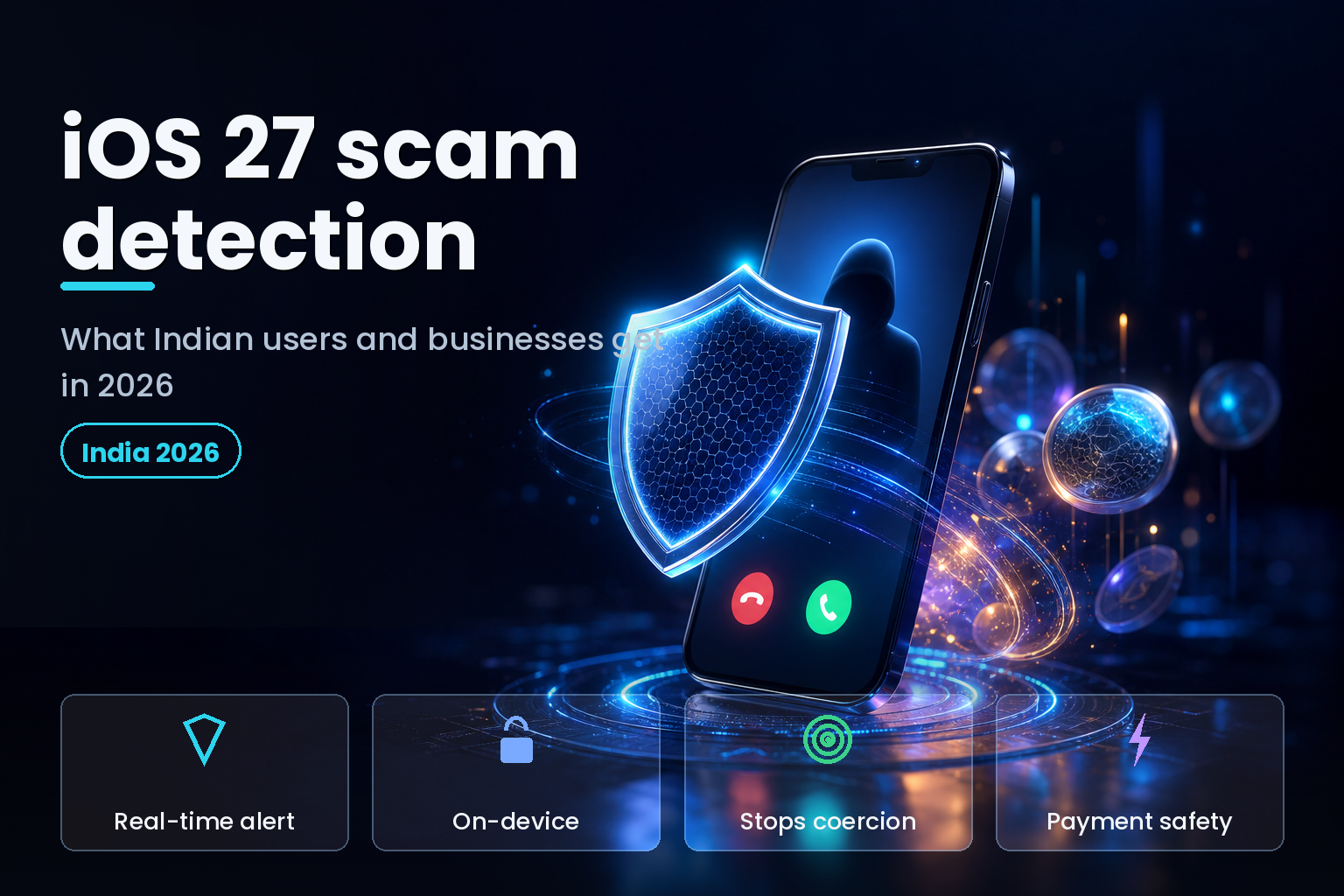
Summary. iOS 27, announced at WWDC 2026 on June 9, adds Trust Insights, a framework that flags in real time when a user is being coached through a scam. It arrives into a country under pressure: Indians lost about ₹22,495 crore, roughly $2.7 billion, to cyber fraud in 2025, on 2.81 million complaints, a 24% jump from a year earlier. Digital-arrest scams alone drew more than 30,000 complaints in 2025 with losses the Supreme Court estimated near ₹3,000 crore, and UPI fraud rose 85% in FY24. Trust Insights runs mostly on-device, assigns a medium or high risk level from behavioural signals, and lets an app add a warning, a delay, or extra verification before money moves. This article covers what Indian users and businesses get on day one, how it maps to local scam patterns, and, just as important, what it does not do.
The feature matters in India precisely because the dominant scams here are coercion, not hacking. A caller frightens or persuades a victim into moving their own money, which is the exact gap Trust Insights is built to close. But it is a tool for app builders and a protection for individuals, not a switch the government flips, so the honest read matters.
India's fraud problem in numbers
The scale is the reason this feature is worth attention. In 2025 Indians reported losing about ₹22,495 crore to cyber fraud, drawn from Ministry of Home Affairs and Indian Cyber Crime Coordination Centre data, with complaint volume up 24% to roughly 2.81 million cases, per analysis of the I4C figures. UPI-based fraud led in both volume and value, having jumped 85% in FY24.
The human face of this is the digital-arrest scam. Fraudsters posing as CBI, Enforcement Directorate, police, or customs officers call a victim, claim their Aadhaar or bank account is tied to a crime, and hold them on a continuous video call in a fake custody, sometimes for days, until they transfer everything. Prime Minister Narendra Modi warned about it directly in Mann Ki Baat: "There is no system like digital arrest under the law," urging a simple "Stop, Think, Take Action" response, per DD News. State Bank of India customers alone lost over ₹6,313 crore across more than 30,700 fraud cases between April 2023 and March 2026, per Business Today.
What iOS 27 scam detection actually does
Trust Insights is a developer framework, not a consumer toggle. It runs mostly on-device and analyses interaction patterns, timing, context, and basic sensor data to detect when a user may be getting coached through a scam, per 9to5Mac. When it sees manipulation, it assigns a medium or high risk level, and the app decides what to do: show a warning, add a delay, or require stronger verification.
Two design choices matter for India. First, privacy: Trust Insights does not inspect the contents of Photos, Messages, or Mail, and discards the behavioural data it reads, per AppleMagazine. Second, resistance to coaching: a user can disable it, but Apple applies a cooldown before the change takes effect, to protect someone a scammer has talked into switching it off mid-call. Both choices fit a market where trust in data handling is fragile and coercion scams are the norm.
What Indian users get on day one
For an individual on a supported iPhone, the benefit is a well-timed pause. When an app that has adopted Trust Insights sees signs you are being coached during a payment or an account change, it can slow the action down and ask a plain question at the moment you are most at risk. That is the moment a digital-arrest victim needs, when a fake officer is rushing them to transfer money.
The honest caveat is dependency. The protection only appears in apps that integrate the framework, and the AI-driven features need an iPhone 15 Pro or later. So a user does not get blanket protection across the phone; they get stronger protection inside the apps that adopt it, on capable hardware. It is a meaningful layer, not a shield over everything.
What Indian businesses get
For an Indian fintech, bank, or consumer app, Trust Insights is a new control on authorised-payment fraud, the category where a logged-in user is tricked into paying. Backend rules see an authenticated user making an authorised transfer and let it through; Trust Insights fires during the interaction, when the coaching is happening. That timing is the value.
The design work sits with the business. A medium-risk signal on a first-time UPI payout to a new beneficiary might trigger a short hold and a plain question about who asked for the transfer; a high-risk signal might require step-up verification. Because Trust Insights requires feedback, integrating it also forces the discipline of tying each risk flag to the real outcome of the transaction, which improves the model and gives fraud teams a clearer picture. For a fuller view, our note on iOS 27 scam detection for consumer brands covers the product angle.
How it maps to India's scam patterns
The local scams are, technically, textbook coercion, which is what makes this feature relevant here rather than abstract.
| India scam pattern | How it works | Where Trust Insights helps |
|---|---|---|
| Digital arrest | Fake officer holds a victim on a video call and demands transfers | A payment-stage risk signal can force a pause |
| Fake bank caller | Caller poses as your bank and walks you through a payment | Coercion signals during the transfer flow |
| UPI collect-request fraud | Victim is coached into approving a request | Risk signal on the approval action |
| Account-takeover coaching | Victim is talked into changing security details | Signal on the account-change category |
| Investment or job scam | Victim is pressured to move money quickly | Timing and pressure signals on payment |
What it does not do
An honest article names the limits. Trust Insights does not work on Android, does not cover phone calls or messages outside apps that adopt it, and its AI-driven detection needs an iPhone 15 Pro or later. It is not a government-level block on scam numbers, and it cannot stop a determined victim who overrides every warning. It also depends on developers integrating it well, which takes design effort rather than a checkbox.
So the realistic framing is that iOS 27 gives Indian users and businesses a strong new tool against the exact coercion scams that dominate here, inside the apps that adopt it. It complements, and does not replace, the national efforts, such as the SIM-card deactivations, mule-account freezes, and public awareness campaigns, that address the problem at scale.
| India fraud signal | Figure (2025) | Source basis |
|---|---|---|
| Total cyber fraud losses | About ₹22,495 crore | MHA / I4C data |
| Complaints filed | 2.81 million, up 24% | I4C figures |
| Digital-arrest losses | Near ₹3,000 crore | Supreme Court estimate |
| SBI customer losses | Over ₹6,313 crore | RTI data, 2023 to 2026 |
Practical steps for Indian users right now
Trust Insights is a strong layer, but the most reliable defence today is still human. The Prime Minister's advice, "Stop, Think, Take Action," is the right instinct against coercion scams, because every one of them depends on rushing the victim. If a caller claims to be from the CBI, a bank, or customs and pressures you to move money immediately, that urgency is the tell.
Three habits close most of the gap. First, no real agency conducts a "digital arrest" over a video call, and as the Prime Minister said, there is no such system under the law, so a demand to stay on a call in custody is proof of a scam. Second, never approve a UPI collect request or transfer to a stranger to "verify" or "clear" anything, because legitimate refunds never require you to pay first. Third, when in doubt, hang up and call the official number yourself, or report to the national cyber-crime helpline, rather than trusting the number that called you.
For a business, the equivalent is to design friction into the risky moments. A first-time payout to a new beneficiary, a large transfer under time pressure, or a security-detail change are the points where a short hold and a plain question stop the most fraud. Trust Insights gives an app the signal to do exactly that, but the intervention you design around it is what protects the user.
India-specific considerations
Two India factors shape adoption. First, the Digital Personal Data Protection Act, 2023 (DPDP): because Trust Insights reads behavioural signals on-device and discards the raw data, it does not create a new pool of sensitive content, which eases the compliance burden of adding scam detection to a payments flow. You still owe clear consent and sound handling for the account and payment data already in your app. Second, hardware reach: the AI-driven detection needs an iPhone 15 Pro or later, so plan your rollout knowing that a share of your Indian user base runs older or non-Apple devices and will not see it, which means Trust Insights is one layer in a wider anti-fraud stack, not the whole defence.
FAQ
How eCorpIT can help
eCorpIT is a Gurugram-based technology organisation with senior-led engineering teams that build fraud and trust-and-safety systems for Indian fintech and consumer brands. We can integrate Trust Insights into your iOS app, design interventions that reduce authorised-payment fraud without harming conversion, and wire the required feedback loops into your risk pipeline in line with the DPDP Act. If you want a scam-detection plan ready for the iOS 27 launch, contact us. You can also browse the eCorpIT blog or read about our team.
References
_Last updated: July 5, 2026._